How will Artificial Intelligence Change the Insurance Industry?
Artificial Intelligence is reshaping the insurance industry by improving risk assessment, speeding up claims processing, detecting fraud, and personalizing customer experiences. AI helps insurers reduce costs, make smarter decisions, and deliver faster, more efficient services.
 Shiva PS
Thousands of unattended claims, long customer queues, piling customer queries- all these are merely posing one question: “Is the Insurance industry really progressing at all?”
Though being the fastest-growing industry, we still feel that calling an insurance company is not a favorite activity. The old processes, consistently not leveraging new technologies, have made the insurance industry the least innovative area. This Industry’s main game players are the big national brands and their legacy product lines, but sadly, they have not evolved in decades.
By 2026, however, AI adoption is accelerating across the insurance value chain, with insurers using or exploring AI and machine learning for underwriting, pricing, claims, customer service, marketing, and fraud detection.
Before getting into this article, read our previous article What Is AI? Know Everything About Artificial Intelligence (AI)
Now,
Why is this scenario existing in the Insurance industry?
Insurance’s global market is closely associated with the public, and this association is presenting unique challenges in introducing technology innovations. The main concern that arises here is “convincing the public that automation is implemented simply not to deny their claims”. Ultimately, AI is often seen as a disruptive force by both the public and insurance executives.
Even though the Insurance industry is always at the forefront of major technology movements, it is grappling with the challenge that AI poses. However, it is high time that the data- and time-intensive insurance processes need artificial intelligence and cognitive technologies for a complete transformation of this traditional industry.
With the new wave of recent technologies such as Artificial Intelligence, Deep Learning, IoT, and Data Science, many industries have already started revolutionizing and showing fantastic business growth, which has started influencing the insurance domain too. In this evolution, it is expected that insurance will improve its current “detect and repair” state to “predict and prevent,” transforming every aspect of the industry in the process.
This broader shift is reflected in the rapid growth of AI. According to Mordor Intelligence, the global AI market is expected to grow from USD 306.04 billion in 2025 to USD 434.42 billion in 2026 and reach USD 2,503.13 billion by 2031, at a 41.95% CAGR from 2026 to 2031. This growth is also accelerating AI adoption across insurance, including claims, underwriting, fraud detection, and customer service.
Does calling an Insurance company invade your time? Not anymore, as the change is here.
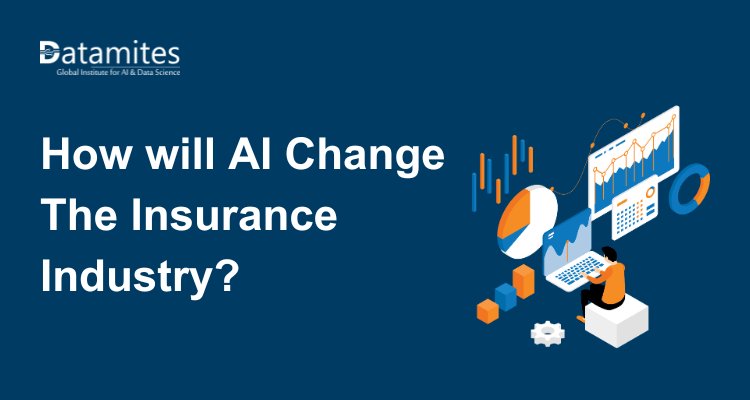
Here are the 5 impacts of Artificial Intelligence on the Insurance industry
Artificial Intelligence is transforming insurance by improving claims processing, customer service, risk assessment, fraud detection, and personalized decision-making.
Impact of AI on Insurance Industry #1: Claims
Claims handling is one of the most tedious and time-consuming tasks for both insurance companies and policyholders. Artificial Intelligence is helping insurers streamline this process by analyzing claim documents, images, and historical data to support faster processing and more consistent decision-making. AI-powered image analysis can assist in assessing vehicle or property damage, estimating repair costs, and identifying claims that may require further review. Another major challenge in claims is detecting fraudulent activity. By analyzing patterns across large volumes of claims data, AI systems can identify unusual behaviors and potentially fraudulent claims earlier, helping insurers improve efficiency while strengthening fraud detection and risk management.
Impact of Artificial Intelligence on Insurance Industry #2: Chatbots
Earlier, chats were completely manualized, and customer support personnel were employed to interact with customers, as there was a feeling that customization could not be achieved through pre-scripted chats. This is not the case in recent times; AI-powered chatbots are helping customers solve their queries instantaneously while providing personalized responses and reducing the workload on customer support teams. In insurance, conversational AI can assist with policy-related questions, claim status updates, document collection, and other routine customer service tasks.
Asking how it can help insurance companies? There are a variety of uses of chatbots, ranging from answering customer queries and providing claim status updates to collecting information and automating routine tasks. AI-powered chatbots can handle repetitive interactions quickly while directing more complex issues to human representatives.
For consumers, chatbots can simplify processes that traditionally require lengthy forms or repeated interactions with customer support. They can guide customers through insurance-related queries, collect relevant information, provide policy details, and assist with routine claims-related requests. This allows customers to access information more quickly while helping insurers reduce the workload on their support teams.
Refer to these articles:
- What is the Difference Between AI Engineer and AI Expert Course?
- What is an AI Agent? Guide to Intelligent Agents in AI
- Generative Adversarial Networks (GANs): How are GANs Transforming AI?
Impact of Artificial Intelligence on Insurance Industry #3: Data
How do you find out whether distracted driving is the reason for the harm? According to the U.S. National Highway Traffic Safety Administration (NHTSA), 3,208 people were killed in crashes involving distracted drivers in 2024. AI can help insurers analyze data from telematics devices, connected vehicles, and dashboard cameras to identify driving patterns such as speeding, harsh braking, sudden acceleration, and potential distracted driving. By combining this data with historical claims information, insurers can improve risk assessment, personalize pricing, detect unusual patterns, and support faster, more informed claims decisions.
Impact of Artificial Intelligence on Insurance Industry # 4: Marketing
In the Insurance domain, Marketing is closely associated with personalization, and it is essential to tie all the positive emotions such as love, happiness, and peace in order to converse with your customers. We very well agree that this personalization is achieved through marketing executives who interact with consumers, but what about the flyers, marketing campaigns, and other communications that are sent to consumers? These communications are often the same for all customers and are not tailored at all. With AI-powered marketing, these communications can be created with human emotion, and a more meaningful message can be delivered to consumers. USAA, United Services Automobile Association, uses AI and predictive algorithms to understand customer needs and deliver more personalized experiences. These technologies can help identify customer needs and provide relevant information, alerts, and personalized guidance based on individual circumstances.
Impact of Artificial Intelligence on Insurance Industry #5: Underwriting:
Currently, underwriters are employed by Insurance companies to evaluate the risk and exposures of their potential clients. This job, when powered by AI tools to analyze the risk effectively, provides more opportunities for insurance companies to come up with predictive risk models. Assessing the risk of an individual and creating a tailored policy for each person is definitely possible. Their machine learning algorithm combs through Facebook posts, LinkedIn profiles, Tweets, and other sources to gather the data to build a customer profile. With this profile, insurance companies can streamline underwriting and price more efficiently based on the collected customer data.
Adapting to Artificial Intelligence:
We all know that the insurance industry is increasingly adopting new technologies, although challenges such as data quality, governance, cost, and workforce readiness can affect the pace of AI adoption. Furthermore, there is an inherent fear that gets attached during implementation since AI solutions are always characterized as high-cost projects disrupting current business practices. However, insurers can begin with focused AI pilot projects and gradually scale successful solutions across their operations. AI and its related technologies will have an enormous amount of impact in all major industries. Advanced technologies and data are already playing a significant role and highlighting dramatic changes across various sectors; it is never too late to get AI integrated into the Insurance world. All it needs is a small entry point to initiate the adoption process to let it flow seamlessly. Adopting newly developed artificial intelligence technology completely changes the customer experience to provide great service for modern customers.
Let there be a new wave of thinking in the Insurance industry because the year 2030 will be here before we know it.
Time to think about shifting to AI career:
Looking ahead to 2030, the insurance industry is likely to combine AI-powered automation with human expertise across customer service, analytics, underwriting, and claims. While AI can streamline processes and support faster decisions, skilled AI and Data Science professionals will remain important for developing and implementing these solutions. As insurers expand their use of AI and data-driven technologies, professionals with relevant skills can find growing career opportunities. Taking an AI or Data Science course can help professionals build the practical skills needed for this evolving industry.
DataMites™ Institute is one of the leading global professional training providers in Data Science, Artificial Intelligence, Machine Learning, Data Mining, and Deep Learning. We are training aspiring candidates with hands-on training that helps them to gain the required skills to work at big organizations at ease. All our courses are perfectly aligned with the current industry requirements and give exposure to all the latest techniques and tools that help professionals to achieve in-depth knowledge and enhanced skills.
DataMites artificial intelligence course also provides placement support, mock interviews, and career guidance to help learners prepare for job opportunities. Its programs include industry-recognized certifications from IABAC and NASSCOM FutureSkills, adding value to learners’ professional profiles. With 40+ offline training centers across India, including Bangalore, Hyderabad, Pune, Chennai, Ahmedabad, Delhi, Mumbai, and Coimbatore, DataMites offers learners flexible options for classroom-based training and career-focused learning.
It is the best time for you to get on board with DataMites™ and join the long list of candidates who have successfully excelled in their careers. For more details, please visit the pages
AI Classes in Bangalore: https://datamites.com/artificial-intelligence-course-training-bangalore/
AI Classes in Hyderabad: https://datamites.com/artificial-intelligence-course-training-hyderabad/
AI Classes in Pune: https://datamites.com/artificial-intelligence-course-training-pune/