What Is AI? Know Everything About Artificial Intelligence (AI)
Artificial Intelligence enables machines to learn from data, make decisions, and perform tasks with greater speed and accuracy. Explore the fundamentals of AI, its key technologies, applications, and growing role across industries.
 Shiva PS
We have been hearing the coolest inventions of AI around the clock but what’s less common is an explanation of “What AI is” and why it is so cool?????
From AI powered virtual assistants and smart chatbots to self-driving cars and intelligent healthcare systems, Artificial Intelligence is transforming the way we live, work, and interact with technology.
How did AI flip the world upside down?
How are companies leveraging AI to produce better results?
Just a few years ago, talking about Artificial Intelligence often sounded like science fiction. Today, it has become part of everyday life. AI has become so accessible that even children interact with AI powered devices and applications in their everyday lives.
What is Artificial Intelligence (AI)?
With most of the blockbuster movies talking about a robot’s emotions when falling in love with a girl, this idea of building super machines capable of thinking like humans is not new to us. AI involves developing intelligent systems that can perform tasks that typically require human intelligence, such as learning, reasoning, problem-solving, recognizing patterns, and understanding information. Particularly, AI systems can learn from data and use that information to perform specific tasks more effectively.
When we talk about AI one might end up with a fear of a computer-instigated apocalypse. Do not fret, it is not going to be scary.
We are in the process of building machines that can help us efficiently and even automate the tasks that are hazardous. With much research and development work going on in AI, it is constantly evolving even though it is a complicated subject. AI is similar to a young kid who sips a hot soup, his/her brain registers the pain and makes a note to not do it again.
AI has the potential to be useful for mankind and is often discussed in terms of “Applied AI” and “Generalized AI.”
- Applied AI refers to AI systems designed to perform specific tasks or solve particular problems. Be it your virtual assistant Apple's Siri or self-driving technologies, many of the AI applications we use today are examples of Applied AI.
- Generalized AI, also known as Artificial General Intelligence (AGI), refers to the concept of developing machine intelligence capable of carrying out a wide range of tasks with a level of flexibility and adaptability comparable to human intelligence. Unlike today's task-specific AI systems, AGI remains a goal of ongoing AI research and has not yet been achieved.
Refer to these articles:
- What is Artificial Narrow Intelligence?
- Traditional AI vs Generative AI: Key Differences, Examples, and Use Cases
- What Are Graph Neural Networks? Simple Guide for Beginners
How Does Artificial Intelligence Work?
Artificial Intelligence works by using data, algorithms, and computational models to identify patterns, learn from information, and produce useful outputs. The basic AI process can be understood through these stages:
- Data Collection: AI systems collect relevant data such as text, images, audio, video, numbers, or sensor information.
- Data Preparation: The collected data is cleaned, organized, and converted into a format that can be used effectively by an AI model.
- Model Training: Machine learning algorithms analyze the data and learn patterns or relationships that help the model perform a specific task.
- Testing and Evaluation: The trained model is tested with new data to measure how accurately and reliably it performs.
- Prediction or Generation: Once deployed, the AI system can make predictions, classify information, provide recommendations, answer questions, or generate content.
- Monitoring and Improvement: AI systems are monitored after deployment so their performance can be evaluated and improved when necessary.
In simple terms, AI can be understood as data → preparation → training → evaluation → deployment → monitoring.
Types of Artificial Intelligence
Artificial Intelligence can be classified based on its capabilities and how it processes information.
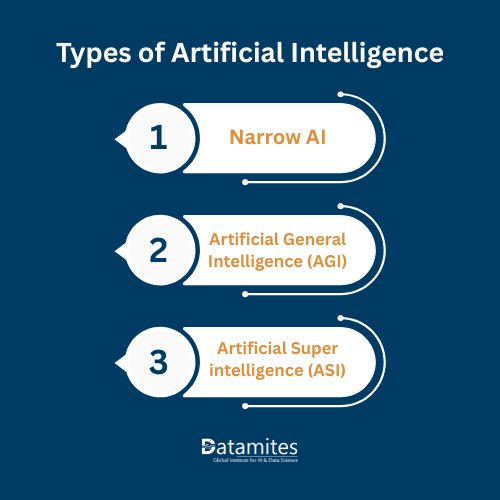
- Narrow AI: Designed to perform specific tasks, such as recommendations, virtual assistants, and fraud detection. Most AI systems used today are Narrow AI.
- Artificial General Intelligence (AGI): Refers to a theoretical AI system capable of performing a broad range of tasks with human-like flexibility. AGI has not yet been achieved.
- Artificial Superintelligence (ASI): Refers to a hypothetical form of AI that could exceed human intelligence across many areas. It remains theoretical.
AI can also be described as Reactive Machines, Limited Memory, Theory of Mind, and Self-Aware AI, which represent different levels of AI capability.
Important developments of AI (Artificial Intelligence):
The most essential development of AI in recent years is “Machine learning” in fact it has become so famous that “AI” and “Machine Learning” are often interchangeably used. We have already discussed the differences between AI, Machine Learning and Deep Learning in our previous article. Dive into it to see their differences.
To give you a brief introduction about Machine Learning, it can be described as the ability of machines to learn patterns from data and improve their performance on specific tasks without requiring every decision to be explicitly programmed. Machine Learning has played a major role in the development of modern AI, including areas such as deep learning, natural language processing, computer vision, and generative AI.
The next important development is “Artificial Neural Networks”. Inspired partly by the way biological neurons process information, neural networks use interconnected computational units to identify patterns and learn from data. Although the concept was introduced decades ago, its practical capabilities expanded significantly with the availability of large datasets, powerful computing systems, and advances in training techniques. Neural networks now form the foundation of many modern AI applications, including deep learning and generative AI systems.
Exciting innovations of AI (Artificial Intelligence):
Our world is filled with technological advances and many exciting innovations emerged through Artificial Intelligence. From scientific discovery and healthcare to content creation and intelligent automation, AI continues to expand its practical applications.
And, “Voilà!!!” the five important innovations are
- Machine Learning has helped researchers analyze astronomical data and identify previously overlooked exoplanets, demonstrating how AI can support scientific discovery.
- AI-powered healthcare systems are helping professionals analyze medical images, identify patterns in patient data, and support clinical decision-making.
- Generative AI can create and transform text, images, audio, video, and computer code, making it one of the most significant developments in modern AI.
- Multimodal AI systems can process and combine different forms of information, such as text, images, audio, and video, enabling more natural and flexible interactions with technology.
- AI agents are emerging as systems capable of planning and carrying out sequences of tasks with limited human intervention, expanding AI applications beyond simple question answering and individual tasks.
Future of AI (Artificial Intelligence):
“What happens when our computers turn smarter?” is the fear-inducing question that lays on our mind when anyone talks about AI.
It is definitely an understandable concern and a number of tech giants have formed a partnership to look at ethical implementations of AI and to set necessary guidelines for future research and deployment of robots and AI.
We can clearly say “Technology will enhance many human capabilities while transforming the way we work”.
This transformation is also reflected in the rapid growth of the AI industry. According to the IMARC Group, the global AI market was valued at USD 143.0 billion in 2025 and is projected to reach USD 949.0 billion by 2034, growing at a CAGR of 22.70% from 2026 to 2034. This growth is being driven by advances in computing, deep learning, and enterprise automation.
Refer to these articles:
- Reinforcement Learning: Basics and Applications
- What is the Difference Between AI Engineer and AI Expert Course?
- What is an AI Agent? Guide to Intelligent Agents in AI
This is just the beginning of AI, with a long road still ahead. Building knowledge in this evolving field can be a valuable step toward career success. Enroll in the DataMites AI Course to learn Artificial Intelligence, Machine Learning, and Deep Learning from DataMites™, a trusted global Data Science institute accredited by IABAC and NASSCOM FutureSkills.
DataMites offers a globally recognized Artificial Intelligence course with industry-accredited certification. Competing with prestigious institutions like IIT and IIM, DataMites delivers top-tier AI training. The program encompasses advanced AI concepts, practical projects, and expert guidance. Renowned for excellence, DataMites prepares professionals to thrive in AI-driven industries.
With a growing learning network across India, DataMites has established 40+ offline training centers, making AI education accessible to learners across multiple locations. The institute has trained more than 200,000 learners through its programs and maintains a presence in key cities including Bangalore, Hyderabad, Pune, Chennai, Ahmedabad, Mumbai, Coimbatore, and Delhi. This broad training network allows aspiring AI professionals to choose learning options based on their location and career goals while gaining access to structured training, practical learning, and industry-oriented guidance.
For more details please visit below pages,
AI Training in Bangalore: https://datamites.com/artificial-intelligence-course-training-bangalore/
AI Training in Hyderabad: https://datamites.com/artificial-intelligence-course-training-hyderabad/
AI Training in Pune: https://datamites.com/artificial-intelligence-course-training-pune/