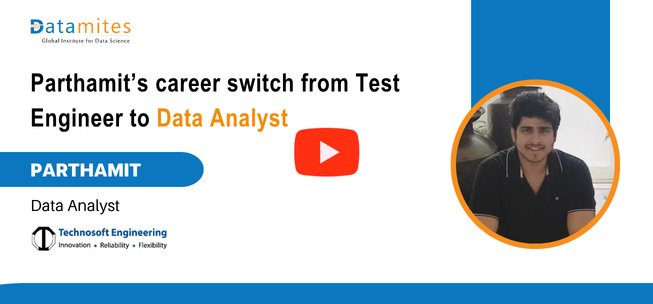
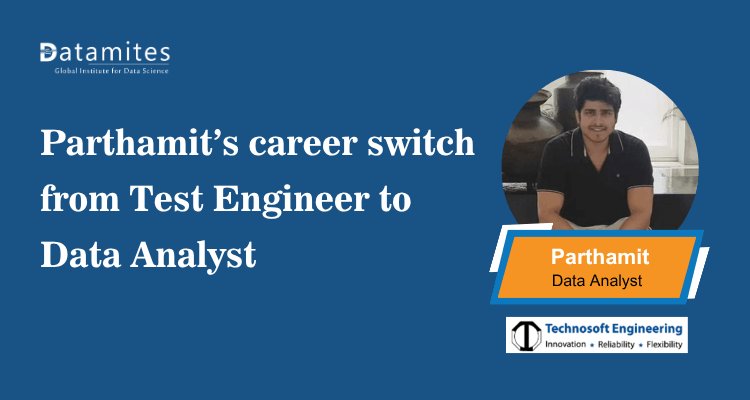
Parthamit’s career switch from Test Engineer to Data Analyst
Discover Parthamit’s inspiring career switch from Test Engineer to Data Analyst as he shares his learning journey, key data analyst skills, project experience, challenges, and insights that helped him successfully transition into the growing field of Data Analytics.
 Kriti Maurya
The field of Data Analytics is creating exciting career opportunities for professionals from various technical backgrounds. As industries increasingly rely on data-driven decision-making, many individuals are transitioning into analytics roles to build future-ready skills and improve career growth. Parthamit’s journey from Manual Test Engineer to Data Analyst is an inspiring example of how continuous learning, practical exposure, and dedication can help professionals successfully switch careers. In this interview-style blog, he shares his learning experience, challenges, skill development journey, and valuable insights for aspiring Data Analysts.
From Test Engineer to Data Analyst: Parthamit’s Career Transition Journey
Parthamit’s journey from Manual Test Engineer to Data Analyst showcases how continuous learning and practical experience can help professionals transition into the growing analytics industry. As businesses increasingly depend on data-driven strategies, the demand for skilled Data Analysts continues to rise. Many aspiring professionals are now exploring IT courses in Chennai to improve their technical skills and career opportunities. In this interview-style article, Parthamit shares his learning experience, challenges, and successful transition into Data Analytics.
Q1. Please introduce yourself and your background.
My name is Parth Pratyay, and I completed my graduation in Electronics and Telecommunication from C.V. Raman Global University in 2020. After graduation, I worked as a Manual Test Engineer for almost two years. Later, I developed an interest in data analytics and decided to transition into this field.
Q2. What inspired you to move into Data Analytics?
During the COVID period, I noticed how rapidly data-related technologies were growing across industries. Although I was working in testing, I wanted to explore a field with more learning and career growth opportunities. That motivated me to learn Data Analytics and Data Science concepts.
Refer to these Articles:
- How Internships Shape Data Analyst Career in Chennai
- Data Analyst training in Chennai for Fresher
- Why Choose Offline Data Analyst Courses in Chennai for IT Career Growth
Q3. When did you complete your analytics course?
I completed my Data Analytics program in September 2025, including my internship. After completing the course, I attended interviews and also worked on freelance projects for a few months. That practical exposure helped me improve my confidence and technical skills.
Q4. Where are you currently working?
Currently, I am working at Technosoft Engineering as a Data Analyst. It is a great opportunity for me as a fresher in the analytics domain. I am gaining practical experience and learning new things every day.
Q5. Which skills helped you during your transition?
I already had basic knowledge of Excel and SQL from my previous role, which gave me a strong foundation in data analyst skills. After entering analytics, I learned Power BI, Python, and basic machine learning concepts to improve my technical expertise. These data analyst skills helped me understand data visualization, reporting, and analytical problem-solving more effectively.
Q6. How important were projects and internships?
Projects and internships played a major role in my learning journey. They helped me understand real-world business problems and improve practical implementation skills. Freelancing projects also helped me stay connected with hands-on practice.
Q7. Which tools do you use regularly in your job?
Currently, I work mostly with Excel, SQL, and Power BI. Power BI is very useful for data visualization and dashboards, while Excel is still widely used in many organizations. Different companies use different tools, so continuous learning is important.
Q8. Which domain are you working in?
I am currently working in the telecom domain. Since my educational background is in Electronics and Telecommunication, I could connect my academic knowledge with my analytics role. The telecom industry generates huge amounts of data, making analytics highly valuable.
Q9. What are your long-term career goals?
My goal is to continuously improve my skills and gain more knowledge in analytics technologies. I want to become an experienced and skilled professional in the coming years. I believe learning and adapting are very important for long-term growth.
Q10. How did DataMites help you?
DataMites helped me build a strong foundation in analytics through practical learning and projects. The course materials and internship support were very useful during my transition. Even now, I revisit the learning content whenever I need clarification.
Q11. What advice would you give to aspiring Data Analysts?
I would suggest learners focus on improving their practical skills and keep working on projects regularly. Continuous practice is important because it helps maintain confidence and technical knowledge. Staying updated with tools and industry trends is also essential.
Key Insights from Parthamit’s Career Transition Journey
DataMites Success stories continue to inspire aspiring professionals who want to transition into successful careers in data analytics. Parthamit’s journey highlights how continuous learning, practical exposure, and consistent skill development can help professionals move into the analytics industry. His experience offers valuable lessons for freshers and working professionals planning a career switch into Data Analytics.
- Consistent Learning Supports Career Transition: Parthamit’s journey shows that transitioning into Data Analytics is achievable with regular learning and dedication. Building analytical skills step by step helped him successfully move from testing to analytics.
- Technical Skills Create Strong Career Opportunities: Skills such as Excel, SQL, Power BI, and Python played an important role in his career transition. These tools are widely used in analytics roles and help professionals perform data analysis, reporting, and visualization effectively.
- Projects and Internships Build Practical Knowledge: Working on internships and real-time projects helped Parthamit gain hands-on experience and improve problem-solving abilities. Practical exposure also increased his confidence during interviews and job applications.
- Continuous Practice Improves Technical Confidence: Regular practice is essential for staying updated with analytics concepts and tools. Consistently working on projects helped him maintain technical confidence and improve his analytical thinking skills.
- Freelancing Helps Freshers Gain Industry Exposure: Freelancing projects provided additional practical exposure and helped him understand real-world business requirements. These experiences strengthened his portfolio and improved his professional skills.
- Domain Knowledge Adds Value in Analytics Careers: His educational background in Electronics and Telecommunication helped him adapt well to the telecom analytics domain. Domain understanding can improve analytical decision-making and industry knowledge.
Parthamit’s journey proves that with the right mindset, practical learning, and continuous skill development, transitioning into Data Analytics is achievable for aspiring professionals. His experience highlights the importance of projects, internships, and consistent practice in building a successful analytics career. As the demand for skilled Data Analysts continues to grow, professionals who focus on learning industry-relevant tools and technologies can unlock excellent career opportunities in the evolving data-driven industry.
Refer to these Articles:
- How Data Analytics is Shaping the Future of E-commerce
- How to Use Statistical Methods in Data Analytics
- Essential Tools for Data Analysts: Excel, SQL, Python, and More
DataMites Institute emphasizes practical learning and industry-focused certifications to help learners build successful careers in the data-driven industry. The institute offers professionally structured training programs in Data Analytics Chennai, along with specialized courses in Data Science, Machine Learning, Artificial Intelligence, Python, Tableau, and MLOps. Its programs are aligned with globally recognized bodies such as IABAC and NASSCOM FutureSkills, ensuring industry-relevant skill development. Learners can also explore advanced certifications, including Certified Data Scientist, AI for Managers, and Computer Vision Expert.
In addition, DataMites provides a comprehensive data analyst course in Hyderabad through offline training centers located in major cities such as Bangalore, Pune, Mumbai, Chennai, Delhi, Kolkata, Coimbatore, Ahmedabad, Chandigarh, and more. The training programs focus on classroom-based learning, hands-on project experience, internship opportunities, and placement assistance to help students and professionals gain practical, industry-ready expertise.