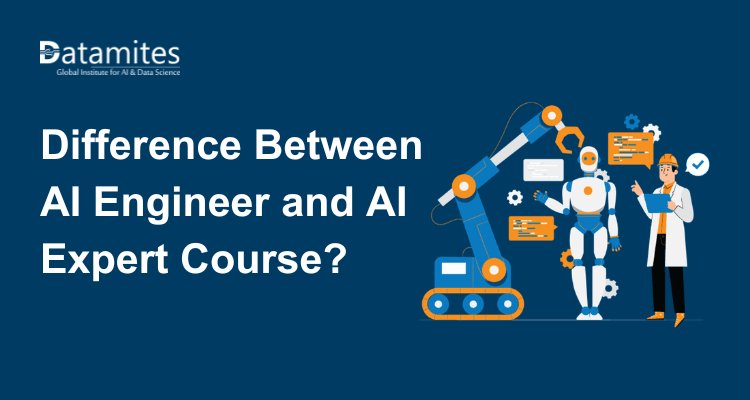
What is the Difference Between AI Engineer and AI Expert Course?
An AI Engineer focuses on building and implementing Artificial Intelligence solutions using technical skills, while an AI Expert course typically covers broader AI concepts and applications. Understanding the difference can help learners choose a course that matches their career goals.
 Datamites Team
Choosing the right Artificial Intelligence course can be challenging when terms such as AI Engineer and AI Expert are often used interchangeably. Although both paths focus on Artificial Intelligence and Machine Learning, they differ in their learning objectives, technical depth, responsibilities, and career applications. Understanding these differences can help students, freshers, and working professionals select a course that aligns with their existing skills and long-term career goals. This article explains the key differences between AI Engineer and AI Expert courses, including their focus areas, skills, career opportunities, and suitability for different learners.
Artificial intelligence has long been a hot topic of excitement among both popular and scientific culture, with the prospective to transform businesses as well as the relationship between people and technology at large. Python is being used as a popular language for AI and numerous tools are being employed for AI purposes. So, why is the use of AI reaching critical mass today?
Artificial intelligence is no longer a thing of the past; rather, it has become a significant part of our daily lives. From personalized recommendations and AI-powered search to virtual assistants and generative AI applications, AI is increasingly integrated into the way we live and work.
What is Artificial Intelligence?
Artificial intelligence (AI) is an extensive branch of computer science that concerns the creation of smart machines that are capable of performing tasks that predominantly entail human intelligence.
Artificial intelligence can be seen as the intelligence of machines through which they try to imitate human intelligence. With the growing scope of Artificial Intelligence and Machine Learning in India, machines can be trained to make decisions on their own under certain circumstances.
Artificial Intelligence is one of the most popular courses in the world. It is good to learn basic machine learning concepts to get a job in this field.
Scope:
The scope of Artificial Intelligence is far and near, the machine smart solutions are employed to curtail modern problems in almost all major sectors like agriculture, health care, education and infrastructure, transport, cyber security, banking, manufacturing, business, hospitality and entertainment.
According to Grand View Research, the global artificial intelligence market was valued at USD 390.9 billion in 2025 and is projected to reach USD 3,497.3 billion by 2033, growing at a CAGR of 30.6%. North America held the largest market share at 35.5% in 2025. The rapid adoption of generative and agentic AI, along with rising enterprise investments, is accelerating AI’s integration into core business operations worldwide.
Freshers should comprehend their competencies and skills and select a better AI role with the possibility of upward mobility. The future scope of Artificial Intelligence continues to grow due to new job roles and advancements in the AI field. The various roles in an AI career are as follows:
Roles in AI:
AI offers diverse career opportunities across development, research, machine learning, robotics, computer vision, natural language processing, and AI operations. Some of the key roles in the AI field include:
- AI Analyst and Developer
- AI Engineers and Scientists
- AI Researchers
- Machine Learning Engineer
- Robotics Specialist
- Computer Vision Engineer
- NLP Engineer
- MLOps Engineer
AI Engineer:
Artificial Intelligence (AI) engineering continues to evolve rapidly, offering professionals opportunities to work on innovative technologies and develop specialized skills.
An artificial intelligence engineer instigates, develops, and delivers production-ready AI products by integrating with the data science department to drive better business processes.
Artificial intelligence engineers are accountable for developing, programming, and training the complex networks of algorithms that make up AI so that they function like the human brain. This role calls for merging expertise in software development, programming, data science, and data engineering.
- They are liable for plotting and raising computer vision solutions leveraging Machine Learning and Deep Learning.
- Develop scalable algorithms by leveraging object tracking, instance segmentation, semantic segmentation, object detection, and keypoint detection.
- Docker technologies for developing deployable versions of models.
- Testing and Deployment Methods.
- Creating and deploying intelligent AI algorithms that do the job.
- Coordinating with other team members.
- Build and manage the overall infrastructure of the AI development process and product.
- Perform statistical analysis and interpret results so that they guide the decision-making process of the organization
AI Engineer Salary
According to Glassdoor, AI Engineer salaries in India vary based on experience:
- Beginner: AI Engineers earn an average base salary of ₹9 lakh per year, with a typical range of ₹6 lakh to ₹13.8 lakh annually (0 to 1 year of experience).
- Intermediate: AI Engineers earn an average base salary of ₹12.5 lakh per year, with a typical range of ₹8 lakh to ₹20 lakh annually (4 to 6 years of experience).
- Experienced: AI Engineers earn an average base salary of ₹30 lakh per year, with a typical range of ₹16.3 lakh to ₹38.8 lakh annually (10 to 14 years of experience).
Actual salaries may vary depending on skills, location, job role, and employer.
The Artificial Intelligence Engineer course provides the necessary knowledge and skills to become a successful AI Engineer. To be precise, the course talks about ways to find solutions to complex problems by employing deep learning, machine learning, computer vision, and NLP methods. Our AI Engineer Course is designed as an amalgamation of the ML Engineer Course and AI Expert Course.
Who Can take up the course?
- Graduates/ Freshers who want to make their career in Artificial Intelligence.
- Professionals in the field of Analytics, who want to make a career in AI.
- Senior Analyst and Team Leader.
- Working professionals planning to transition their careers into Artificial Intelligence and Machine Learning.
- Professionals from software development, data science, data analytics, or related technical backgrounds who want to move into AI engineering.
- Individuals looking to upskill in AI, Machine Learning, Deep Learning, Computer Vision, and NLP.
AI EXPERT:
AI Expert Certification can help learners build and validate their knowledge in key areas of Artificial Intelligence and Machine Learning. This certification is particularly drafted by experts in AI and covers concepts ranging from foundational principles to advanced topics. Machine learning is very important for AI Experts, proficiency in ML is of high priority. Certified AI Expert training is expertly modeled and skillfully designed training, extending strong knowledge on various aspects of AI. AI certification can help demonstrate foundational knowledge and strengthen a learner's professional profile.
An AI expert applies Artificial Intelligence and Machine Learning techniques to develop, evaluate, and optimize intelligent systems for different applications.
He programs computer systems to identify fingerprints and voices, resolve problems, and explicate information in a proper manner. DataMites provide encyclopedic knowledge of the domain, the tools, and techniques thereby aiding you to be an expert in the realm. Once you gain expertise in AI and ML, you are all set to take up the AI Engineer Course!
AI Engineer Salary
As per Ambition Box, the average salary for an Artificial Intelligence (AI) Expert India typically earns around ₹13.6 lakh to ₹15 lakh per year, while the average salary is approximately ₹10.6 lakh annually.
Who can take up the course?
- Individuals aspiring to build a career in Artificial Intelligence.
- Fresh graduates and students looking to enter the AI industry.
- Working professionals planning to transition into Artificial Intelligence.
- Professionals working in the operations domain who want to develop AI skills.
Go through the below sources for region wise AI expert salary across the word
- What is the Salary of an AI Expert in the Asia Pacific Region?
- What is the Salary of an AI Expert in North America?
- What is the Salary of an AI Expert in Oceania?
- What is the Salary of an Artificial Intelligence Expert in South America?
- What is the Salary of an AI Expert in Africa?
- What is the Salary of an Artificial Intelligence Expert in the Middle East?
- What is the Salary of an Artificial Intelligence Expert in Europe?
Numerous IT professionals pursue careers in AI and ML technologies and look for ways to upskill, strengthen their technical capabilities, and progress toward specialized AI roles. As businesses increasingly adopt intelligent solutions across industries, the demand for professionals who can understand, develop, and implement AI technologies continues to grow. Choosing between an AI Expert and AI Engineer pathway ultimately depends on the learner’s existing knowledge, career goals, and desired level of technical specialization.
DataMites Artificial Intelligence Courses offer practical, industry-focused training to build skills in Artificial Intelligence and Machine Learning. The Artificial Intelligence Course is a 9-month program with 780 hours of learning, covering key AI concepts, tools, and applications.
The AI Expert Course is a focused 3-month program with 300 hours of learning, designed to build strong foundations in AI and ML. Learners can also earn IABAC and NASSCOM FutureSkills certifications, helping validate their skills and strengthen their professional profiles.
DataMites AI training is available through 40+ offline training centers across India, giving learners the flexibility to choose classroom-based learning in major cities such as Pune, Bangalore, Hyderabad, Chennai, Mumbai, Coimbatore, and Ahmedabad. These centers provide learners with access to structured training and practical AI learning opportunities closer to their location.