Must-Learn AI Skills for Students and Professionals in Satara
Explore must-learn AI skills for students and professionals in Satara, covering technical foundations, machine learning, AI tools, practical projects, and career preparation.
 Priyanka BR
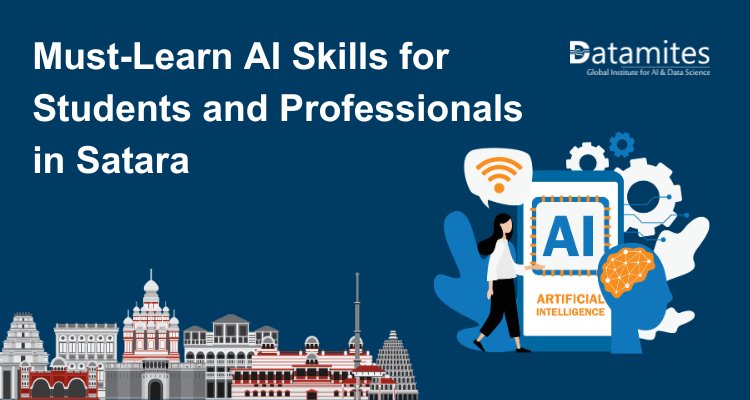
Artificial Intelligence is influencing how organizations operate across Satara’s IT, software, manufacturing, healthcare, automation, and service sectors. As businesses increasingly use intelligent applications and data-driven approaches to improve their operations, professionals who possess practical AI skills are becoming increasingly relevant. For students and working professionals, learning Python, statistics, data analysis, machine learning, and logical reasoning can create a strong foundation for pursuing AI-related career opportunities.
After establishing the basics, learners can progress into advanced domains including deep learning, Natural Language Processing (NLP), computer vision, TensorFlow, PyTorch, and cloud-based AI solutions. Gaining knowledge of these technologies can help aspiring professionals understand how AI is implemented in practical situations and prepare for opportunities developing within Satara’s technology and business landscape.
Importance of AI Skills for Students and Professionals in Satara
Satara is gradually developing as a business and technology-oriented location, with activities spanning IT services, software development, manufacturing, automation, and digital businesses. As organizations adopt analytics, automation, and intelligent systems to improve efficiency and decision-making, professionals with applicable AI knowledge can respond more effectively to changing workplace expectations. Strengthening capabilities in programming, data, machine learning, and AI applications can therefore help learners remain competitive in the changing employment environment.
Moreover, AI skills are useful beyond conventional technology positions. Organizations can apply intelligent technologies to predictive maintenance, quality control, customer engagement, healthcare analysis, financial forecasting, and process automation. Students can improve their career profiles by completing practical projects, while experienced professionals can introduce AI methods into their current roles and move toward specialized opportunities. The expanding global AI industry also demonstrates the importance of these skills. According to Statista, the worldwide Artificial Intelligence market is expected to reach US$617.62 billion by 2026, highlighting the growing relevance of AI expertise for students and professionals preparing for future careers.
Refer to these articles:
- Traditional RAG vs Agentic RAG - What’s the Difference
- AI Sovereignty: The New Mandate for Data Governance in the Cloud Era
- How Knowledge-Augmented Generation (KAG) Is Solving AI Hallucinations
Essential Technical Skills for Building an AI Career in Satara
Artificial Intelligence combines programming, mathematics, data processing, algorithms, and analytical thinking. Therefore, beginners should build a balanced set of fundamental technical skills and practical abilities before progressing into more specialized AI technologies.
1. Python and Programming
Programming is an essential component of numerous Artificial Intelligence applications, with Python being one of the most commonly used languages for machine learning and AI development. Learners should understand Python syntax, functions, data structures, object-oriented programming, and important libraries. SQL is also useful for working with databases, while Java and C++ can be relevant for certain development requirements.
2. Mathematics and Statistics
A sound mathematical foundation can help learners understand how AI and machine learning algorithms function. Important areas include linear algebra, probability, statistics, and calculus. Understanding these concepts can support learning in areas such as optimization, prediction, model assessment, and the mathematical foundations of machine learning.
3. Data Analysis and Preparation
The effectiveness of an AI model depends significantly on the quality and preparation of its data. Learners should know how to collect, clean, transform, explore, and visualize datasets. Tools including Pandas, NumPy, Matplotlib, and Power BI can help beginners gain hands-on experience with data and recognize meaningful patterns before developing machine learning models.
4. Machine Learning
Machine learning allows computer systems to identify patterns in datasets and use them to make predictions or decisions. Learners should develop an understanding of supervised and unsupervised learning, regression, classification, clustering, feature engineering, model validation, and introductory reinforcement learning to establish a solid foundation in this area.
5. AI and Machine Learning Frameworks
AI frameworks allow learners to apply theoretical concepts and develop working solutions. Technologies such as Scikit-learn, TensorFlow, PyTorch, Keras, OpenCV, and NLP libraries are useful for experimenting with different AI applications. Learners can select frameworks based on the specialization they intend to pursue.
6. Cloud Deployment and AI Infrastructure
Many modern AI systems depend on computing infrastructure capable of handling model training, testing, and deployment. Learners should become familiar with cloud computing, virtual machines, storage, APIs, model deployment, and scalable infrastructure. Understanding cloud platforms can help professionals take AI applications beyond local development environments and deploy them for practical use.
7. Analytical and Problem-Solving Ability
Strong technical knowledge needs to be supported by analytical thinking and problem-solving skills. AI professionals must identify the actual problem, examine available data, select appropriate techniques, evaluate results, and improve their solutions when required. Developing a structured approach to problem-solving can therefore benefit professionals across different AI career paths.
8. Practical Project Experience
Hands-on projects give learners the opportunity to apply their knowledge to realistic situations. Projects involving recommendation systems, predictive analytics, chatbots, image classification, and intelligent automation can demonstrate an individual's ability to implement AI concepts. A well-developed project portfolio can also provide practical examples that candidates can discuss during interviews.
AI Tools and Technologies Worth Learning in Satara
As organizations in Satara explore automation, analytics, and intelligent applications, familiarity with relevant AI tools can help students and professionals strengthen their practical capabilities. However, learners do not need to master every available technology. Instead, they should focus on Artificial Intelligence tools that support their preferred career path and specialization.
Programming and Development Tools
Python, SQL, Jupyter Notebook, Google Colab, and Git offer a useful combination of tools for coding, experimentation, testing, collaboration, and AI development.
Machine Learning and Deep Learning
Scikit-learn, TensorFlow, PyTorch, and Keras are important technologies for creating machine learning and deep learning models and exploring different approaches to AI development.
Data Processing and Visualization
Pandas, NumPy, Matplotlib, Seaborn, Tableau, and Power BI can help learners process datasets, perform analysis, identify trends, and communicate insights through visual representations.
NLP Technologies
NLTK, SpaCy, and Hugging Face Transformers are useful for developing applications involving text analysis, sentiment detection, conversational systems, classification, and modern language-model use cases.
Computer Vision and Image Processing
OpenCV and object-detection technologies allow learners to explore applications involving image processing, visual quality inspection, object identification, automated monitoring, and computer-based visual analysis.
Cloud Platforms and Big Data Tools
AWS, Microsoft Azure, Google Cloud, and Apache Spark can help professionals handle large datasets, access computing resources, support AI workloads, and develop scalable data and AI applications.
How These AI Skills Can Help in Satara
AI knowledge can help professionals contribute to areas such as automation, predictive analytics, intelligent reporting, quality monitoring, and operational optimization. For example, machine learning can identify useful patterns from business and operational datasets, while computer vision can assist with visual inspection and automated monitoring. Data analytics can also help organizations make decisions using measurable insights. Developing Artificial Intelligence Skills for Professional roles can therefore help individuals apply AI technologies more effectively in practical workplace situations.
At the same time, AI capabilities can support career opportunities in IT services, healthcare, finance, retail, software development, and other digitally driven sectors. Exploring a top IT course in Satara, together with foundational concepts, specialized technologies, and practical projects, can help learners develop a stronger profile for AI-oriented roles.
AI Skills for Different Career Roles and Opportunities in Satara
Artificial Intelligence provides multiple career directions, allowing learners to select roles according to their interests, existing capabilities, and preferred areas of specialization.
1. AI Engineer
AI engineers work with Python, machine learning, deep learning, TensorFlow, PyTorch, APIs, and cloud platforms to design, train, assess, and deploy intelligent applications and models.
2. Data Scientist
Data scientists use Python, SQL, statistics, Pandas, NumPy, Tableau, and Power BI to examine datasets, develop predictive models, and generate insights that can support business decisions.
3. NLP Developer
NLP developers work with Python, NLTK, SpaCy, Transformers, and large language model concepts to create chatbots, text-processing applications, classification systems, and other language-based solutions.
4. Computer Vision Specialist
Computer vision specialists use Python, OpenCV, convolutional neural networks, image processing, and object-detection methods to develop applications for image recognition, monitoring, inspection, and automation.
5. AI Consultant or Project Manager
AI consultants and project managers combine Artificial Intelligence concepts, data analytics, cloud technologies, project management, communication, and business analysis to understand organizational requirements, identify appropriate AI solutions, and coordinate implementation.
Choosing a suitable career direction is only the beginning of becoming job-ready. Learners also need regular practice and structured education to develop the skills required for professional roles. Students and professionals looking for an AI training institute in Satara can consider programs that combine theoretical learning with practical assignments, projects, and exposure to real-world AI applications.
A structured learning journey enables learners to gradually progress from programming and data analysis to machine learning, deep learning, NLP, and computer vision. Completing practical projects can strengthen this knowledge by allowing learners to understand how AI technologies can address different industry challenges. Combining conceptual learning with implementation can help learners build confidence and develop capabilities that match evolving AI career requirements.
Refer to these articles:
- Online vs Classroom Artificial Intelligence Courses in Pune: Which Is Better
- How MBA Graduates in Pune Can Build a Career in Artificial Intelligence
- Top Companies Hiring AI Professionals in Pune
The DataMites Artificial Intelligence course in Satara follows a comprehensive 9-month learning structure with 780 learning hours. The program covers areas such as AI engineering, AI expertise, foundational AI concepts, and NLP, while also introducing neural networks, Keras, big data, cloud technologies, and AI ethics. Learners receive opportunities for hands-on projects, internship exposure, job assistance, and flexible learning options, along with IABAC and NASSCOM FutureSkills credentials.
As Artificial Intelligence continues gaining adoption across industries, learners can also explore DataMites training opportunities through its 50+ offline centers, including Artificial Intelligence training in Pune, Delhi, Mumbai, and Nagpur. Developing a balanced skill set covering programming, data analysis, machine learning, advanced AI technologies, and practical project experience can help students and professionals prepare for the changing demands of AI-driven careers.