A Complete Guide to AI in Finance
Explore the complete guide to AI in finance, covering key trends, real-world use cases, benefits, challenges, and career opportunities. Learn how AI is transforming banking, risk management, and investment strategies for a data-driven financial future.
 Kriti Maurya
Artificial Intelligence is transforming the financial landscape, making AI in finance and banking a strategic necessity rather than just a technological upgrade. Financial institutions use AI to process large volumes of data, enabling faster, accurate, and data-driven decisions across banking, insurance, and fintech.
The evolution of AI and finance from basic automation to advanced machine learning allows organizations to predict risks and personalize services. Additionally, AI in the finance industry improves efficiency by automating tasks like compliance and reporting. With growing competition, AI in financial services is essential for innovation, agility, and long-term business growth.
The research study reveals that 94.74% of respondents believe AI will play a significant role in the future of finance, while 84.21% show strong confidence in AI’s ability to deliver accurate financial predictions.(Source: ResearchGate)
Why AI in Finance is Emerging as a Strategic Career for Leaders
The rapid adoption of AI in finance and banking is driving demand for leaders who can connect financial expertise with advanced technology. This shift extends beyond technical roles, requiring executives to guide AI investments and implementation strategies effectively.
According to the KPMG Global Report, 71% of organizations are already using AI in finance operations, with 41% adopting it at a moderate or large scale, highlighting rapid enterprise adoption.
The study, based on 2,900 companies across 23 countries, shows AI is expanding across core finance areas like accounting, risk, and treasury, signaling a strong global shift toward AI-driven finance functions.(Source: KPMG)
A key reason ai in the finance industry is becoming a strategic career path is the growing reliance on data-driven insights. Leaders must interpret complex AI outputs and translate them into actionable business decisions that align with organizational goals.
Additionally, expertise in AI and finance offers a strong competitive advantage by enabling innovation, operational efficiency, and improved customer experiences. As AI in financial services evolves, cross-functional collaboration with data and tech teams becomes essential for leadership success.
Core Skills Finance Leaders Need to Succeed in AI-Driven Finance
To thrive in an AI-driven environment, finance professionals must develop a robust set of AI finance skills. These skills go beyond traditional financial expertise and include a blend of technical, analytical, and strategic capabilities.
- Data Analytics & Machine Learning Knowledge: Strong understanding of data processing, AI models, and analytics is essential. These AI finance skills help leaders evaluate insights and apply them effectively in AI in the finance industry.
- Strategic Thinking & Business Alignment: Leaders must identify where AI creates value and align it with business goals. In AI and finance, this ensures impactful and measurable outcomes.
- Proficiency in AI Tools & Platforms: Familiarity with modern tools used in AI in the finance industry enhances efficiency and decision-making capabilities.
- Understanding Explainable AI: Knowledge of explainable AI in finance ensures transparency, compliance, and trust in AI-driven decisions.
These combined competencies define the modern skill set required for success in AI-driven finance.
Refer to the articles below:
- How AI Is Changing the Future of Product Development Strategy
- Top AI Tools for Marketing
- Essential AI Skills for Healthcare Professionals
AI Tools for Finance Transforming the Industry
The rapid adoption of advanced ai tools for finance is driving innovation and efficiency across the financial sector. These tools enable organizations to harness the full potential of AI and stay competitive in a dynamic market environment.
Machine Learning Platforms for Advanced Data Analysis
Machine learning platforms are at the forefront of this transformation. They enable financial institutions to analyze large datasets, uncover patterns, and generate actionable insights. These platforms play a critical role of AI in finance and banking services.
Robotic Process Automation (RPA) for Operational Efficiency
Robotic Process Automation (RPA) is a key component of AI tools for finance. It automates repetitive tasks such as data processing, compliance checks, and customer onboarding. This leads to reduced operational costs while improving accuracy and efficiency in AI in finance and banking.
Data Visualization Tools for Strategic Decision-Making
Data visualization tools convert complex datasets into easy-to-understand visual formats. They help leaders make quick, informed decisions and effectively connect technical analysis with business strategy, making them essential in modern financial environments.
As the adoption of AI in the finance industry continues to grow, these tools will become increasingly sophisticated, offering new opportunities for innovation and growth.
Applications of Artificial Intelligence in Finance
The scope of the applications of artificial intelligence in finance spans multiple sectors, transforming how financial services are delivered and experienced. Below are five key applications explained with clear pointers:
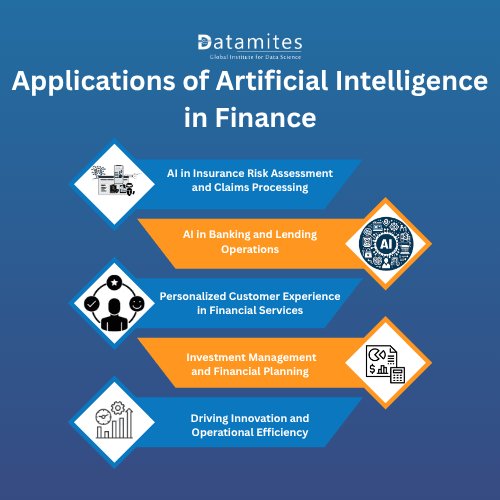
1. AI in Insurance Risk Assessment and Claims Processing
In the insurance sector, ai in the insurance industry is widely used for evaluating risks, automating claims processing, and improving customer service. AI systems analyze large datasets to provide accurate risk assessments, leading to better underwriting decisions and faster claim settlements.
2. AI in Banking and Lending Operations
ai in finance and banking is reshaping credit scoring and loan approvals. AI models assess borrower profiles using multiple data points, reducing default risks and enabling faster, more reliable lending decisions.
3. Personalized Customer Experience in Financial Services
AI enhances user experience by offering tailored financial products and services. Through behavior analysis and predictive insights, AI in financial services helps organizations deliver customized recommendations and improve customer satisfaction.
4. Investment Management and Financial Planning
AI supports smarter investment strategies by analyzing market trends and forecasting outcomes. These capabilities strengthen portfolio management and highlight the growing importance of AI and finance in wealth management.
5. Driving Innovation and Operational Efficiency
The integration of AI across sectors showcases the transformative power of AI and finance. From automation to advanced analytics, these applications improve efficiency, reduce costs, and foster innovation throughout the financial ecosystem.
These diverse applications highlight the transformative impact of AI and finance, demonstrating its potential to drive innovation and efficiency across the industry.
How to Start a Career in AI Finance being a Fresher
Starting a career in this field requires a strategic approach that combines education, skill development, and practical experience.
- Build a Strong Educational Foundation: Start with degrees in finance, data science, or computer science. Specialized programs in ai in the finance industry help strengthen domain knowledge and technical expertise.
- Earn Relevant Certifications: Certifications in AI, machine learning, and financial analytics validate your skills and show commitment to continuous learning in AI and finance.
- Gain Hands-On Experience: Practical exposure to ai tools for finance is essential. Working on real-world projects helps bridge the gap between theory and application.
- Develop Industry-Relevant Skills: Focus on building strong AI finance skills, including data analysis, strategic thinking, and problem-solving abilities.
- Network and Stay Updated: Engage with industry professionals, attend events, and follow trends in finance and banking to unlock career opportunities.
By developing the right AI finance skills and gaining practical experience, aspiring professionals can position themselves for success in this rapidly evolving field.
Key Challenges in Implementing AI in Finance strategy
Despite its numerous benefits, the implementation of ai in finance and banking comes with several critical challenges that organizations must carefully address to unlock its full potential. Below are five key challenges explained clearly:
- Data Privacy and Security Financial institutions handle highly sensitive customer information, making robust security measures an absolute necessity. In the context of AI in finance and banking, ensuring data protection is critical for maintaining customer trust and meeting compliance standards.
- Ethical Concerns and Algorithmic Bias AI models can produce biased outcomes when trained on flawed or unrepresentative data. Addressing these issues is essential for ensuring fairness and transparency in AI-driven financial services, particularly in areas like credit scoring and loan approvals.
- Integration with Legacy Systems Many financial institutions still rely on outdated infrastructure, making it difficult to seamlessly adopt modern AI solutions. Overcoming this hurdle demands significant financial investment, technical expertise, and long-term strategic planning.
- Regulatory Compliance As AI adoption accelerates across the finance industry, regulatory frameworks are continuously evolving to address emerging risks. Organizations must stay informed of changing requirements and ensure full compliance to avoid potential legal and financial penalties.
- Talent and Skill Gaps Implementing AI in finance requires specialized expertise in both technology and financial domains. Many institutions struggle to attract and retain professionals who possess the necessary skills to develop, manage, and maintain advanced AI systems effectively.
Additionally, regulatory compliance remains a key consideration. As AI adoption grows, regulatory frameworks are evolving to address new risks and challenges.
Refer to the articles below:
- What is Artificial Narrow Intelligence
- Traditional AI vs Generative AI: Key Differences, Examples, and Use Cases
- PyTorch vs TensorFlow: Which is Better in 2026
What are the Future Trends for AI in Finance
The future of AI and finance is filled with opportunities for innovation and growth. Emerging technologies such as quantum computing, advanced analytics, and natural language processing are set to further enhance the capabilities of AI.
As AI in finance and banking continues to evolve, organizations will increasingly rely on AI for strategic decision-making. The integration of AI with other technologies, such as blockchain, will create new possibilities for secure and efficient financial transactions.
The adoption of AI in finance is reshaping the industry, creating new opportunities for leaders and professionals alike. By embracing innovation and developing the necessary AI finance skills, organizations can unlock the full potential of AI and achieve sustainable success.
DataMites Bangalore provides a well-structured AI for Finance courses aimed at empowering finance professionals to make smarter, data-driven decisions using artificial intelligence. The program covers fundamental AI concepts, financial analytics, and practical applications such as risk management, fraud detection, investment analysis, and financial forecasting.
In addition to finance-focused learning, the course also offers specialized modules including AI for Product Managers, AI for HR Analytics, AI in Marketing, AI in Healthcare, and Business Leadership, enabling learners to gain cross-domain expertise. Participants benefit from flexible learning options, including both online and classroom sessions, along with real-time internships that provide hands-on industry experience.
With globally recognized certifications from IABAC, DataMites has a strong presence across major cities such as Bangalore, Hyderabad, Pune, Chennai, Ahmedabad, Mumbai, Coimbatore, Delhi, Nagpur, and Kochi, delivering industry-relevant and career-oriented training programs.