Data Analytics in Retail Industries
Explore how Data Analytics in Retail Industries helps businesses understand customer behavior, optimize inventory, improve pricing, forecast demand, enhance customer experiences, and increase profitability. Discover key applications, benefits, tools, and emerging trends shaping data-driven retail decisions.
 Datamites Team
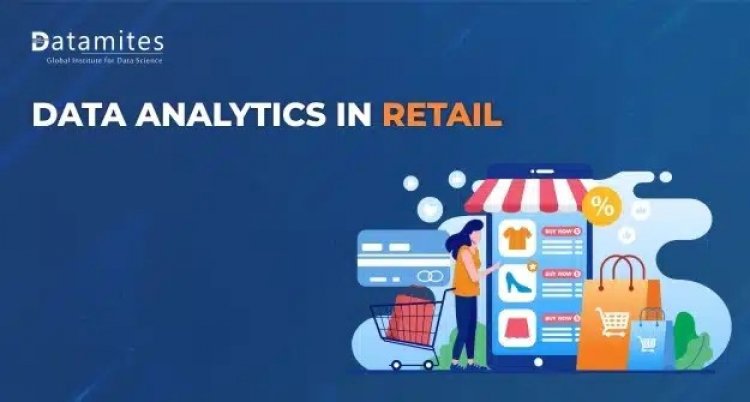
Data analytics involves examining data to identify patterns, generate insights, and support business decisions. According to Career Foundry, data can be analyzed, optimized, and can be transformed into meaningful data. Data analytics have been automated to processes raw data algorithms for business output. It optimizes the data to perform in a standard way and make efficient decisions. Data analytics is a broad term that defines any type of data to reveal trends and metrics to increase business value. With the help of data analytics, companies can bring advanced tools into the picture to draw classic statistics.
Data Analytics process valuable data and use it for making better business decisions. Data Analytics helps predict the future and draws relevant business ideas to organize the industry. With the help of Data Analytics in retail industries, industries can tracks product history to optimize market strategies.
Introduction to Data Analytics in Retail Industries
Data Analytics in retail industries helps retailers to expand and grow their business successfully. With the advancement of data, data analytics is improving the market business by responding to new trends to enhance customer experience. Data analytics plays a vital role in the retail industry by tracking the product’s value, optimizing price, and accepting market challenges. Data analytics enables companies to personalize market trends and market strategies. The transformation in technology has taken place significantly, allowing retailers to make decisions based on data analysis.
Data analytics is transforming the retail industry by helping businesses understand customer preferences, optimize pricing, manage inventory, and improve profitability. According to the Times of India, data analytics enables retailers to enhance customer satisfaction and make informed, data-driven business decisions. By analyzing sales trends, customer behavior, and market demand, retailers can identify growth opportunities, reduce operational inefficiencies, and make smarter decisions that support long-term business growth.
According to Global News Wire, the market size of data analytics in retail industries is USD 5.26 Billion and will reach up to USD 18.33 Billion by the year 2028.
Refer this article: Applying Data Analytics to Finance
What are the roles of Data Analytics in Retail Industries?
The future of data analytics has transformed by putting a greater impact on daily lives. Here is the list of important roles that data analytics play in the retail industry:
1. Product sell-through rate– Data analytics in retail industries analyzes specific data to resonate with customers’ demand and satisfaction. Data is used to analyzing, improving and retailing in custom rates. In the retail industry, the most important part is to attract customers and offer them customized products and services retail industry aims to tailor targeted campaigns and achieve optimal success through product services.
2. Price optimization- The use of data analytics in retail industries improves the function of price optimization by using important data algorithms. Products are highly tracked and data analytics enhances price optimization by using simple factors.
3. Anticipate supply chain disruption- Data analytics is used in retail industries to get external sources and impact the business market. Data analytics uses real-time data before data disruption and accordingly monitors it to enable profitability.
4. Forecasting demand and supply- Forecasting demand and supply became important to meet the expected need of business markets. With the help of data analytics, retail industries are now able to predict growing production, revenues, and future inventory. It helps in planning different processes to execute market strategies and implement better business decisions.
5. Improvising market mix- Data Analytics embarks on improvement in the marketing scenario to impact productivity in the near future. As transformation has accelerated highly and taken technology to the next level it re-evaluates multiple techniques to bring success to the retail industries. Data analytics transforms the analytical model to evaluate marketing and evaluating mix.
Read this article: How is Data Analytics Influencing the Educational Sector?
What are the benefits of Data Analytics in retail industries?
- Incentivize sales by optimal pricing– With the advancement of technology, data analytics has become frequently in use to leverage product pricing in the market. Optimal pricing tries to see how it will enhance the demand for sales and product bundles. Using data analytics, retail industries can streamline the journey of valuable customers and organize customer services.
- Unlock insights from customer journeys- Data analytics extracts valuable data to analyze customer behavior. The customer journey is complex in itself spanning most digital channels. Data analytics determines the market engagement among the customer and puts emphasis on customer satisfaction.
- Take personalization to next level- Customer is the prominent factor in the retail industry and data analytics helps to extract information from product recommendations and market campaigns to experience customer purchase history.
- Trends prediction in the market- Retailers can use predictive analytics to identify products likely to experience higher demand during specific seasons, promotions, or events. During festivals, there are seasonal sales because data predicts that the market will be worthy during sales and with the help of sentiment analysis it will analyze whole market trends. With the help data gathered, products that are ought to be trending during a specific time are predicted.
- Virtual applications- The process of data analytics in retail industries tries to value customer experience and feature customer reviews to analyze the product/ brands. Virtual applications reduce the cost and handle product exchange. With the help of data analytics, the industry measures the size of the product and provides informational data from the previous purchase.
Also refer this article: Exploratory Data Analysis
What Is the Future of Data Analytics in Retail Industries?
As retailers collect increasing volumes of transaction, inventory, customer, and digital-channel data, advanced analytics will play an important role in turning this information into actionable business insights. Recent market research also indicates strong growth in the sector: Fortune Business Insights estimates that the global retail analytics market will grow from USD 11.96 billion in 2026 to USD 37.18 billion by 2034, at a CAGR of 15.20%. The salary of a data analyst in India ranges between ₹4L - ₹10LPA according to the Glassdoor report.
The data analytics has transformed retail industries and reshaped business strategies to embrace the market shift.
Emerging Trends in Retail Analytics
Several technologies are expected to shape the future of retail analytics:
- Generative AI for retail analytics: Generative AI can help retailers summarize data, generate reports, identify patterns, and support faster business decision-making. McKinsey reports that many retailers are already experimenting with generative AI across internal operations and customer service.
- AI-powered demand forecasting: Retailers can combine historical sales, promotions, inventory, seasonal patterns, and other signals to improve demand forecasting and inventory planning.
- Real-time analytics: Retailers are increasingly using real-time data from stores, websites, applications, sensors, and connected devices to monitor customer behavior, inventory, and operations.
- AI-powered personalization: Customer data can be analyzed to provide personalized product recommendations, offers, search results, and shopping experiences.
- Computer vision: Cameras and computer vision systems can support shopper traffic analysis, shelf monitoring, inventory management, and store operations. Grand View Research identifies shopper traffic analysis and inventory management as important areas within the growing in-store analytics market.
- Agentic AI: Emerging agentic AI systems can perform multi-step analytical and operational tasks, including monitoring retail performance, identifying issues, and supporting merchandising decisions.
- Omnichannel analytics: Retailers will increasingly combine data from physical stores, websites, mobile applications, marketplaces, and social platforms to understand the complete customer journey.
- Privacy-focused analytics: As retailers use more customer data, privacy, security, responsible AI, and appropriate data governance will become increasingly important.
What are the Data Sources in Retail Analytics?
Retail analytics depends on data collected from multiple operational, digital, and external sources. Combining these sources gives retailers a broader view of sales, customers, inventory, marketing performance, and market conditions.
- Point-of-Sale Transactions: Point-of-sale (POS) systems generate information about purchases made in physical stores. Data may include products sold, quantities, prices, discounts, transaction times, payment methods, and store locations. Retailers can analyze this information to understand sales performance and purchasing patterns.
- E-Commerce Clickstream Data: Clickstream data records how customers interact with an e-commerce website or application. It can include pages visited, products viewed, searches, clicks, cart activity, and checkout behavior. This data helps retailers understand online customer journeys and identify potential conversion opportunities.
- Customer Loyalty Programs: Loyalty programs provide information about customer purchases, shopping frequency, product preferences, and engagement. When used appropriately, this data can help retailers understand customer segments and develop more personalized offers and experiences.
- Product Catalog Data: Product catalog data contains information about products, including product names, categories, descriptions, prices, brands, specifications, and product attributes. It provides important context for analyzing sales, product performance, recommendations, and customer preferences.
- Inventory and Warehouse Systems: Inventory and warehouse systems provide information about stock levels, product movement, replenishment, warehouse operations, and order fulfillment. Retailers can use this data to monitor inventory and support demand forecasting and supply chain analysis.
- Customer Reviews: Customer reviews provide qualitative and quantitative information about customer experiences with products and services. Retailers can use text analytics and sentiment analysis to identify common customer concerns, product feedback, and emerging preferences.
- Marketing Campaign Data: Marketing platforms generate information about campaigns, advertisements, emails, promotions, impressions, clicks, conversions, and customer engagement. Retailers can analyze this information to evaluate campaign performance and understand which activities generate customer responses.
- Website and App Behavior: Website and mobile application data can reveal how customers search for products, navigate pages, interact with content, and complete purchases. Retailers can use behavioral analytics to identify customer interests, improve digital experiences, and understand conversion patterns.
- Pricing and Promotion Data: Pricing and promotion data includes product prices, discounts, coupons, promotional periods, and campaign offers. Analyzing this information alongside sales and demand data can help retailers understand how pricing and promotions influence purchasing behavior.
By combining these data sources, retailers can gain comprehensive insights to improve decision-making, customer experiences, and operational efficiency.
Real-World Retail Analytics Case Studies
Real-world retail analytics applications demonstrate how leading retailers use data, AI, and machine learning to improve customer experiences, optimize inventory, forecast demand, and support data-driven business decisions.
1. Walmart: AI-Powered Demand Forecasting and Inventory Management
Walmart uses data analytics and AI to forecast customer demand and optimize inventory placement. Its forecasting engines analyze demand at a granular level and continuously incorporate signals from stores, customers, and other sources. These forecasts are then used by inventory placement and replenishment systems to determine the appropriate quantities and locations for products across stores and fulfillment facilities.
Key application: Demand forecasting, inventory optimization, supply chain analytics, and real-time decision-making.
2. Target: AI for Inventory, Personalization, and Customer Analytics
Target uses AI across inventory management, merchandising, personalization, and digital shopping experiences. The company has reported using AI to forecast product demand, identify potential out-of-stock items, and help position inventory where it is needed. Target also uses customer and behavioral data to personalize recommendations and offers through its digital platforms and loyalty program.
In 2026, Target also introduced AI-powered features such as Buy Again, which uses previous shopping behavior to surface frequently purchased products and relevant deals.
Key application: Demand forecasting, inventory analytics, customer personalization, recommendation systems, and loyalty analytics.
3. Amazon: AI and Analytics for Personalized Product Recommendations
Amazon has used machine learning for product recommendations for more than two decades. Its recommendation and AI systems use signals such as customer shopping activity, searches, purchases, and product preferences to help personalize product discovery. Amazon's newer AI shopping tools also provide conversational product recommendations and personalized assistance based on individual shopping activity.
Amazon has also applied computer vision and sensor-fusion technologies in physical retail environments. For example, its Dash Cart uses computer vision and sensors to identify items while customers shop, enabling real-time receipt and checkout processing.
Key application: Recommendation engines, customer analytics, personalization, computer vision, and real-time retail analytics.
These case studies highlight how retail analytics can be applied across different areas of the retail industry, from customer personalization and recommendations to inventory management, demand forecasting, and operational efficiency.
Challenges of Data Analytics in Retail Industry
Although data analytics offers valuable insights for retailers, implementing and managing analytics systems can present several challenges, including data quality, privacy, security, integration, infrastructure costs, and the need for skilled professionals.
- Data Quality and Missing Data: Retail analytics depends heavily on accurate and complete information. Incorrect product records, duplicate transactions, inconsistent customer information, and missing values can affect analytical results and may lead to inaccurate business decisions.
- Data Integration Across Stores and Digital Channels: Retailers often collect information from physical stores, websites, mobile applications, marketplaces, warehouses, and customer-service systems. Integrating these sources can be challenging because different systems may use different formats, identifiers, and data structures.
- Customer Privacy: Retail analytics frequently involves customer-related information such as purchase history, preferences, and online behavior. Businesses need to handle this information responsibly and follow applicable privacy requirements while using customer data for analysis and personalization.
- Data Security: Retailers manage large amounts of financial, customer, employee, and operational information. Weak security controls can expose sensitive data to unauthorized access or cyber threats, making data protection an important part of an analytics strategy.
- Analytics Infrastructure Costs: Building and maintaining analytics infrastructure can require significant investment in cloud platforms, databases, data pipelines, analytical software, storage, computing resources, and security systems. Smaller retailers may face greater challenges in managing these costs.
- Real-Time Processing Requirements: Some retail applications require information to be processed almost immediately. Inventory monitoring, fraud detection, dynamic pricing, and personalized recommendations may require systems capable of handling high volumes of data with low latency.
- Bias in Analytical Models: Analytics models can produce biased results when the underlying data is incomplete, unrepresentative, or influenced by historical patterns. Retailers need to evaluate models carefully to identify potential bias and ensure that analytical outputs are appropriate for their intended use.
- Forecast Uncertainty: Demand forecasts and other predictive models are based on historical and current information, so their predictions are not guaranteed to be accurate. Unexpected events, analysing consumer behaviour and how changing consumer preferences, supply disruptions, or economic conditions can affect forecast accuracy.
- Model Maintenance and Monitoring: Analytical models can become less accurate as customer behavior, product demand, market conditions, and business processes change. Retailers need continuous monitoring, validation, and periodic model updates to maintain reliable analytical performance.
- Lack of Skilled Analytics Professionals: Retail organizations may require professionals with skills in data analytics, statistics, machine learning, data engineering, visualization, and business intelligence. A shortage of professionals with these combined technical and business skills can make it difficult for retailers to implement and maintain advanced analytics systems.
Addressing these challenges is essential for retailers to build reliable analytics systems and make informed, data-driven decisions.
What is the future of data analytics in retail industries?
Data analytics in retail industries is likely to emerge in the upcoming years as technology has reached beyond imagination and has developed new tech innovations and business trends. As the business market is evolving its sector, data analytics has been playing an essential role in collecting pivotal data to enhance customer service in retail industries. The key trend in business today is to forecast the future and restore it by processing data. The salary of a data analyst in India ranges between ₹4L - ₹10LPA, according to the Glassdoor report.
The data analytics has transformed retail industries and reshaped business strategies to embrace the market shift. The main target in the retail industry is their customers and fulfilling their demands with enhanced products and services. Social media has initiated major tactics to bring a personalized retail experience to increase business demand.
Also read this article: 10 Common Data Structures Every Programmer Must Know
Technology has brought innovations and has advanced digitalization progress. The retail industry has changed its business process a lot and used new methods to bring customer efficiency. The use of data analytics has brought changes in the retail industry and harnessed loyalty into the customer purchasing process. With the help of data analytics, the retail market has improved the growth of eCommerce and customer satisfaction. As we optimize the data, it boosts the revenue of the retail business.
DataMites Data Analytics Training is designed to help learners build job-ready skills in Excel, SQL, Python, Power BI, Tableau, and statistics. With practical projects, case studies, expert guidance, and career support, DataMites helps aspiring professionals advance their data analytics careers.
DataMites is a recognized and professional institute that provides a trending course on data science, artificial intelligence, python, and machine learning. All the courses of DataMites are highly accredited by IABAC. The students who get trained in DataMites get the privileged of expert professionals, a specialized syllabus, handed with case studies, and mock tests. The students get assistance for job placement and a proper understanding of the domain.
What is HR analytics?
Certified Data Analyst Course