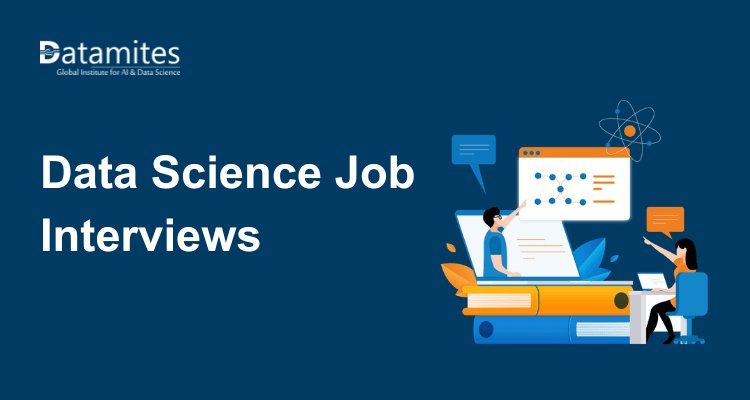
Data Science Job Interviews
Prepare for Data Science job interviews with insights into common interview questions, technical skills, problem-solving approaches, and key concepts. Learn how to confidently handle interviews and improve your chances of landing the right role.
 Datamites Team
After all the hard work you put in to get prepared for a Data Science career, the next important step is preparing for a Data Science job interview. Even if you are confident in your skills and have a strong professional background, a Data Science interview can still be a stressful experience.
Data Science interviews are often practical and hands-on, so preparing well requires time and consistent practice rather than simply memorizing questions found online. Depending on the role, you may encounter technical screening questions such as:
- What is a random forest?
- How to interpret a p-value
- Where do you use the decision tree algorithm?
- Which language you prefer R or Python and why so?
You may also encounter open-ended questions during the screening or interview process, such as:
- How can Data Science help a business?
- Why did you choose to become a Data Scientist?
Although these questions may seem simple, they can lead to lengthy answers. A good approach is to prepare your responses beforehand and keep them clear, concise, and focused, ideally answering straightforward questions within about a minute.
This preparation will help you communicate your knowledge confidently while leaving enough room for the interviewer to explore your experience and problem-solving approach.
What do interviewers looking for?
From my experience of working with big companies in advising them in Data Science Strategy, I can tell you that many companies, even the big ones, have a limited idea about what a data scientist should know. Some require Data Scientists with strong business & analysis skills and expect them to drive Data Science projects with a team of Machine learning experts, Analysts and Developers, while others expect Data Scientists to a strong knowledge in creating models and building things by themselves. Especially, if the Data Science team is just a few people and Data Scientist should be capable of building things.
What kind of questions to expect?
Well, this depends on the kind of job role you have applied for. That being said, the questions in Data Science interviews can be broadly categorized into 5 areas: 1.General 2. Statistics 3. Programing including R, Python etc., 4. Modelling & Problem Solving 5. Behavioural and Cultural fit
And of course, some terrible questions, which generally have no answers, to test your temperament.
General Questions
These are usually to know the high-level knowledge in Data Science.
- How Data Science is different from traditional business intelligence?
- Do you think Data Science can be useful to our organization? How?
- What are the different types of Analytics? (for ex., Descriptive, Predictive, Discovery, and Prescriptive..)
- What would be the timeline you suggest to transform our organization to Data Science enabled organization (Typically this question for senior professionals as Data Scientist)
- What steps would you follow to solve a Data Science problem?
- How would you explain a Data Science project to a non-technical stakeholder?
- How would you determine whether a business problem can be solved using Data Science?
Statistics Questions:
These questions are intended to test your knowledge in applied statistics and math.
- What is regression, where it is applied?
- Explain Binomial Probability Formula?
- What does the R-Square value mean?
- Explain the Central limit theorem with an example.5. What is Gaussian distribution? Where it is applied?
- What is Gaussian distribution? Where it is applied?
- What is a p-value, and how do you interpret it?
- What is the difference between correlation and causation?
- What are Type I and Type II errors?
- What is statistical significance?
- What is statistical power?
- How would you handle outliers?
- How would you determine whether a result is statistically significant?
Programming Questions:
These questions would be focussed on general programming skills, SQL and data retrieving skills, big data, popular applications for data analysis and languages such as R and Python.
- What is sparsity? How do you deal with it?
- Model Performance vs Accuracy, which is more important when designing a machine learning model?
- How would you represent 5-dimensional data effectively?
- What is the difference between an outer join, inner join, left/right join, and union?
- What Python libraries do you commonly use for Data Science and why?
- How would you handle missing values using Pandas?
- How would you identify and remove duplicate records?
- What is the difference between NumPy and Pandas?
- What are CTEs in SQL?
- What are SQL window functions?
- How would you calculate a rolling average using SQL?
- How would you find the second-highest salary using SQL?
- How would you work with a dataset that is too large to fit into memory?
Modeling & Problem Solving:
- How do you identify spam emails from ham emails? Which algorithm do you suggest?
- What you prefer, 5 days of effort for developing a 90% accurate solution, or 10 days for 100% accuracy? Explain why?
- Where does a general linear model fail? Give few examples.
- How would you validate a model you created to generate a predictive model of a quantitative outcome variable using multiple regression?
- How would you detect bogus reviews, bogus Facebook accounts used for malicious purposes?
- Can you suggest a model identify plagiarism?
- How would you build a spam email classification system? Which algorithm would you choose, and how would you evaluate its performance?
- Would you choose a 90% accurate solution delivered in 5 days or a 100% accurate solution delivered in 10 days? How would you make the decision?
- What are the limitations of linear models? When would you choose a tree-based model instead?
- How would you validate a multiple linear regression model? Which metrics and diagnostic techniques would you use?
- How would you build a system to detect fraudulent or abusive accounts and reviews?
- How would you build a system to detect plagiarism or semantic similarity between documents?
Behavioural and Cultural fit
- What do you think makes a good data scientist?
- How did you become interested in data science?
- Tell me about a time you failed, and what you have learned from it.
- What unique skills do you think you’d bring to the team?
- Tell me about a Data Science project you took from problem definition to deployment.
- Tell me about a time your model failed in production.
- Tell me about a time you disagreed with a stakeholder.
- How do you explain technical uncertainty to a non-technical stakeholder?
- How do you verify AI-generated code or analysis before using it?
- How do you keep your Data Science and AI knowledge current?
Finally, it’s all depends on how confident you are and that doesn’t mean that you know the answer to all the possible questions. You don’t have to master everything you need to perform that role in the interview itself, rather you will be learning and improving your skills based on the role you perform. So trust yourself, prove that you have a good foundation and can learn quickly to contribute to the role you are being interviewed for. Remember that a failed interview is a great learning opportunity so that you can crack the next one. Wish you the very best.
Datamites™ is a leading training institute for Data Science courses in India. Signup now and gets certified.
DataMites Institute offers comprehensive DataMites data science training programs focused on helping learners develop industry-relevant skills in data science and AI. With branches in Bangalore, Pune, Hyderabad, Chennai, Mumbai, Coimbatore, and Ahmedabad, DataMites provides accessible learning opportunities for aspiring data science professionals. The programs also offer placement assistance and internship opportunities, enabling learners to gain hands-on experience and prepare for career opportunities in the industry.