From Computer Engineering to AI Developer: Akash’s AI Career Success Story
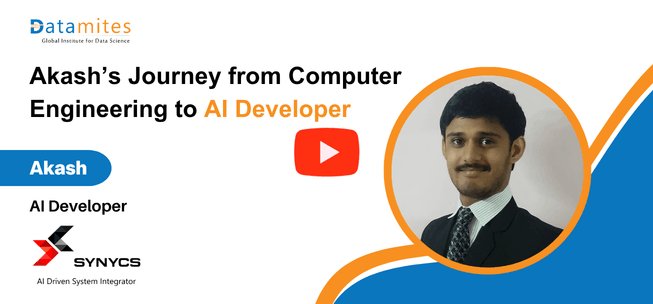
Akash’s journey shows how a computer engineering graduate can transition into an AI career with the right skills and guidance. It highlights the importance of practical learning, hands-on projects, and structured training in becoming a successful AI developer.
 Priyanka BR
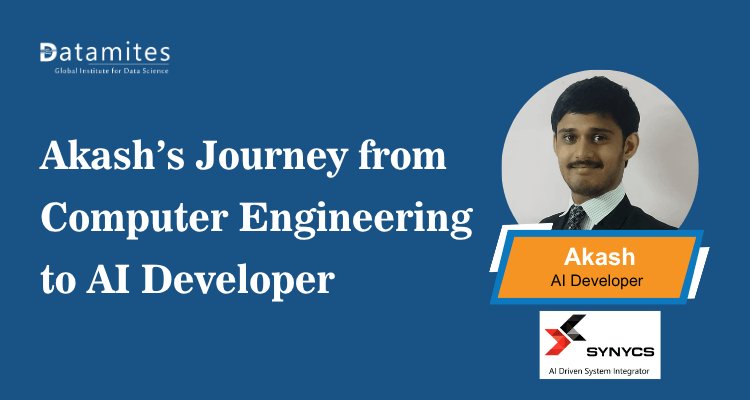
Have you ever wondered how a fresher with a computer engineering background can step into an AI Developer role in today’s competitive market? Meet Akash, who transformed his interest in Artificial Intelligence into a successful career by following the right learning path, staying consistent, and making the most of expert guidance.
His journey required focus and persistence. From strengthening his understanding of machine learning and core concepts to building multiple real-world projects, Akash worked continuously to turn his skills into practical expertise. The turning point came when he joined DataMites, where a structured and hands-on learning approach helped him bridge the gap between theory and real-world application.
If you are aiming to start your career as an AI Developer, Akash’s journey clearly shows how consistent effort, project-based learning, and the right mentorship can help you move from learning to landing your first job in Artificial Intelligence.
How DataMites Helped Akash Start His AI Career as an AI Developer
Akash’s journey highlights how a Computer Engineering graduate developed a strong interest in Artificial Intelligence, built practical skills through hands-on learning at DataMites, and successfully began his career in Artificial Intelligence as an AI Developer.
Q1. Can you introduce yourself and your background?
My name is Akash, and I completed my BE in Computer Engineering from JSPM Technical Campus. During my studies, I developed a strong interest in Data Science and Artificial Intelligence, which motivated me to pursue a specialized course in this field.
Q2. Why did you choose Data Science and AI as a career?
I was always curious about how intelligent systems work and how data can be used to make decisions. The growing demand for AI professionals also influenced my decision, but my main motivation was a genuine interest in the field.
Q3. When did you complete your Data Science and AI course?
I completed my Data Science and AI course in May 2025 from DataMites. After that, I started focusing completely on improving my skills and preparing for job opportunities. The structured learning and hands-on approach during the program really helped me build a strong foundation.
Q4. When did you get your first job offer?
I received my job offer in February 2026, and I joined shortly after. Currently, I am working as an AI Developer at Synycs. It was a great moment for me because all my efforts finally paid off, and starting my career in the AI domain with this role has been a very rewarding experience.
Q5. Did you have any programming knowledge before starting?
Yes, since I come from a Computer Engineering background, I already had some experience with Java, Python, HTML, and CSS. This helped me understand concepts faster during the course.
Q6. What did you learn during your AI program?
During my program at DataMites, I learned Machine Learning, Python, and SQL in depth. These are very important because they form the base for advanced AI concepts like Deep Learning, LLMs and SLMs. The way concepts were taught, along with practical implementation, made it easier for me to apply them in real projects.
Q7. How was your experience with statistics?
I didn’t find statistics very difficult because I had basic knowledge from my academic background. Also, the way it was taught during the course made it easier to understand and apply.
Q8. What kind of projects did you work on?
I worked on multiple Machine Learning projects covering regression, classification, and clustering. In total, I completed more than 15 projects, including several capstone and client projects.
Q9. Did you build end-to-end projects?
Yes, I made sure all my projects were end-to-end. I handled everything from data cleaning to model building and finally deployment using Flask and AWS. This helped me gain practical experience.
Q10. What did you do after completing the course?
After the course, I focused on advanced AI topics like LLMs, RAG, and deep learning. I used online resources like YouTube, and also took guidance from my mentors whenever I had doubts.
Q11. How important are LLMs in today’s industry?
LLMs are extremely important right now. I focused on learning how to use APIs, integrate them into applications, and build AI-based solutions. These skills are very useful in real-world projects.
Q12. How many interviews did you attend?
I attended around four interviews before getting selected. In the beginning, I faced rejections, but I learned from my mistakes and improved with each attempt.
Q13. What kind of questions were asked in interviews?
Most interviews focused heavily on Machine Learning concepts. I was frequently asked about overfitting, bias-variance tradeoff, and hyperparameter tuning. Questions on data preprocessing, PCA, and model deployment were also common.
Q14. What was your daily study routine?
I focused on understanding concepts during classes and cleared my doubts immediately. After that, I practiced coding, revised concepts, and also prepared common interview questions regularly.
Q15. What advice would you give to beginners?
From my experience, just completing a course is not enough. You need to practice consistently, work on multiple projects, and keep exploring new technologies. Revision and continuous learning are very important if you want to succeed in this field.
Refer to these articles:
- CrewAI vs. AutoGen vs. LangGraph: Which multi-agent framework should you learn in 2026?
- What is Artificial Narrow Intelligence?
- What Are Graph Neural Networks? Simple Guide for Beginners
Key AI Career Insights from Akash’s Journey at DataMites
Akash’s journey reflects a practical and focused approach to building a career in Artificial Intelligence and Data Science. His experience also shows how choosing the right IT courses in Pune can shape a strong career path. It offers clear takeaways for learners aiming to enter this field with confidence and the right strategy:
- Akash’s progress shows that building a strong foundation in machine learning, Python, and SQL is essential, as these core skills supported his transition into advanced AI concepts like deep learning and LLMs
- His journey highlights that having a computer engineering background and prior exposure to programming can significantly speed up the learning process and improve understanding of complex topics
- He demonstrated that working on a high number of projects creates a strong portfolio, as completing more than 15 projects, including capstone and client projects, helped him stand out to employers
- His experience proves that end-to-end project development, including data cleaning, model building, and deployment using tools like Flask and AWS, adds real industry value to a candidate’s profile
- Akash emphasized that continuous learning beyond the course is crucial, as he explored trending Artificial Intelligence tools and technologies like LLMs, RAG, and AI frameworks such as LangChain to stay aligned with industry demands
- His journey shows that mentorship and trainer support at DataMites played a key role in clearing doubts and guiding him during both learning and upskilling phases
- He demonstrated that learning from interview rejections is an important part of the process, as each attempt helped him identify gaps and improve his preparation strategy
- His preparation strategy highlights the importance of practicing Python coding, SQL queries, and revising machine learning concepts regularly to perform well in technical interviews
- Akash’s experience also shows that understanding fundamental concepts like overfitting, bias-variance tradeoff, and model deployment is critical, as these are commonly tested in AI and data science interviews
Overall, his journey proves that with structured learning, consistent practice, hands-on project experience, and the right guidance, it is possible for freshers to successfully start a career as an AI Developer and grow in the field of Artificial Intelligence
Refer to these articles:
- How a Fresher Can Become an AI Developer: Sahil’s AI Career Journey
- From Fresher to AI Developer: Rahul Wani’s AI Career Journey
- How Sivakumar Became an AI Engineer as a Fresher – AI Career Success Story
Akash’s journey shows that building a strong foundation in Data Science and Artificial Intelligence is achievable with the right strategy, consistent effort, and hands-on experience. After completing his Computer Engineering degree, he began his learning journey by enrolling in an Artificial Intelligence Course in Pune at DataMites. Through this offline program, he focused on developing strong skills in Python, machine learning, and data handling. With extensive project work, real-time applications, and continuous support from trainers, he was able to strengthen his technical abilities and gain the confidence needed to clear interviews and successfully start his career as an AI Developer.
DataMites Institute offers a well-structured 9-month Artificial Intelligence program designed to help learners build industry-ready skills through practical tools, real-time projects, and a strong focus on responsible AI practices. The course includes multiple specialized career pathways such as AI Engineer, AI Specialist, AI for Product Managers, AI Foundation, and Certified NLP Professional, allowing learners to choose a direction aligned with their goals. With globally recognized certifications from IABAC and NASSCOM FutureSkills, the program prepares learners with the practical knowledge and confidence needed to step into real-world roles in AI and machine learning.
With 30+ offline centers across India, DataMites makes AI learning accessible nationwide. If you are from Karnataka, exploring Artificial Intelligence Courses in Bangalore is a smart starting point. With its offline presence in Bangalore, DataMites offers hands-on training, real-time projects, and expert guidance to help you build a strong foundation and move confidently toward an AI career.