How a Fresher Can Become an AI Developer: Sahil’s AI Career Journey
A fresher’s journey into AI development becomes achievable with the right skills, guidance, and consistent practice, as shown through Sahil’s inspiring path. This story highlights how strategic learning and real-world exposure can transform beginners into confident AI professionals.
 Priyanka BR
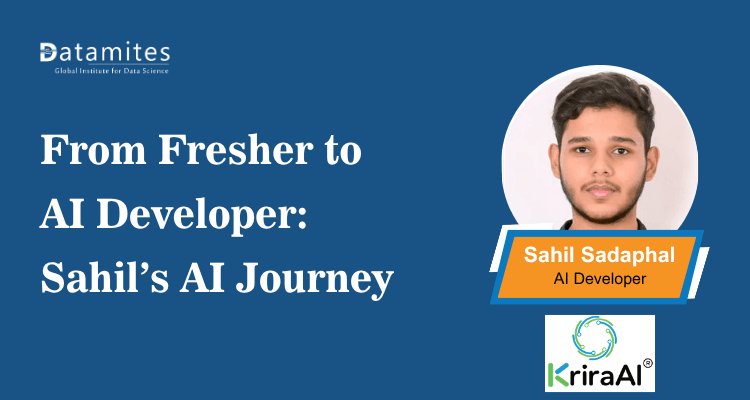
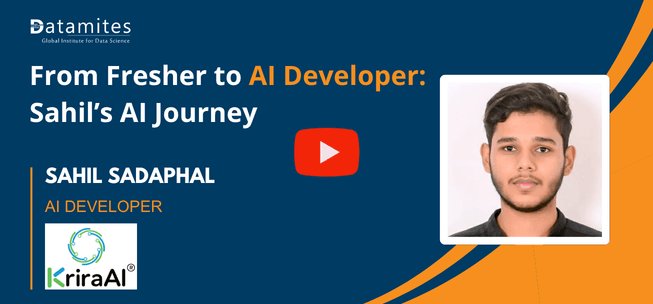
Sahil Sadaphal’s journey into the AI field reflects how a strong foundation and consistent effort can shape a successful career path. With a background in Computer Science, he made a focused decision after graduation to move into Artificial Intelligence and Data Science, choosing a path that required both technical depth and practical application.
While his programming knowledge gave him an initial advantage, mastering machine learning and deep learning concepts required dedication, long study hours, and continuous self-learning. Through hands-on projects during his internship, he strengthened his practical understanding and built the confidence needed to handle real-world problems. A key turning point in his journey was the structured training at DataMites, which helped him connect theoretical concepts with industry-level skills.
Sahil’s story highlights how the right learning approach, combined with project experience and consistent practice, can help aspiring professionals build a strong career in Artificial Intelligence and Data Science.
How Sahil Built His Career as an AI Developer with DataMites Institute
Breaking into the AI field requires the right combination of technical knowledge, practical exposure, and consistent effort. Sahil Sadaphal’s journey shows how structured training at DataMites, along with hands-on projects and continuous self-learning, helped him build a strong foundation in machine learning and deep learning, ultimately preparing him for a successful career in the AI domain.
1. Can you introduce yourself?
I am Sahil Sadaphal. I completed my graduation in 2023, after which I joined DataMites to pursue data science. During the course, I learned machine learning, deep learning, and statistics, which are essential for this domain. After completing the course, I did an internship at Rubixe, where I worked on real-time data science projects.
2. What did you do after completing your graduation?
After completing my degree in Computer Science, I enrolled in a Data Science course at DataMites, where I learned key concepts like machine learning, deep learning, and statistics. Along with that, I worked on real-time projects during my internship, which helped me build practical skills. Recently, I got placed as an AI Developer at KriraAI.
3. Did you have any prior programming experience?
Yes, I had a strong foundation. I completed a diploma in Information Technology and later pursued a degree in Computer Science, which gave me prior exposure to programming.
4. What motivated you to choose AI and Data Science as a career?
During my graduation, there was a lot of discussion around data being the future. That motivated me to explore this domain instead of traditional paths like web development.
5. How was your learning experience during the course?
Since I already had programming knowledge, my learning experience at DataMites was quite smooth. However, machine learning concepts were slightly challenging, so I had to invest extra time and effort to understand them better.
6. how many hours per day did you dedicate to studying?
I dedicated around 6 to 7 hours daily, especially while learning machine learning and deep learning concepts along with their mathematical foundations.
7. What kind of projects did you work on during your internship?
During my internship, I worked on:
- Insurance prediction project (regression)
- FIFA-based project
- Clustering Algorithm project using algorithms like K-Means and PCA
These projects strengthened my practical understanding.
8. Were projects important during interviews?
Interestingly, my AI Developer interview focused more on deep learning concepts rather than traditional machine learning or project discussions.
9. How did mock interviews help you?
Mock interviews were very useful. Initially, I was strong in theory but lacked hands-on skills in Python and SQL. After feedback, I improved and cleared the next round.
10. How did you prepare for AI interviews?
Preparation involved two key areas:
- Strong theoretical understanding (ML, DL, statistics)
- Hands-on coding practice (Python and SQL)
Both are equally important.
11. What kind of questions were asked in your AI Developer interview?
The interview focused heavily on deep learning topics such as:
- Forward and backward propagation
- Neural networks (ANN, CNN)
- RNN and LSTM concepts
- Regularization and batch normalization
- Transformer architecture and attention mechanism
12. What skills are essential to become an AI Developer?
Key skills include:
- Strong understanding of machine learning and deep learning
- Hands-on experience with Python and SQL
- Knowledge of neural networks, CNN, RNN, LSTM
- Understanding of advanced topics like transformers
- Building and showcasing projects on GitHub
13. How did you prepare your resume?
I created my resume using LaTeX tools and ensured it was ATS-friendly. I also reviewed it using online tools and AI platforms for improvement suggestions.
14. How difficult were the mock interviews?
Initially, they felt tough due to lack of hands-on practice. But after preparation, they became manageable. Consistency is key.
15. What advice would you give to freshers entering AI?
Focus on fundamentals, practice coding daily, and don’t hesitate to explore multiple learning resources. Also, only mention skills in your resume that you are confident about.
16. How was your overall training experience?
I completed the course at DataMites in an online mode, and my overall training experience was very good. The trainers explained the concepts clearly, and they used to solve our doubts during the sessions, which made the learning process smooth and effective.
Refer to these articles:
- Generative AI and Predictive AI: Key Differences Explained
- Supervised vs. Unsupervised Learning: What’s the Difference?
- What is a Confusion Matrix in Machine Learning?
Sahil Key Takeaways on Launching an AI Developer Career with DataMites Institute
His journey highlights how a learner with a programming background can successfully transition into the Artificial Intelligence field through structured training at DataMites, hands-on internship projects, consistent self-study, and focused preparation in both theory and practical skills.
- Sahil Sadaphal completed his graduation in 2023 and transitioned into the AI and data science domain immediately after.
- He enrolled in a Data Science course at DataMites, where he built a strong foundation in machine learning, deep learning, and statistics.
- Prior programming knowledge helped him learn concepts faster, but machine learning required additional effort and self-study.
- Consistent study of around 6 to 7 hours daily played a crucial role in mastering complex topics.
- He supplemented course materials with external resources like books and online content to strengthen his understanding.
- Hands-on internship experience at Rubixe, working on real-time projects, significantly improved his practical skills.
- Projects in domains like insurance prediction and clustering enhanced his resume and confidence.
- Mock interviews helped identify gaps, especially in Python and SQL, which he improved through focused practice.
- Strong theoretical knowledge combined with practical coding skills is essential to crack AI and data science interviews.
- Deep learning concepts such as CNN, RNN, LSTM, and transformers are critical for AI Developer roles.
- Self-learning played a major role in gaining advanced knowledge beyond the course curriculum.
- Building and showcasing projects is important for standing out in interviews.
- Resume preparation should be ATS-friendly and highlight only confident skills.
- Online interviews are now the standard hiring method in the industry.
- Continuous learning and adaptability are necessary, as the AI field is constantly evolving.
Refer to these articles:
- From Mathematics Graduate to AI Engineer: Sumit’s AI Success Story
- How Shubham Cracked Two AI Engineer Job Offers as a Fresher
- Can Switching Careers Lead to an AI Engineer Role? Avatansh’s AI Career Success Story
Sahil Sadaphal’s journey clearly reflects how the right combination of structured learning, consistent practice, and real-world exposure can shape a successful career in Artificial Intelligence. From building a strong foundation in machine learning and deep learning at DataMites to gaining hands-on experience through internship projects, he steadily developed both technical depth and practical confidence.
His ability to identify gaps, improve through mock interviews, and focus on both theory and coding played a key role in his progress. This journey serves as a practical example for aspiring professionals, especially those exploring opportunities like an Artificial Intelligence Course in Surat, that with the right guidance, disciplined effort, and continuous learning, transitioning into an AI Developer role is an achievable goal.
DataMites Training Institute offers a comprehensive 9-month Artificial Intelligence program focused on building job-ready skills through hands-on tools, real-time projects, and ethical AI practices. Recognized as a Top IT Course, it provides multiple career tracks such as AI Engineer, AI Specialist, AI Foundation, and NLP, helping learners choose the right path. With certifications from IABAC and NASSCOM FutureSkills, the program prepares learners for real-world AI and machine learning roles.
DataMites Institute offers strong placement support with mock interviews, resume building, and career guidance to help learners become job-ready. While Sahil chose online learning for flexibility, offline classroom options are also available. For learners from Gujarat, DataMites provides Artificial Intelligence Training in Ahmedabad, ensuring quality training with direct support for building an AI career.
DataMites also has a strong offline presence across 30+ cities in India, making quality AI education accessible to learners nationwide. Along with Ahmedabad, DataMites Institute offers programs in major tech hubs such as Artificial Intelligence Course in Hyderabad, Bangalore, Pune, Chennai, Mumbai, Coimbatore, and Delhi, giving learners the flexibility to choose their preferred location while receiving consistent, industry-relevant training.