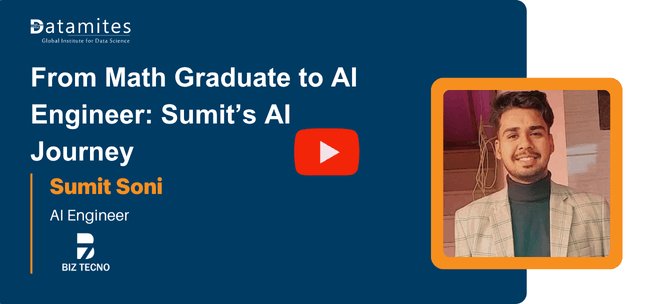
From Mathematics Graduate to AI Engineer: Sumit’s AI Success Story
A mathematics graduate, Sumit leveraged his analytical skills to transition into AI engineering, mastering key tools and technologies along the way. His journey highlights how dedication and continuous learning can turn a non-traditional background into a successful AI career.
 Priyanka BR
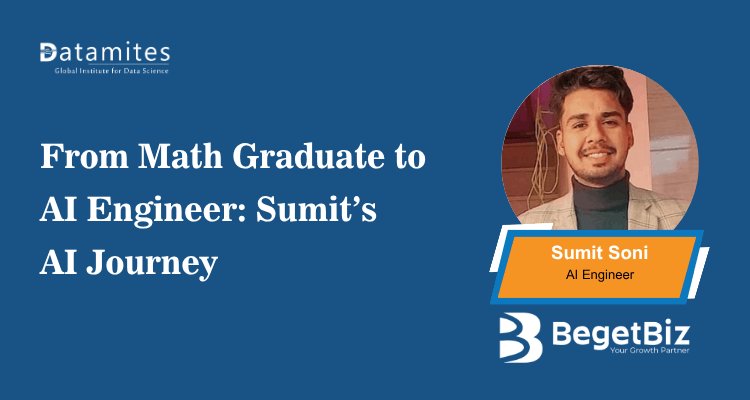
Have you ever wondered how a fresher can break into the AI industry despite no technical background and communication challenges? Meet Sumit, who turned his curiosity about Artificial Intelligence into a career through consistency and the right guidance.
Coming from a rural background, he initially struggled with both technical concepts and English communication. However, through continuous practice, mock interviews, and real-world exposure, he gradually built confidence.
The turning point was structured, hands-on learning at DataMites, where he developed practical skills and improved professionally. His journey proves that with consistent effort and the right direction, anyone can build a successful career in AI.
How Sumit Started His AI Career as an AI Engineer with DataMites
Sumit’s journey highlights how a mathematics graduate from a rural background discovered his interest in Artificial Intelligence through tools like ChatGPT, built strong practical skills through structured training at DataMites, and successfully launched his career as an AI Engineer.
1. Can you introduce yourself and your background?
I come from Rajasthan and completed my bachelor’s degree in Mathematics. After graduation, I moved to Bangalore to pursue a career in Data Science, where I started learning machine learning, deep learning, and how data is processed in real-world applications.
2. What inspired you to choose Data Science and AI?
In 2022, I came across AI tools like ChatGPT, and I was amazed by how they understand and respond to human language. That curiosity pushed me to explore how these systems work, which eventually led me into Data Science, especially Natural Language Processing.
3. How did you manage your daily study routine?
I followed a strict schedule and woke up at 4:00 AM because that’s when I could focus the most. In the morning, I spent around two hours understanding theoretical concepts like machine learning algorithms, and later in the day, I dedicated four to five hours to practical work such as coding and building projects. Overall, I studied for around six to seven hours daily, keeping in mind the growing demand for IT courses and AI skills in the industry.
4. Where did you get placed and what role did you secure?
After completing my training at DataMites, I got selected as an AI Engineer at BegetBiz. This opportunity allowed me to apply my skills in real-world AI applications, including building intelligent systems and working on practical machine learning solutions, marking a strong start to my career in the AI field.
5. What role does ATS play in resume selection?
I learned that most companies use ATS systems to filter resumes before they reach HR. So, if your resume doesn’t contain the right keywords, it may get rejected automatically. That’s why optimizing the resume based on the job description is very important.
6. What kind of projects did you work on?
I worked on both NLP and Computer Vision projects.
I built chatbots that can interact with users in real time and even integrate with platforms like WhatsApp. I also developed a computer vision project for detecting diseases in rice crops, which can help farmers identify issues early.
7. Which domain interests you more: NLP or Computer Vision?
I am more interested in Natural Language Processing because I’m fascinated by how language models work and how AI can understand human communication.
8. What types of questions were asked in your interview?
The interview had three rounds.
In the first round, I was asked about my background and why I chose AI. In the technical round, most questions were about building chatbots, handling real-time data, and concepts like RAG and agentic AI. They also asked detailed questions about my projects.
9. How did you prepare for interviews?
I focused mainly on my projects and concepts. I made sure I understood everything I had built because interviewers often go deep into your project work rather than asking only theoretical questions.
10. How many mock interviews did you attend and why?
I attended around six to seven mock interviews. My main challenge was communication skills, especially speaking in English confidently. Mock interviews helped me improve how I present my answers and communicate with interviewers.
11. What was your biggest challenge during your journey?
My biggest challenge was communication. Coming from a rural background, I was not very confident in speaking English. Even though I was strong technically, I struggled to express my thoughts clearly in interviews.
12. How did you overcome your communication barrier?
I practiced consistently through mock interviews and by speaking regularly. Over time, I became more comfortable expressing my thoughts, which improved my overall performance in interviews.
13. What was your experience with internship and placement support?
I had a very good experience. I regularly received job opportunities and guidance before interviews. Whenever I lacked a skill required for a role, I was given support sessions to improve quickly before the interview.
14. What advice would you give to beginners in Artificial Intelligence?
Focus on consistency and don’t look for shortcuts. Build strong fundamentals, work on real projects, and practice regularly. Also, don’t ignore communication skills because they are equally important as technical knowledge.
Refer to these articles:
- Reinforcement Learning: Basics and Applications
- What is the Difference Between AI Engineer and AI Expert Course?
- What is an AI Agent? Guide to Intelligent Agents in AI
Sumit’s Key Takeaways on Building an AI Career with DataMites Institute
His journey highlights how consistency, practical exposure, and the right mentorship can help anyone break into the Artificial Intelligence field—even from a completely non-technical or rural background.
- Background: Sumit comes from a village in Rajasthan and completed his graduation in Mathematics. With limited exposure to technology initially, he later decided to explore opportunities in the AI and Data Science domain.
- Career Transition Decision: After discovering AI tools like ChatGPT, he developed a strong interest in how intelligent systems work. This curiosity motivated him to move to Bangalore and pursue structured learning in Data Science.
- Learning Foundation: Through his training, he built a solid understanding of machine learning, data processing, and core AI concepts, which became the backbone of his technical journey.
- Interest in Emerging AI Fields: He developed a keen interest in Natural Language Processing (NLP), especially in understanding how large language models and conversational AI systems function.
- Structured Learning Approach: He followed a disciplined daily routine, balancing theoretical learning with hands-on practice, which helped him strengthen both conceptual clarity and technical skills.
- Project-Based Learning: He worked on real-world projects, including chatbot development and computer vision applications like crop disease detection, which enhanced his practical knowledge.
- Resume and Job Strategy: He learned to tailor his resume according to job descriptions and optimize it for ATS systems, improving his chances of getting shortlisted.
- Interview Preparation: He actively participated in multiple mock interviews to improve both technical performance and communication skills, especially overcoming challenges in English speaking.
- Career Breakthrough: After completing his training at DataMites, he secured a role as an AI Engineer at BegetBiz, marking the beginning of his professional journey in AI.
- Key Lesson: His journey proves that with consistent effort, practical implementation, and the right guidance, anyone can successfully build a career in Artificial Intelligence, regardless of their starting point.
Refer to these articles:
- How Shubham Cracked Two AI Engineer Job Offers as a Fresher
- Can Switching Careers Lead to an AI Engineer Role? Avatansh’s AI Career Success Story
- How Mahesh Transitioned into an AI/ML Engineer Role After Working as an Embedded Engineer
Sumit’s journey clearly demonstrates that success in the AI field is not determined by where you start, but by how consistently you work towards your goal. From building technical skills to improving communication and gaining real-world experience, every step played a crucial role in shaping his career. His experience shows that with the right mentorship, practical exposure, and a disciplined approach, anyone can confidently step into the world of Artificial Intelligence and build a strong, future-ready career.
Just like Sumit, if you’re from Rajasthan and looking to start a career in AI, DataMites offers industry-focused Artificial Intelligence courses in Jaipur designed to help you get started from scratch. With structured learning, hands-on projects, expert mentorship, and dedicated placement support, DataMites provides the right environment to develop job-ready AI and Data Science skills. Whether you’re a fresher or from a non-technical background, their training approach can help you confidently step into the AI industry.
DataMites Jaipur provides a comprehensive 9-month Artificial Intelligence program aimed at equipping learners with job-ready AI skills. The curriculum includes key topics such as Python programming, machine learning, deep learning, neural networks, TensorFlow, Keras, big data tools, cloud technologies, and ethical AI practices.
Recognized by IABAC and NASSCOM FutureSkills, the course is offered in both online and offline formats. It also features real-time projects, internship opportunities, and placement assistance, enabling students to gain practical experience and confidently enter the growing AI job market in Rajasthan.