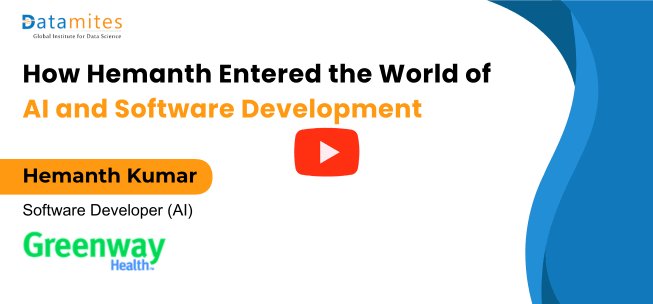
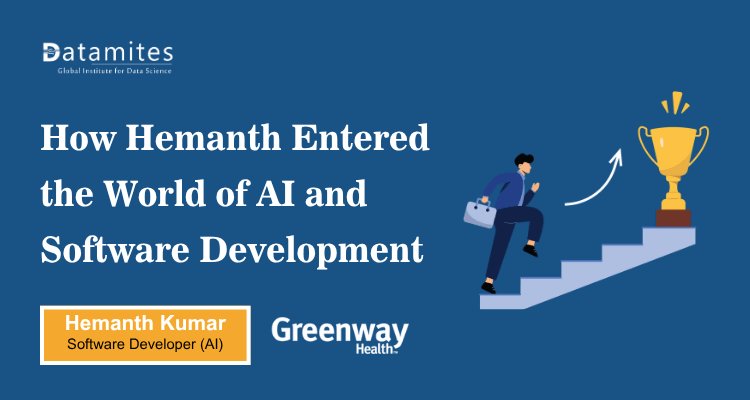
How Hemanth Entered the World of AI and Software Development
Hemanth began his journey into AI and software development during a career transition phase, building skills through structured learning, consistent practice, and real-world exposure to gradually grow as a developer.
 Priyanka BR
Have you ever wondered how someone can build a strong career in Artificial Intelligence and software development without a straight or planned path in the beginning? Meet Hemanth, who started his journey during the COVID period while figuring out his direction in the IT industry and improving his skills through structured AI training.
His journey wasn’t simple. From going back and strengthening core programming concepts to adapting to real-time project demands in the IT industry, Hemanth understood that steady progress, hands-on practice, and confidence in execution are what truly drive growth. The real shift happened when he joined structured AI training at DataMites, where he strengthened his foundation in Python and AI concepts and learned how to apply them in real industry scenarios.
After completing the training, he entered the IT industry as a software developer in the banking domain and later moved into a full-stack role in the healthcare sector, working with modern development practices and AI-integrated tools. His journey clearly shows how continuous learning and the right guidance can shape a successful and evolving career in AI and software development.
How DataMites Played a Role in Hemanth’s Artificial Intelligence Career
The IT industry has changed significantly with the rise of Artificial Intelligence tools in daily development work. Companies now expect skills beyond programming, including implementation, communication, problem-solving, and AI tools. In this alumni interaction, Hemanth shared his journey from learning Python basics to becoming a full-stack developer in the healthcare domain, along with insights on industry expectations and continuous learning.
1. Can you briefly introduce yourself and share your career journey?
I completed my Bachelor of Technology in Andhra Pradesh during the COVID period, when job opportunities were very limited for freshers. While searching for a career path in IT, I joined AI training at DataMites and learned Python basics along with AI concepts. Initially, I wanted to enter the AI field, but later I got an opportunity as a software developer in the banking domain. The skills I learned during training helped me clear interviews and adapt to real-time industry work quickly.
2. Why did you choose Python and AI?
I wanted to enter the IT industry, and Python with AI was one of the trending fields at that time. More than the technology itself, I focused on learning programming basics and logical thinking. Those fundamentals later made it easier for me to adjust and work with different technologies throughout my career.
3. Did learning AI and Data Science help you become a software developer?
Yes, definitely. Even though I later worked as a .NET developer, the concepts I learned during training helped me perform well in interviews and company training sessions. Theoretical and practical learning both helped me understand real industry expectations.
4. What was your first job role after training?
My first role was in a Pune-based company where I worked in the banking domain as a .NET developer. During the initial three-month training period, I was able to complete tasks quickly because I already understood the basics of programming Languages and implementation concepts.
5. What technologies did you work on in your first company?
I worked on .NET development, backend systems, SQL stored procedures, and banking-related applications. Even though I initially learned Python, I came to understand that programming concepts are similar across technologies. The implementation changes, but the logic remains almost the same.
6. What is your current role?
Currently, I am working as a Software Developer (AI) at Greenway Health India Pvt. Ltd.. My work involves frontend, backend, server-side development, and AI-integrated tools as part of my daily responsibilities.
7. How are AI tools changing software development today?
Earlier, developers depended a lot on seniors and team leads for guidance. If we did not understand a workflow, we had to wait for someone to explain it. Now, AI tools and coding agents can explain flows, generate code, and solve problems quickly. This saves a lot of time and improves productivity.
8. What AI tools are commonly used in companies now?
Nowadays, we use many AI tools like GitHub Copilot, Cursor, Gemini, ChatGPT, and Sonnet. Many people only know ChatGPT, but there are many other tools available in the market. Developers should explore different tools and understand how to use them effectively.
9. What is the difference between AI Ask tools and AI Agents?
Ask tools mainly provide responses or code based on prompts. Agents work more like humans. They can understand workflows, automate processes, and guide developers through tasks. Agents are becoming more advanced and useful in software development.
10. Why are programming basics still important in the AI era?
Even if AI generates code, developers still need to understand concepts like variables, polymorphism, encapsulation, and logical thinking. Without basics, people cannot properly use AI tools or understand whether the generated solution is correct.
11. What do interviewers expect from freshers today?
Interviewers mainly check confidence, implementation skills, and communication. Many students know theory but struggle to explain practical approaches. Companies want candidates who can confidently explain their understanding and solve problems.
12. Are marks important during interviews?
Marks alone are not enough. Sometimes students with average marks explain concepts better than toppers. Companies prefer candidates who can implement solutions, explain logic, and communicate confidently during interviews.
13. How can students improve their technical skills?
Students should not depend only on the institutes or teachers. Training institutes provide direction, but students must put their own effort into learning. There are many open source resources, YouTube channels, coding communities, and AI tools available for learning new technologies.
14. What advice do you have for freshers learning AI tools?
Freshers should start exploring AI tools immediately because technology changes very fast. Instead of spending too much time on unnecessary content online, students should spend time understanding what is happening in the IT industry and learning how modern AI tools work.
15. Are AI tools reducing software jobs?
Many people fear layoffs because of AI, but skilled people will always have opportunities. If someone has good technical knowledge, confidence, communication skills, and implementation ability, they can survive and grow in the industry.
16. What challenges exist in remote work environments?
The main challenge is communication. Sometimes people are unavailable or slow to respond. Developers must maintain good communication and teamwork even in remote environments.
17. Why are the first six months in IT important?
The first six months are very important because that is when freshers learn real-time implementation, workflows, and project handling. During this period, people understand how the company works and how teams collaborate.
18. Can Data Science learners move into AI or software development roles?
Yes, definitely. Whatever you learn initially becomes a path to enter the IT industry. Once you enter the company, they will train you based on business requirements and project needs. A Data Science learner can move into AI, backend development, frontend development, support roles, or many other domains.
Refer to these articles:
- What is Artificial Narrow Intelligence?
- Traditional AI vs Generative AI: Key Differences, Examples, and Use Cases
- What Are Graph Neural Networks? Simple Guide for Beginners
Hemanth’s Key Takeaways on Building a Career in AI and Software Development
His journey shows how strong fundamentals, consistent learning, and practical exposure can help build a stable career in Artificial Intelligence and modern software development.
- Background: Hemanth completed his Bachelor of Technology in Andhra Pradesh during the COVID period, when opportunities were limited, and his career direction was unclear.
- Career Start: He began his IT journey by joining AI training at DataMites, where he learned Python basics and foundational AI concepts.
- Learning Phase: Through structured training, he worked on building strong programming fundamentals, improving problem-solving skills, and gaining practical, real-world implementation experience.
- Technical Exposure: He gained exposure to core development concepts that later helped him adapt to different project requirements in the IT industry.
- First Industry Role: He started working as a software developer in the banking domain, where he handled backend development and .NET-based applications.
- Career Growth: He later moved into a full-stack role in the healthcare domain, working across frontend, backend, server-side development, and AI-integrated tools.
- Tools & Technologies: His work involved modern development environments along with AI tools and coding assistants used in daily software development.
- AI Integration: He adapted to the growing use of Artificial Intelligence tools like coding assistants and agents that support faster development and workflow automation.
- Skill Growth: Continuous learning helped him improve adaptability, technical confidence, and real-time problem-solving in different domains.
- Advice for Learners: He emphasizes that basics, consistent practice, and confidence in implementation matter more than just theoretical knowledge.
- Outcome Summary: His journey reflects how structured learning, practical exposure, and continuous upskilling can help build and grow a successful career in Artificial Intelligence and software development.
Refer to these articles:
- Manikanta’s Career Transition into Software Python Developer
- How Vitchco Raj Built a Successful Career in Artificial Intelligence
- How Khushi Became a Lead ML Engineer in the AI Industry
If you are also looking to build a strong career like Hemanth in Artificial Intelligence and software development, the right guidance and structured learning can make a big difference. To gain these skills effectively, choosing the right institute plays an important role. If you are someone looking for the best AI course in Andhra Pradesh, DataMites offers a structured Artificial Intelligence Course in Hyderabad designed to help you build strong programming fundamentals, gain hands-on project experience, and get practical exposure to real-world AI tools and technologies.
DataMites Institute offers a structured 9-month Artificial Intelligence course focused on building job-ready skills through practical training, real-time projects, and hands-on tools. The program is designed in line with the growing demand for IT courses and skilled professionals in the AI and IT industry, helping learners gain industry-relevant knowledge. It opens up career opportunities such as AI Engineer, AI Specialist, and NLP Professional. With globally recognized certifications from IABAC and NASSCOM FutureSkills, the course equips learners with practical exposure and the confidence needed to succeed in today’s competitive AI and technology sector.
DataMites has built a strong network of 30+ offline training centers across India, making Artificial Intelligence education easily accessible for learners. With centers in major locations like DataMites Bangalore, Chennai, Pune, Mumbai, Ahmedabad, Coimbatore, and Delhi, students can choose a convenient learning location. This presence supports structured training, hands-on projects, and industry-focused learning to help build strong careers in Artificial Intelligence.