How to Become an Artificial Intelligence Engineer in South Africa?
Learn how to become an artificial intelligence engineer in South Africa, including essential skills, learning paths, career opportunities, job prospects, and salary expectations. Discover the technologies to learn and practical steps to prepare for a career in AI engineering.
 Swagatam Sinha

Have you ever wondered how the apps you use every day recognize your voice, recommend products, or answer questions in seconds? Behind many of these features are AI engineers who build and develop intelligent systems. As South African businesses explore AI to improve customer service, analyze data, and automate routine tasks, the role is becoming an interesting career option for people with technical and problem-solving skills.
But how do you get started in AI engineering? Which skills should you learn, what jobs can you apply for, and how much can you earn in South Africa? This guide explains the steps to becoming an AI engineer, the technical skills employers look for, and the career opportunities and salary prospects you should understand before choosing this path.
What Does an AI Engineer Do?
AI engineers develop software that helps businesses solve practical problems. In South Africa, their work can involve helping banks detect suspicious transactions, enabling retailers to recommend products, or building tools that process documents automatically.
Their responsibilities include preparing data, developing and testing machine learning models, and connecting them to applications. They also monitor existing systems and make improvements when needed.
For example, an AI engineer in Johannesburg might build a system to identify unusual banking transactions, while someone in Cape Town could develop product recommendation tools for an online store.
Key Responsibilities of an AI Engineer
Developing applications: Building software for tasks such as fraud detection, image recognition, and customer support.
Working with data: Cleaning and organizing data to ensure it is suitable for model development.
Testing solutions: Checking results, identifying errors, and improving performance.
Connecting systems: Integrating models with websites, databases, and business applications.
Maintaining applications: Monitoring performance and updating systems when requirements change.
AI engineers often work with software developers, data analysts and business teams. Their main responsibility is to build reliable solutions that address real business needs.
The Global Demand for AI Engineers: Trends and Opportunities
AI engineering is becoming relevant across industries as companies invest in software that can analyze information, automate routine work and support business decisions. According to PwC’s 2026 Global AI Jobs Barometer, which analyses more than one billion job advertisements across six continents, skills requirements are changing rapidly in roles exposed to AI. This creates opportunities for engineers who can develop, test, and maintain practical AI applications.
Opportunities Across Global Markets
The demand for AI skills varies by country, but several markets offer relevant opportunities. In the United States, technology companies and financial institutions develop AI products and business applications. India has a growing technology services sector, with multinational companies expanding their AI and software development operations. Singapore supports AI adoption across financial services and digital businesses, while Germany offers applications in manufacturing, engineering, and industrial automation.
Research from SHRM published in September 2026 found that AI skills appeared in an average of 28.5% of IT and computer science job postings in the United States, the highest share among the 27 countries studied. This reflects demand for AI-related expertise across technical roles, though it does not represent AI engineer vacancies alone.
Global Market Outlook and Emerging Technologies
The Business Research Company estimates that the global AI market will reach USD $317.85 billion in 2026 and USD $919.62 billion by 2030. As adoption expands, skills in Python, machine learning, generative AI, APIs and cloud deployment can help aspiring engineers prepare for evolving employer requirements. Checking job listings in target markets can also help identify the most relevant skills to learn.
Refer to these articles:
- How AI Engineer Programs Develop Practical Skills for Career Advancement
- Data Scientist vs ML Engineer vs AI Engineer: Which Career Path Is Right for You?
- Essential AI Skills for Healthcare Professionals
Is AI Engineering a Good Career Choice in South Africa?
AI engineering can be a promising career option in South Africa for people interested in coding and solving practical problems. Banks use AI for fraud detection, retailers improve product recommendations, and healthcare organizations explore AI for analyzing medical information.
According to MarketsandMarkets, South Africa's AI market is projected to grow from USD 1.34 billion in 2026 to USD 6.77 billion by 2031, at a CAGR of 26.1%. However, market growth does not guarantee a similar increase in AI engineering jobs.
As demand for AI skills develops, companies across finance, retail, healthcare and technology are exploring ways to apply AI to their operations.
AI Engineering Opportunities Across South African Cities
Johannesburg and Sandton offer potential opportunities in banking, fintech and enterprise software, while Cape Town has technology companies and startups working on digital products and automation. Pretoria is worth exploring for technology and research-related roles. In Durban and Gqeberha, manufacturing, logistics and industrial operations may offer applications for AI and predictive analytics.
Learners based in Gauteng can compare artificial intelligence courses in Johannesburg to find programs that match their technical background and career goals.
Vacancies may appear under titles such as AI engineer, machine learning engineer, AI developer or Python developer. Candidates should review current job listings to understand employer requirements.
Factors to Consider Before Choosing This Career
Programming skills: Learn Python and develop problem-solving abilities.
Continuous learning: Keep up with AI tools, frameworks, and development methods.
Qualifications and projects: Build a foundation in mathematics, computer science, or software engineering, supported by practical projects.
Location and opportunities: Compare vacancies across South African cities to identify relevant roles.
Career goals: Decide whether to focus on machine learning, AI application development, model deployment, or AI infrastructure.
Refer these articles:
- How to Become an Artificial Intelligence Engineer in Saudi Arabia
- How to Become an Artificial Intelligence Engineer in Australia
- How to Become an Artificial Intelligence Engineer in UK
Step-by-Step Guide to Becoming an AI Engineer
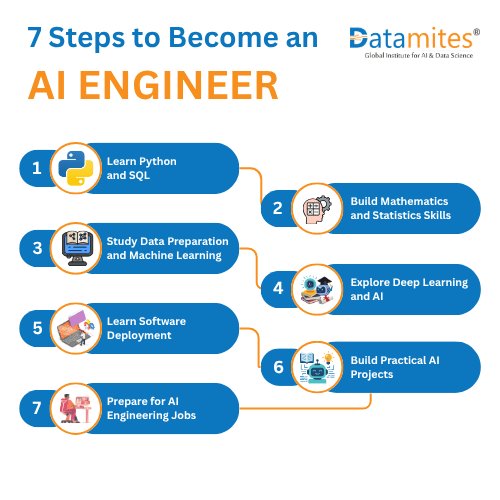
There is no single route into AI engineering. You can build the required skills through a university degree, independent projects, software development experience or structured training. The following steps provide a practical starting point.
Step 1: Learn Python and SQL
Start with Python fundamentals, including functions, loops, data structures, and error handling. Learn SQL to retrieve, filter and analyze data stored in databases.
Step 2: Develop Mathematics and Statistics Skills
Study probability, statistics, linear algebra, and basic calculus. These concepts help you understand how AI models learn, make predictions and measure performance.
Step 3: Learn Data Preparation and Machine Learning
Practise cleaning datasets, handling missing values and evaluating models. Start with regression, decision trees and classification using libraries such as pandas, NumPy and scikit-learn.
Step 4: Explore Deep Learning and AI Applications
Learn neural networks using TensorFlow or PyTorch. Then explore natural language processing, computer vision or generative AI based on your interests and career goals.
Step 5: Understand Software Deployment
Learn Git, GitHub, APIs and frameworks such as Flask or FastAPI. These tools help you integrate AI models into applications and understand how they are deployed and maintained.
Step 6: Build Practical Projects
Develop two or three projects, such as a demand forecasting model, customer message classifier, or image recognition application. Document your methods, results, and limitations, and publish your work on GitHub.
Step 7: Prepare for Job Applications
Explore entry-level roles such as junior AI engineer, AI developer or junior Python developer. Prepare a CV highlighting your technical skills and projects, and practice explaining your code and model evaluation results.
Which AI Technologies Should You Learn First?
The most useful learning sequence depends on your existing knowledge, but beginners can start with a core set of programming and data tools before moving to advanced applications.
A background in data science can help you understand statistical modelling and machine learning, while data analytics provides a foundation in data preparation, exploration and interpretation.
| Learning stage | Technologies and concepts | Main learning objective |
| Programming | Python, SQL, Git | Write code and work with databases |
| Data preparation | pandas, NumPy | Clean and explore datasets |
| Machine learning | scikit-learn | Train and evaluate predictive models |
| Deep learning | TensorFlow or PyTorch | Understand and build neural networks |
| AI specializations | NLP, computer vision, generative AI | Apply techniques to specific problems |
| Deployment | APIs, Flask or FastAPI, cloud platforms | Integrate models into applications |
Once these basics are clear, learners can explore large language models (LLMs), embeddings and retrieval-augmented generation (RAG).
Focus on building practical projects while learning data privacy, bias and AI reliability rather than simply collecting tools for your CV.
Refer the following articles:
- How to Become an Artificial Intelligence Engineer in India
- How to Become an Artificial Intelligence Engineer in Netherlands
- How to Become an Artificial Intelligence Engineer in Singapore
How Can Beginners Get Their First AI Job in South Africa?
Beginners can prepare for AI roles by developing technical skills, building projects and applying for relevant entry-level positions.
For learners who need flexibility alongside work or studies, online artificial intelligence courses in South Africa can provide an alternative way to develop technical knowledge and practice AI concepts.
Explore Entry-Level Roles
Look for junior Python developer, machine learning intern and AI developer positions. Johannesburg, Sandton and Cape Town are useful starting points for exploring technology and fintech opportunities.
Build a Project Portfolio
Create two or three projects using Python, data analysis and machine learning. Publish your code on GitHub and explain your approach and results.
Prepare for Interviews
Practise Python, SQL, statistics and machine learning fundamentals. Be ready to discuss your projects and connect with professionals through developer communities.
A course certificate does not guarantee employment. Practical skills, project experience and employer requirements influence hiring decisions.
AI Engineer Salaries and Career Growth in South Africa
AI engineer salaries in South Africa vary according to experience, technical specialization, employer, and location. Professionals with skills in machine learning, generative AI, Python, and cloud-based AI deployment may qualify for different salary levels depending on the role and the organization's requirements.
According to Glassdoor, the median total pay for an AI engineer in South Africa is approximately R925,000 per year. Its Johannesburg salary data reports the same median, with estimated base pay ranging from R700,000 to R978,000 annually and additional pay estimated at R100,000 to R200,000. These figures reflect reported compensation estimates and should not be treated as guaranteed earnings for every experience level.
In Johannesburg, Indeed reports an average annual salary of approximately R929,780 for AI/ML engineers, based on two reported salaries. Because the sample is small and covers a combined AI/ML job title, this figure should be treated as an indicative estimate rather than a standard salary for all AI engineers.
In Cape Town, Jobstore reports an average base salary of approximately R68,750 per month for artificial intelligence engineers. This is equivalent to R825,000 annually if the monthly rate remains consistent throughout the year.
These figures provide a reference for understanding AI engineering salaries in two major South African cities. However, they should not be compared as directly equivalent averages because the sources use different job titles and data collection methods. Actual earnings depend on experience, technical capabilities, job responsibilities, and employer requirements.
Career Growth for AI Engineers
AI engineers can progress into more specialized or senior roles as they gain practical experience and technical expertise.
Junior AI Engineer: Develops and tests AI models and applications under supervision.
AI Engineer: Builds, integrates and maintains machine learning and AI solutions.
Senior AI Engineer: Leads complex projects, improves model performance and guides technical decisions.
AI Architect or AI Lead: Designs AI systems and oversees implementation across projects or teams.
AI Engineering Manager: Manages engineering teams, project delivery and AI development strategy.
Career progression depends on practical experience, project outcomes, technical skills and leadership abilities.
Read the following articles:
How Professional AI Training Can Support Your Learning
Independent learning offers flexibility, but deciding which subjects to study first and how to apply theoretical knowledge can be challenging. A structured training program can help learners follow a clear learning path, practice technical skills and gain experience through projects.
Before enrolling, review the curriculum, duration, learning format, prerequisites and fees. Look for coverage of Python, statistics, machine learning, deep learning and deployment, along with opportunities to work on practical projects.
For learners seeking a flexible study schedule, online artificial intelligence engineer training can provide a way to develop technical knowledge while balancing work or other commitments.
Learners across Johannesburg, Cape Town, Pretoria, Durban and other South African cities can consider online training if attending a local program is inconvenient. Those exploring artificial intelligence courses in Cape Town or other locations should compare the curriculum, project work and learning schedule before making a decision.
DataMites Institute is a globally recognized training institute with more than 12 years of experience and over 200,000 learners worldwide. Its AI Engineer program covers Python, machine learning, deep learning, generative AI and cloud technologies, alongside live instructor-led training, an internship and real-time projects. Prospective learners can review the course details, fees and available learning formats to determine whether the program suits their learning goals.
Regardless of the training route you choose, consistent practice remains essential. Build projects, understand the decisions behind your models and learn how to test and deploy AI applications. These activities can help you develop practical skills that are relevant to AI engineering roles.
Becoming an AI engineer in South Africa requires a combination of programming knowledge, mathematical understanding, machine learning skills and practical experience. Starting with Python and SQL, progressing to machine learning and deep learning, and building a portfolio of projects can provide a clear path for beginners.
Explore job requirements across Johannesburg, Cape Town, Pretoria and other technology hubs to understand which skills employers expect. Compare salary estimates carefully, as earnings vary by experience, role and source methodology.
Whether you choose independent study, a university qualification or professional training, focus on applying what you learn to real problems. A strong technical foundation, consistent project work and a willingness to keep learning can help you prepare for opportunities in AI engineering.
Artificial Intelligence Career

Detecting Insurance Fraud Using Artificial Intelligence

Explained A/B Testing in Machine Learning