How AI Agents Are Changing Healthcare Operations
Explore how AI agents are transforming healthcare operations by automating administrative tasks, streamlining hospital workflows, improving patient coordination, and supporting faster decision-making to make healthcare services more efficient and effective.
 Prerana B A
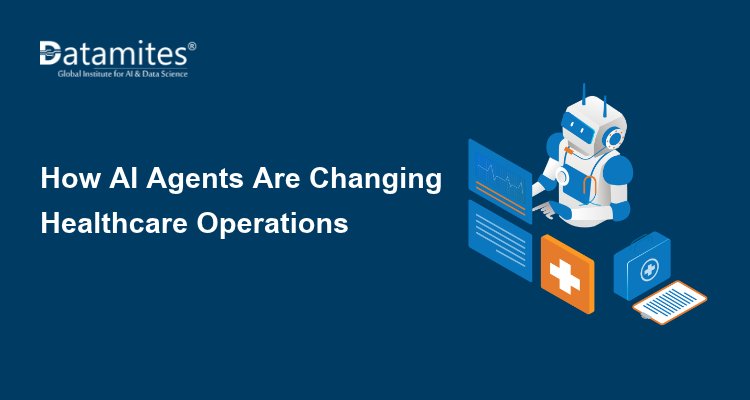
Healthcare organizations manage several activities every day, including patient appointments, medical documentation, staff coordination, resource planning and administrative workflows. Managing these activities efficiently is essential for providing timely services and reducing operational pressure.
AI agents in healthcare are helping hospitals and healthcare organizations manage these responsibilities by automating repetitive tasks, retrieving information and coordinating different workflows. Unlike traditional automation tools, AI agents can understand instructions, respond to changing situations and perform multiple connected tasks within defined boundaries. Their growing use is creating new opportunities for improving healthcare operations while keeping medical professionals involved in important decisions.
What Are AI Agents in Healthcare?
AI agents in healthcare are intelligent software systems that can understand tasks, process information, make decisions within predefined limits and perform actions to achieve specific objectives.
Traditional automation follows fixed instructions, while generative AI primarily creates content such as text and summaries. AI agents can combine these capabilities with tools, databases and connected applications to complete multi-step tasks.
For example, an AI agent receiving an appointment request could check available time slots, identify suitable departments, schedule an appointment and send a confirmation message. More advanced systems can coordinate multiple agents to manage different stages of a healthcare workflow.
This approach is commonly associated with agentic AI in healthcare, where AI systems work towards defined goals with varying levels of independence and human supervision.
How AI Agents Are Changing Healthcare Operations
AI agents are finding applications across administrative, operational and selected clinical support activities. Here are six important ways they can help healthcare organizations.
Appointment Scheduling and Patient Management
Managing patient appointments involves checking doctor availability, handling cancellations, sending reminders and responding to booking requests.
AI agents can automate these activities by connecting with hospital scheduling systems. They can identify available slots, process appointment requests, send reminders and help patients reschedule visits.
For example, when a patient cancels an appointment, an AI agent can identify the vacant slot and notify eligible patients according to hospital scheduling rules.
Medical Documentation and Administrative Tasks
Healthcare professionals spend considerable time preparing clinical notes, updating patient records and managing administrative documents.
AI agents can support documentation workflows by organizing information, summarizing approved records and preparing draft reports for professional review. They can also assist with routine data entry and document management.
These applications of AI healthcare automation can reduce repetitive administrative work and allow healthcare teams to focus more attention on patient-related responsibilities.
Healthcare Workflow Automation
Hospitals require coordination between departments such as reception, laboratories, radiology, pharmacies and billing.
AI agents can help coordinate routine activities, including patient registration, referral tracking, follow-up notifications and departmental updates.
For example, after a patient registration request is completed, an AI agent can trigger the next administrative steps, notify the relevant department and update the workflow status.
This type of healthcare workflow automation can help reduce delays caused by manual coordination.
Hospital Resource Management
Hospitals must manage resources such as medical equipment, hospital beds, staff schedules and treatment facilities.
AI-powered agents can analyze operational information and help administrators identify resource availability, scheduling gaps and potential workload challenges.
For instance, an AI agent may identify available beds based on updated hospital records and notify the admission team. Similarly, it can assist with staff scheduling by highlighting potential conflicts.
These capabilities can support better planning and resource utilization, although final operational decisions should remain with authorized personnel.
Patient Communication and Support
Patients regularly need information about appointment timings, hospital services, registration procedures, billing and follow-up visits.
AI agents can respond to routine questions through chat interfaces, messaging platforms and virtual assistants. They can also share approved information and direct patients to the appropriate hospital department.
For example, a patient asking about required documents for an appointment can receive an immediate response based on the hospital's approved guidelines.
However, medical symptoms, emergencies and treatment-related questions should be directed to qualified healthcare professionals.
Medical Data Management
Healthcare organizations generate large amounts of information through electronic health records (EHRs), laboratory systems, imaging platforms and administrative databases.
AI agents can retrieve, organize and summarize relevant information from connected systems, provided they have appropriate access permissions.
For example, an authorized hospital administrator could use an AI agent to retrieve department-level appointment information and prepare an operational summary.
These AI-driven healthcare systems can make relevant information easier to access while following data protection and confidentiality requirements.
What Are the Benefits of AI Agents in Healthcare Operations?
The adoption of AI agents can offer several operational advantages:
- Reduced administrative workload: Automating repetitive activities can reduce the time spent on routine documentation and scheduling.
- Faster workflows: AI agents can coordinate connected tasks and reduce delays in administrative processes.
- Improved departmental coordination: Automated notifications and workflow updates can support communication between hospital departments.
- Better patient communication: Virtual assistants can provide timely responses to common administrative questions.
- Efficient resource management: AI-supported insights can help administrators plan staff schedules, equipment and facility usage.
- Access to relevant information: Agents can retrieve and summarize authorized information from connected healthcare systems.
These benefits depend on implementation quality, system integration and the level of human supervision.
What Are the Challenges of Implementing AI Agents in Healthcare?
Despite their potential, AI agents introduce important challenges that healthcare organizations must address.
- Data privacy and security: Healthcare information is sensitive. Organizations need appropriate access controls, encryption, secure integrations and data protection practices.
- System integration: Connecting AI agents with existing hospital management systems and electronic health records can be technically challenging.
- Accuracy and reliability: AI-generated information may contain errors or incomplete details. Outputs must be checked before being used for important decisions.
- Regulatory compliance: Healthcare organizations must consider applicable data protection, medical software and healthcare regulations when implementing AI systems.
- Human oversight and accountability: AI agents should operate within clearly defined boundaries. Healthcare professionals and administrators must retain responsibility for decisions involving patient safety and critical operations.
The World Health Organization emphasizes the importance of privacy, transparency, accountability and human rights in healthcare AI governance.
What Is the Future of AI Agents in Healthcare?
The future of AI agents in healthcare is likely to involve greater coordination between specialized AI systems, hospital platforms and healthcare professionals.
Multi-agent AI systems could allow separate agents to manage scheduling, patient communication, documentation and resource coordination while sharing relevant information through controlled integrations.
A November 2026 study published in Scientific Reports explored an agentic AI system for hospital management, addressing operational challenges such as physician scheduling, patient waiting times and resource utilization. This reflects growing research interest in applying agentic AI to hospital administration.
Other developments may include AI-powered administrative assistants, deeper electronic health record integration and more personalized patient communication.
However, wider adoption will require reliable testing, continuous performance monitoring and appropriate human supervision. The WHO's September 2026 report on AI-related health research ethics also highlights the need for stronger oversight to address privacy, fairness, transparency and accountability.
AI agents in healthcare are creating new opportunities to improve hospital operations through appointment scheduling, administrative automation, patient communication, medical data management and resource coordination.
Although these systems can help reduce repetitive work and improve workflow efficiency, they should complement rather than replace healthcare professionals. With appropriate security measures, reliable integrations and human oversight, AI agents can become valuable tools for building more organized and efficient healthcare operations.
DataMites Institute offers industry-oriented AI for healthcare courses designed to help healthcare professionals understand AI fundamentals and explore their applications in patient care, hospital operations, and medical research. In addition to healthcare-focused programs, the institute offers specialized AI training in HR and People Analytics, Finance, Marketing, and Business Management.
Learners can choose from online training, classroom-based sessions, and project-oriented internships to gain practical exposure and develop industry-relevant skills. The healthcare program follows IABAC-aligned certification standards and leads to the Certified AI Professional in Healthcare & Clinical Operations credential. With 50+ offline centres across India, including Bangalore, Chennai, Hyderabad, Pune, Mumbai, Ahmedabad, Coimbatore, and Delhi, DataMites makes AI education accessible to healthcare professionals and individuals looking to build skills in this growing field.