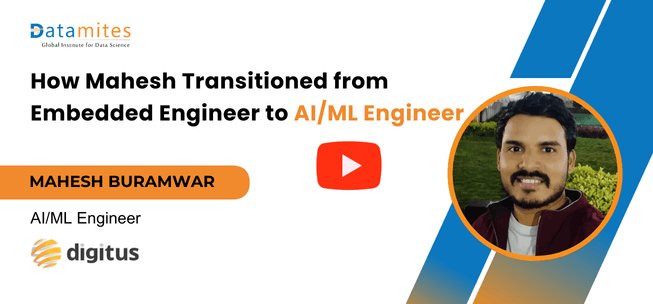
How Mahesh Transitioned into an AI/ML Engineer Role After Working as an Embedded Engineer
After working as an Embedded Engineer, Mahesh decided to shift his career toward the growing field of Artificial Intelligence and Machine Learning. His journey highlights how continuous learning, the right training, and determination helped him successfully move into an AI/ML Engineer role.
 Priyanka BR
Switching careers is never easy, especially when moving into a fast-growing field like Artificial Intelligence and Machine Learning. Mahesh from Maharashtra faced this exact challenge after working as an embedded engineer in Hyderabad and later spending time preparing for the UPSC civil services exams. As he explored his options during this phase, an important question naturally came up: what could be the next career move?
Rather than returning to his previous role, Mahesh began exploring opportunities in AI and Machine Learning, a field that was rapidly expanding with strong career potential. With the right mentorship and practical learning at DataMites, he started building the skills needed to step into the AI industry.
So, how did someone who once worked in embedded systems and prepared for UPSC eventually transition into the AI and ML field? His story will show you exactly how this career shift became possible and how the right guidance helped him turn ambition into achievement.
Mahesh’s AI/ML Career Journey with DataMites
This Q&A session explores Mahesh’s journey from working as an embedded engineer and preparing for the UPSC exam to successfully stepping into the world of artificial intelligence. It highlights his learning experience, skill development, project preparation, and the interview process that helped him secure a role in AI/ML.
1. Could you share a brief introduction about yourself?
Hi, my name is Mahesh, and I’m from Maharashtra. I completed my Electronics Engineering and initially worked as an embedded engineer in Hyderabad. Later, I decided to explore other career paths, including preparing for the UPSC civil services exams. After understanding the competitive nature of that path, I shifted my focus toward a career that offered better growth opportunities and aligned with my interests, which eventually led me to the field of Data Science and AI.
2. How did you discover AI as a career option?
While preparing for UPSC, I was simultaneously searching for courses that could lead to a stable career. I came across DataMites certification in Data Science and decided to enroll. That’s how I began my journey into AI and ML.
3. What was your first experience in the data science and AI field?
After completing the course at DataMites, I did an internship with TDD in Bangalore. This experience gave me practical exposure to machine learning projects and eventually helped me secure a role as an AI/ML Engineer at Digitus Business Solutions.
4. Why didn’t you return to embedded engineering after UPSC preparation?
Returning to embedded systems after a career gap is challenging. Electronics projects require continuous involvement, and a gap can make it difficult to catch up. Data science, on the other hand, offered high-growth opportunities and a conceptual learning curve that matched my skills.
5. What kind of projects did you work on during your internship?
I worked on projects involving RAG pipelines and agent-based frameworks. I also implemented a water leakage detection system and worked on unsupervised machine learning projects like restaurant clustering, sentiment analysis using NLP, and a question-answering system based on knowledge sources.
6. How did your prior coding experience help you in learning Python?
As an embedded engineer, I was familiar with C programming, which helped me understand coding fundamentals like data types and variables. Transitioning to Python was smooth because it is simpler and more intuitive for data science and AI applications.
7. Did any skills from UPSC preparation help you in AI?
Yes, the habit of reading extensively, taking notes, and understanding complex concepts greatly helped. It allowed me to grasp machine learning algorithms, build pipelines, and understand data thoroughly.
8. How many hours per day did you dedicate to learning and practice?
I dedicated around 3 to 4 hours daily after class sessions to practice on datasets. While theory is important, hands-on practice with real datasets is crucial to mastering data science skills.
9. What interview preparation strategy worked best for you?
The interview process involved multiple rounds: an MCQ test on Python, SQL, and ML concepts, a coding round with practical datasets, a technical discussion, and a final HR round. Preparing thoroughly on concepts and practicing coding logic was key to success.
10. Did you need to write actual code in interviews, or was logic sufficient?
For some rounds, writing full code wasn’t mandatory. Understanding the approach and logic, such as using isolation forest for anomaly detection or feature engineering, was more important than memorizing every import and function.
11. Which tools and technologies are you currently working with?
Currently, I’m working on domain-specific research and demo projects as part of my role. Previously, I handled RAG and agent-based frameworks for real-time intrusion detection systems, including automated alerts via SMS and email.
12. What advice do you have for freshers preparing for data science interviews?
Focus on both theoretical concepts and practical implementation. Practice with real datasets on platforms like Kaggle, understand supervised and unsupervised algorithms, feature selection, handling missing data, scaling, standardization, and building ML pipelines.
13. Any final thoughts for aspiring AI professionals?
Stay consistent, practice regularly, and focus on building a strong conceptual foundation. Tools and frameworks will evolve, but understanding the principles of machine learning and AI is what will sustain a long and successful career.
Refer to these articles:
- Reinforcement Learning: Basics and Applications
- What is the Difference Between AI Engineer and AI Expert Course?
- What is a Confusion Matrix in Machine Learning?
Mahesh’s Key Takeaways on Transitioning into an AI/ML Career with DataMites
His journey demonstrates how persistence, continuous learning, and practical exposure can help professionals successfully move into the rapidly growing field of Artificial Intelligence and Machine Learning.
- Background: Mahesh is from Maharashtra and completed his Electronics Engineering. He began his career as an embedded engineer in Hyderabad, where he gained early experience working with programming and technical systems.
- Career Redirection: After working for some time, he decided to leave his job to prepare for the UPSC civil services exams. During this period, he reassessed his career goals and started exploring technology roles with strong growth potential.
- Training Decision: While researching career-oriented programs, he enrolled in a Data Science certification course at DataMites to gain structured learning and practical exposure to AI and machine learning.
- Learning Foundation: The program helped him build knowledge in Python programming, data preprocessing, machine learning algorithms, and the process of developing complete machine learning pipelines.
- Programming Transition: Coming from an embedded systems background, he had experience with C programming. This foundation helped him adapt to Python and apply it effectively in data science projects.
- Project Experience: He worked on several projects, including RAG-based pipelines, agent-based systems, restaurant clustering using unsupervised learning, sentiment analysis using NLP, and a question-answering system built using knowledge sources.
- Industry Exposure: Through an internship opportunity in Bangalore, he gained practical experience working on modern AI frameworks and real-world data science applications.
- Interview Preparation: His preparation included strengthening concepts in Python, SQL, statistics, and machine learning while also practicing scenario-based problem solving.
- Career Breakthrough: After completing his training and internship, Mahesh secured a role as a Machine Learning Engineer, successfully transitioning into the AI industry.
- Key Lesson: His journey highlights that consistent learning, strong fundamentals, and hands-on project experience are essential for building a successful career in AI and machine learning.
Refer to these articles:
- How Did Preet from Surat Land His First AI Engineer Job as a Fresher?
- How Working Professionals Can Switch to an AI/ML - Mehvish’s AI Career Success Story
- How Prathmesh Cracked His First AI Engineer Job as a Fresher from Nagpur
Mahesh’s journey shows that transitioning into the field of Artificial Intelligence and Machine Learning is possible with determination, continuous learning, and the right guidance. After exploring different career paths, he chose to build his skills through a structured learning program at DataMites, where he gained hands-on experience in Python, machine learning, and real-world AI projects.
Through practical training, internship exposure, and consistent preparation, Mahesh built strong skills in AI and ML. With the growing demand for IT courses, he focused on hands-on learning and real-world projects, which eventually helped him secure a role as a Machine Learning Engineer.
DataMites Training Institute offers a 9-month Artificial Intelligence course designed to build strong, job-ready AI skills through practical tools, real-time projects, and responsible AI practices. The program includes specialized tracks such as AI Engineer, AI Expert, AI for Product Managers, AI Foundation, and Certified NLP Expert. With certifications accredited by IABAC and NASSCOM FutureSkills, DataMites provides hands-on learning to help students confidently start their careers in Artificial Intelligence.
Students looking to build AI careers in Maharashtra can enroll in an artificial intelligence course in Mumbai, where DataMites offers structured training, real-world projects, and practical learning through its classroom sessions to help learners develop strong industry-ready AI and ML skills.
Similarly, professionals aiming to enter the AI field can consider an AI ML course in Pune, where learners gain practical exposure to Python, machine learning concepts, and real-world projects. In Pune, DataMites offers offline training centers in Baner and Kharadi, making it convenient for students and working professionals to access classroom learning and hands-on guidance.