LLMs vs. SLMs: Key Differences and How to Choose the Right Model
Compare LLMs vs SLMs, explore their performance, costs, and use cases, and learn how to choose the best model for your AI projects in 2025.
 Swagatam Sinha
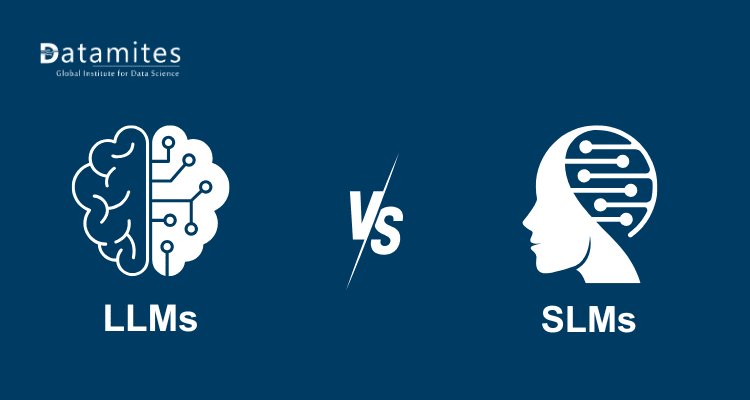
The rapid growth of language models has transformed how businesses automate workflows, enhance customer experiences, improve analytics, and streamline operations. Until recently, Large Language Models (LLMs) dominated the landscape due to their impressive capabilities and broad use cases. However, Small Language Models (SLMs) have emerged as a strong alternative for organizations seeking faster, more cost-efficient, and privacy-friendly solutions.
Understanding the difference between LLMs and SLMs is essential for choosing the right model especially as companies balance accuracy, cost, scalability, performance, and security. This guide explains their strengths, limitations, real-world applications, and how to evaluate which model fits your needs.
What Are LLMs?
Large Language Models are advanced models trained on massive datasets with billions of parameters. Their size allows them to understand context deeply, generate high-quality responses, and handle complex tasks across industries.
Strengths of LLMs
- High accuracy and detailed understanding
- Strong reasoning and problem-solving capabilities
- Versatile across multiple domains
- Excellent at generating long-form content
- Effective in technical, analytical, or creative tasks
Market Size and Growth
The global LLM market has seen rapid expansion:
- In 2024, the LLM market size reached approximately USD 14.2 billion. It is forecast to grow at a compound annual growth rate (CAGR) of ~35.7% through 2033, potentially reaching over USD 223 billion by the end of that period. [Source: Data intelo]
- Another report estimates growth from USD 6.34 billion in 2024 to USD 24.89 billion by 2029, with a 31.5% CAGR. [Source: The Business Research Company]
This growth reflects enterprise demand for automation, analytics, customer support systems, and content intelligence capabilities.
Enterprise Adoption Trends
Market data reveals widespread integration:
- Over 100,000 companies worldwide have deployed applications powered by LLMs.
- Around 57% of enterprises plan to integrate LLM tools into workflows within the next year.
- Nearly 73% of Fortune 500 companies use LLM-based productivity and analytics tools.
- Customer service bots powered by LLMs now handle approximately 25% of all enterprise support queries.
These figures demonstrate the breadth of adoption across sectors such as finance, retail, healthcare, and education.
LLMs Use Case Examples
- Content Generation: LLMs like GPT-4o generate long-form reports, summaries, and multilingual content with high contextual coherence.
- Customer Support: Multimodal LLMs can understand text, images, and audio to resolve complex customer issues.
- Software Development: Tools powered by LLMs (e.g., GitHub Copilot) assist developers with code generation and troubleshooting.
LLMs are particularly useful where complex reasoning, deep context understanding, and cross-domain tasks are priorities.
Refer to these articles:
- Traditional RAG vs Agentic RAG
- Green AI Guide: Quantization and FinOps to Reduce LLM Costs
- The Future of Coding: Can AI Replace Software Engineers?
What Are SLMs?
Small Language Models are compact models with a much lower parameter count. They are optimized for fast, lightweight, and resource-efficient performance often running directly on devices or edge environments.
Strengths of SLMs
- Lower compute cost
- Fast inference and reduced latency
- Suitable for devices with limited resources
- Strong privacy control as models can run locally
- Energy efficient and easier to deploy at scale
Market Forecasts and Growth
Market researchers project strong growth for the SLM segment:
- The SLM market was valued around USD 6.5–7.9 billion in 2024, with forecasts projecting growth to USD 29.6–29.64 billion by 2032 (CAGR ~15.8%). [Source: Globe News wire]
- Independent forecasts also estimate the market growing to approximately USD 22.76 billion by 2032 at a 19.3% CAGR.
- Deep learning-based SLMs alone generated roughly USD 6.5 billion in 2024, reflecting rapid adoption of smaller transformer-based models. [Source: Research and Markets]
This growth is driven by increasing demand for efficient, low-latency solutions and on-device AI.
Industry Trends of SLM
- SLM use in healthcare is accelerating, supporting clinical documentation automation, patient engagement systems, and privacy-compliant AI workflows.
- Consumer devices and edge computing platforms increasingly rely on SLMs to deliver real-time AI responses without cloud dependencies.
- Cloud deployment remains dominant, with around 55% of SLM usage occurring on cloud platforms, enabling scalable, cost-effective adoption.
SLMs are particularly compelling for organizations focusing on efficiency, lower infrastructure cost, and strong data privacy controls.
Read to these articles:
- Reinforcement Learning: Basics and Applications
- What is an AI Agent? Guide to Intelligent Agents in AI
- Generative Adversarial Networks (GANs): How are GANs Transforming AI?
LLMs vs. SLMs: Key Differences
Understanding the core differences between LLMs and SLMs helps businesses choose the right model for their specific needs.
1. Model Size
LLMs: 10B–100B+ parameters
SLMs: ~1B–3B parameters
Larger models provide deeper reasoning but require extensive hardware support.
2. Performance
LLMs generally offer richer and more accurate responses, while SLMs focus on efficiency.
- For tasks like deep analysis or multi-step reasoning, LLMs hold the advantage.
- For repetitive or simple tasks, SLMs are fast and reliable.
3. Speed and Latency
LLMs: Higher latency due to heavy processing
SLMs: Millisecond-level response times
SLMs often power mobile AI assistants and on-device applications where speed is critical.
4. Cost and Infrastructure
LLMs: Expensive to run, require GPUs or cloud infrastructure
SLMs: Far cheaper, run on CPUs or edge hardware
SLMs are ideal when businesses aim to reduce cloud spending.
5. Data Privacy
SLMs allow local execution, eliminating the need to send sensitive data to cloud servers. Industries like healthcare, banking, and government benefit from this model.
When LLMs Are the Better Choice
LLMs are ideal for tasks that require deep understanding, complex reasoning, and handling large volumes of information efficiently.
1. Complex Content Generation
Large product catalog descriptions, long-form reports, and technical documentation.
2. Enterprise Analytics
Analyzing financial reports, cybersecurity logs, supply-chain data, or business intelligence.
3. Customer Support at Scale
Handling diverse queries, multilingual support, and sentiment evaluation.
Industry Example:
A large insurance company uses LLMs to process claim descriptions, detect fraud indicators, and summarize claim history for faster approval cycles.
When SLMs Are the Better Choice
SLMs are ideal for scenarios that demand speed, efficiency, and strong data privacy without heavy computational resources.
1. On-Device AI
Running applications offline or with strict latency requirements.
2. Cost-Sensitive Deployments
When thousands of instances are required such as retail POS systems or IoT networks.
3. Privacy-Centric Use Cases
Healthcare devices, banking apps, and enterprise intranet applications.
Industry Example:
A manufacturing company uses SLMs on factory-floor devices to analyze machine data in real time, reducing downtime without relying on constant cloud connectivity.
Refer to these articles:
- Data Scientist vs ML Engineer vs AI Engineer
- Data Engineer vs Analytics Engineer vs Data Analyst
- Why Synthetic Data Is the Future of GDPR Compliance
How to Choose the Right Model
Use the following decision factors to guide your selection:
1. Determine Your Use Case
- Need high-accuracy reasoning? → Choose LLMs.
- Need speed and low cost? → Choose SLMs.
2. Evaluate Resource Availability
- Access to GPUs or high-compute cloud? → LLMs work.
- Limited compute or edge devices? → SLMs fit better.
3. Assess Privacy Requirements
- Sensitive data environments often require local inference → SLMs.
4. Consider Deployment Scale
- Large-scale enterprise deployments benefit from lightweight SLMs.
- Specialized departments with deep analysis needs benefit from LLMs.
5. Cost Analysis
Compare cloud cost, compute consumption, number of users, and scale. SLMs reduce infrastructure burden significantly when used at high volume.
Future Trends: Where LLMs and SLMs Are Heading
Emerging trends indicate how LLMs and SLMs will evolve, helping organizations leverage the right model for efficiency, scalability, and industry-specific needs.
- Hybrid Model Strategies: Many companies will use both, depending on task complexity.
- On-Device AI Growth: Smartphones, laptops, and edge hardware will increasingly rely on SLMs.
- Specialized Domain Models: Industry-specific models (finance, legal, healthcare) will gain popularity.
- Efficiency Optimizations: Both LLMs and SLMs will improve with quantization, distillation, and hardware acceleration.
As organizations move toward balanced AI deployment strategies, the divide between LLMs and SLMs will narrow, making both valuable depending on the specific business need.
LLMs and SLMs serve distinct but equally important roles in today’s AI landscape. LLMs excel in deep reasoning, complex tasks, and high-level content generation, while SLMs provide speed, cost efficiency, and privacy-friendly deployment. The right choice depends on your goals, infrastructure, budget, and operational needs.
Companies that strategically combine both approaches gain a competitive advantage scaling AI responsibly while optimizing performance, cost, and user experience.
At DataMites, we are committed to empowering professionals with the skills they need to succeed in emerging technologies. Our training programs focus on practical, industry-relevant learning that prepares students for real-world challenges.
Our Artificial Intelligence Courses in Chennai are designed to provide hands-on experience, expert guidance, and certification, helping learners master AI concepts and applications. At DataMites, we ensure every student gains the knowledge and confidence to advance their career in AI and data science.