Roadmap to Become an AI Product Manager
Discover the complete roadmap to become an AI Product Manager, including essential skills, tools, and strategies. Learn how to build expertise in AI, align business goals, and lead innovation in a rapidly evolving digital landscape.
 Kriti Maurya
Artificial intelligence is rapidly transforming industries, especially finance and decision-making. This shift highlights the importance of a roadmap to become an AI product manager. An AI Product Manager blends data science, machine learning, and business strategy to deliver impactful, value-driven AI product solutions.
The Product Design and Development market is expected to grow from USD 13.49 billion in 2025 to USD 14.27 billion in 2026, and further reach USD 18.61 billion by 2031, registering a CAGR of 5.45% between 2026 and 2031, according to Mordor Intelligence.
Understanding the Role of an AI Product Manager
AI Product Managers play a vital role in leading AI solutions, aligning technology with business goals, and driving data-driven decisions. They define product vision, translate algorithms into business value, and support digital transformation across industries. In 2026, AI’s growing impact especially in finance demands professionals skilled in strategy, data literacy, and ethical AI. With increasing reliance on automation, explainable AI, and data-driven strategies, the roadmap to become an AI product manager is essential for those aiming to lead innovation.
Step-by-Step Roadmap to Become an AI Product Manager
Embarking on the journey to become an AI Product Manager requires a strategic blend of product expertise, technical awareness, and real-world experience.
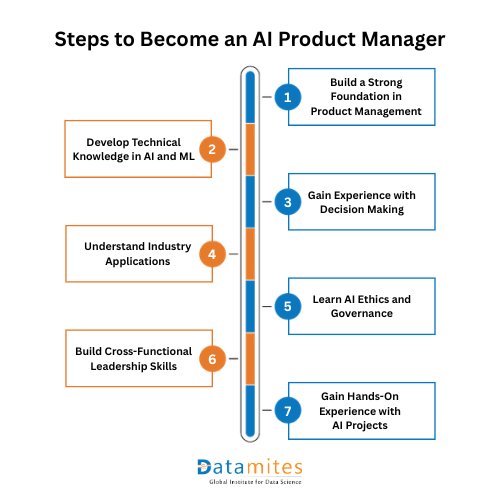
1. Build a Strong Foundation in Product Management
Begin by learning the core principles of product management, including AI product development lifecycle management, customer-focused design, and Agile or Scrum practices.
2. Develop Technical Knowledge in AI and Machine Learning
You don’t need to code like a data scientist, but understanding machine learning basics, data workflows, and evaluation metrics is essential.
3. Gain Experience with Data-Driven Decision Making
AI products depend heavily on data, so learning how to analyze and interpret it is crucial. It enables you to identify opportunities, improve decision-making, and measure product success accurately.
4. Understand Industry Applications
Different industries use AI in unique ways, with finance being a major adopter. Explore areas like fraud detection, algorithmic trading, and risk analysis to build domain-specific expertise.
5. Learn AI Ethics and Governance
Responsible AI practices are critical in today’s landscape.
Focus on transparency, fairness, bias reduction, and regulatory compliance to build trustworthy AI products.
6. Build Cross-Functional Leadership Skills
AI Product Managers work with diverse teams, including engineers, data scientists, and business leaders. Strong communication and leadership skills help you align everyone toward a shared product vision.
7. Gain Hands-On Experience with AI Projects
Practical experience is key to mastering AI product management. Engage in real-world projects, collaborate with ML teams, and experiment with AI features to strengthen your skills.
Real-world experience enhances your understanding of product manager tools and strengthens your overall profile.
Refer to the articles below:
Essential Tools Every AI Product Manager Must Know
To build, scale, and optimize AI-driven products, mastering the right set of tools is crucial. These tools not only enhance productivity but also enable smarter decision-making, better collaboration, and deeper insights.
1. Data Analysis Tools
A strong foundation in data analysis is vital for any AI Product Manager to interpret trends and guide decisions effectively. Tools like Python, R, SQL, and Jupyter Notebooks help in handling large datasets, performing statistical analysis, and extracting meaningful insights for strategic planning.
2. Product Management Platforms
Efficient product execution requires seamless coordination across teams, and that’s where platforms like Jira, Trello, and Asana come in. These AI product managers tools help manage workflows, track progress, and maintain clear product roadmaps, ensuring alignment between stakeholders and development teams.
3. Machine Learning Platforms
While AI PMs may not always build models, understanding platforms like TensorFlow, PyTorch, and AWS SageMaker is essential. These tools provide insight into how models are developed, trained, and deployed, helping managers make informed decisions and communicate effectively with teams.
4. Visualization Tools
Tools such as Tableau and Power BI enable AI PMs to create interactive dashboards and visual reports, making complex data easier to understand for both technical and non-technical stakeholders.
5. Experimentation and Analytics Tools
Tools like Google Analytics, Mixpanel, and A/B testing platforms allow AI PMs to monitor user behavior, test hypotheses, and optimize product features for better performance and user experience.
These tools are essential for refining AI Product development Strategy and improving user outcomes.
Building the Essential Skill Set for an AI Product Manager
To thrive as an AI product manager, you need a balanced mix of technical expertise, business insight, and leadership ability. Below are the key skills that define success in this role:
Data Literacy and Analytical Thinking
Ability to interpret data, identify trends, and make data-driven decisions. Helps in evaluating model performance and guiding product improvements effectively.
Strategic Planning and Execution
Skill in defining a clear product vision and aligning it with business goals. Ensures smooth execution from idea to launch while adapting to market changes.
Strong Communication Skills
Essential for bridging the gap between technical teams and non-technical stakeholders. Enables clear articulation of product goals, challenges, and AI-driven insights.
Understanding of AI/ML Concepts
Basic knowledge of machine learning models, algorithms, and their limitations. Helps in making informed decisions without needing to code extensively.
Business Acumen
Ability to assess ROI, manage budgets, and prioritize features based on value. Ensures the product delivers both customer satisfaction and business growth.
These skills for AI product manager ensure you can lead products that deliver real value.
Tips to Stand Out as an AI Product Manager
Standing out in this competitive field requires more than just technical knowledge.
1. Develop a Unique AI Product Strategy
Focus on creating differentiated solutions that address real-world problems, particularly in digital transformation in finance.
2. Build a Strong Portfolio
Showcase AI-driven projects that highlight your ability to:
Solve business problems
Improve financial decision making
Execute end-to-end product strategies
3. Stay Updated with AI Trends
Continuous learning is essential for staying relevant in your career as AI product manager.
4. Network with Industry Experts
Engage with professionals in AI and product management to expand your knowledge and opportunities.
5. Focus on Business Impact
Always align your work with measurable outcomes, ensuring your AI Product Strategy delivers tangible results.
Master continuous learning, combine technical insight with business strategy, and consistently deliver value to truly stand out as an AI Product Manager.
AI Product Management future demand in 2026
Demand for AI Product Managers is rising as organizations adopt automation and intelligent systems. Industries like finance increasingly use AI for risk assessment, deeper customer insights, and faster, real-time financial decision-making to stay competitive. This makes the roadmap to become AI product manager not just relevant but essential for future leaders.
A McKinsey report reveals that about 73% of organizations now use AI in at least one business function, highlighting its growing strategic importance. Becoming an AI Product Manager in 2026 requires a clear roadmap, strong skills, and mastery of key tools.
Refer to the articles below:
- Traditional AI vs Generative AI: Key Differences, Examples, and Use Cases
- What Are Graph Neural Networks
- Top AI Trends That Will Shape 2026
DataMites Institute provides a well-rounded AI for Product Managers Courses designed to help professionals integrate artificial intelligence into product strategy and decision-making. The course covers essential AI concepts and practical use cases, with specialized tracks in areas like Product Management, HR Analytics, Finance, Marketing, Healthcare, and Generative AI for business leaders.
Learners can select flexible learning options such as online classes, in-person training, or internship-based programs for hands-on experience. Accredited by IABAC, the certification is globally recognized. DataMites also operates in major Indian cities including Hyderabad, Ahmedabad, Chennai, Bangalore, Pune, Mumbai, and Coimbatore.