Top Use Cases for AI in Finance
Discover top use cases of AI in finance, including fraud detection, risk management, and predictive analytics. Learn how AI adoption in finance improves efficiency, decision-making, and customer experience with real-world insights and expert-driven strategies.
 Kriti Maurya
The financial industry is undergoing a profound transformation driven by the rapid advancement of Artificial Intelligence (AI). From automating repetitive tasks to enhancing risk management and fraud detection, the use cases of AI in finance is redefining how institutions operate, compete, and deliver value. As global markets become more complex and data-driven, organizations are increasingly prioritizing AI adoption in finance to stay ahead.
This article explores the role of use of AI in finance, highlights real-world implementations, and examines how businesses can effectively integrate AI into their financial operations while maximizing the benefits of AI in finance.
The Future of AI Integration in Finance Services
The future of finance is increasingly driven by AI, with KPMG reporting that 71% of organizations have adopted AI in corporate finance, and 41% using it at scale. As technology evolves, the role of AI in finance will expand through innovations like autonomous financial systems, predictive analytics, and AI-powered advisors. Today, AI is no longer a futuristic concept but a transformative force reshaping financial operations from fraud detection to personalized services.
The role of AI in finance has evolved into predictive analytics and intelligent decision-making, enabling real-time insights from vast data. The MarketsandMarkets report forecasts growth to USD 190.33 billion by 2030 at 30.6% CAGR. Key applications include risk assessment, fraud detection, trading, automation, and compliance, driving digital transformation.
Top Applications of AI in Finance for Analysis
Artificial Intelligence is rapidly transforming the financial landscape, enabling institutions to enhance decision-making, improve risk management, and deliver smarter, data-driven services at scale.
1. Fraud Detection and Prevention
One of the most impactful applications of AI is in fraud detection. Traditional systems rely on rule-based mechanisms, which are often insufficient in identifying sophisticated fraud patterns. AI-powered systems, however, analyze behavioral patterns and detect anomalies in real time.
The applications of ai in finance for fraud detection allows institutions to:
- Identify suspicious transactions instantly
- Reduce false positives
- Enhance customer trust
This is a prime example of the benefits of AI in finance, as it not only prevents financial losses but also strengthens regulatory compliance.
Refer to the articles below:
- Essential AI Tools for finance Smarter Analysis
- Leveraging AI for HR and People Analytics: Tools and Techniques
- How AI Is Changing the Future of HR
2. Credit Scoring and Risk Assessment
AI-driven credit scoring models analyze alternative data sources such as transaction history, social behavior, and spending patterns. This improves the accuracy of lending decisions and expands financial inclusion.
The role of use of AI in finance in risk assessment includes:
- Predicting loan defaults
- Enhancing underwriting processes
- Reducing human bias
With increasing AI adoption in finance, institutions are moving beyond traditional credit scoring systems to more dynamic and inclusive models.
3. Algorithmic Trading
AI is widely used in algorithmic trading to analyze market trends, historical data, and real-time signals. These systems execute trades at high speed and accuracy, maximizing returns while minimizing risks.
The applications of ai in finance for trading provides:
- Faster decision-making
- Improved market predictions
- Reduced emotional bias
This demonstrates how AI enhances both operational efficiency and strategic decision-making.
4. Personalized Financial Services
AI enables financial institutions to offer personalized recommendations by using AI for customer analytics based on customer behavior and preferences. From investment advice to tailored banking services, AI improves customer engagement.
The benefits of AI in finance in this area include:
- Enhanced customer experience
- Increased customer retention
- Better financial planning tools
Personalization is becoming a key driver of AI adoption in finance, especially in retail banking and fintech platforms.
5. Regulatory Compliance and Reporting
Compliance is a major challenge in the financial sector due to constantly evolving regulations. AI simplifies this process by automating data collection, monitoring transactions, and generating reports.
The applications of ai in finance for compliance helps:
- Detect regulatory violations
- Automate reporting processes
- Reduce compliance costs
AI in finance boosts efficiency, improves decisions, reduces risks, and enhances customer experience, helping organizations stay compliant while effectively navigating future challenges and opportunities.
Proven Real-World Case Studies Driving Impact
From transforming risk management to automating complex financial processes, real-world case studies highlight how AI is delivering measurable impact and redefining the future of the finance industry.
JPMorgan Chase: Automating Contract Review at Scale
JPMorgan Chase has implemented AI through its COiN (Contract Intelligence) platform to automate the review of legal documents. Traditionally, this process required thousands of hours of manual work by legal professionals.
With AI, the bank can:
- Analyze complex legal documents within seconds
- Reduce human error
- Improve operational efficiency
This real-world application highlights the role of use of AI for finance in transforming back-office operations and demonstrates significant benefits of AI in finance in terms of cost and time savings.
KPMG: Elevating Audit Accuracy with AI and Data Analytics
KPMG leverages AI and advanced data analytics to enhance audit quality. By analyzing large datasets, AI helps auditors identify anomalies and potential risks more effectively.
Key outcomes include:
- Improved audit accuracy
- Enhanced risk identification
- Increased transparency
This case illustrates how AI adoption in finance is reshaping auditing processes and reinforcing trust in financial reporting.
PayPal: Combating Financial Fraud in Real Time
PayPal uses AI-driven systems to monitor transactions and detect fraudulent activities in real time. With millions of daily transactions, traditional systems would struggle to keep up.
AI enables PayPal to:
- Detect fraud instantly
- Adapt to new fraud patterns
- Enhance user security
This example underscores the ai for finance course as a critical for safeguarding digital transactions and improving customer confidence.
How to Implement AI in the Finance for strategic advantage
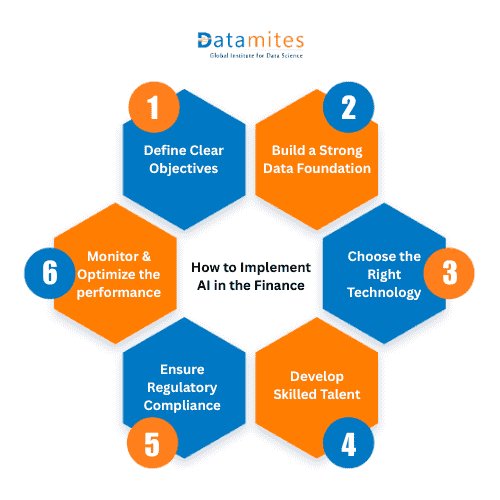
Implementing AI in financial operations requires a strategic and structured approach. Organizations must align technology with business goals to maximize the benefits of AI in finance.
Step 1: Define Clear Objectives: Identify specific use cases such as fraud detection, risk management, or customer service. Understanding the role of use of AI in finance within your organization is essential for successful implementation.
Step 2: Build a Strong Data Foundation: AI systems rely on high-quality data. Financial institutions must ensure data accuracy, consistency, and security to support effective AI models.
Step 3: Choose the Right Technology: Selecting appropriate AI tools for data analytics and platforms is critical. Organizations should evaluate solutions based on scalability, integration capabilities, and compliance requirements.
Step 4: Develop Skilled Talent: AI implementation requires skilled professionals, including data scientists, AI engineers, and financial analysts. Upskilling teams is a key factor driving AI adoption in finance.
Step 5: Ensure Regulatory Compliance: Financial institutions must adhere to strict regulatory standards. AI systems should be transparent, explainable, and compliant with industry regulations.
Step 6: Monitor and Optimize: Continuous monitoring and improvement are essential to ensure AI systems deliver optimal performance and adapt to changing market conditions.
Strategic Benefits of AI in Financial Operations
The benefits of AI in finance extend beyond operational efficiency. AI is transforming the entire financial ecosystem by enabling smarter, faster, and more reliable decision-making.
1. Enhanced Efficiency and Automation: AI automates repetitive tasks, reducing manual effort and operational costs. This allows financial professionals to focus on strategic initiatives.
2. Improved Decision-Making: AI provides data-driven insights, enabling organizations to make informed decisions quickly and accurately.
3. Risk Mitigation to prevent financial losses: Advanced analytics help identify potential risks and prevent financial losses. The applications of ai in finance plays a crucial role in strengthening risk management frameworks.
4. Cost Reduction and automating process: By automating processes and improving accuracy, AI significantly reduces operational costs.
5. Better Customer Experience: AI-driven personalization enhances customer satisfaction and loyalty, making it a key driver of AI adoption in finance.
6. Scalability and Growth: AI systems can handle large volumes of data and transactions, supporting business growth and expansion.
Integrating AI in finance enhances efficiency, accuracy, and strategic insights, enabling sustained growth. In today’s digital landscape, adopting AI is essential to remain competitive, agile, and future-ready.
Refer to the articles below:
- PyTorch vs TensorFlow: Which is Better in 2026
- What Are Graph Neural Networks
- Top AI Trends That Will Shape 2026
DataMites Bangalore offers a comprehensive AI for Finance course designed to help finance professionals leverage artificial intelligence for smarter, data-driven decisions. The program covers core AI concepts, financial analytics, and real-world applications such as risk management, fraud detection, investment analysis, and forecasting.
It also includes specialized AI for Product Managers, AI for HR Analytics, AI in Marketing, AI in Healthcare, and Business Leadership. Learners benefit from flexible online and classroom training, along with real-time, real time-based internships for hands-on experience. With globally recognized IABAC certifications, DataMites operates across major cities including Bangalore, Hyderabad, Pune, Chennai, Ahmedabad, Mumbai, Coimbatore, Delhi, Nagpur, and Kochi, offering industry-focused training.