Traditional AI vs Generative AI: Key Differences, Examples, and Use Cases
Explore the key differences between Traditional AI and Generative AI with real-world examples, use cases, and latest 2026 insights. Learn how businesses can choose the right AI approach for growth and innovation.
 Swagatam Sinha
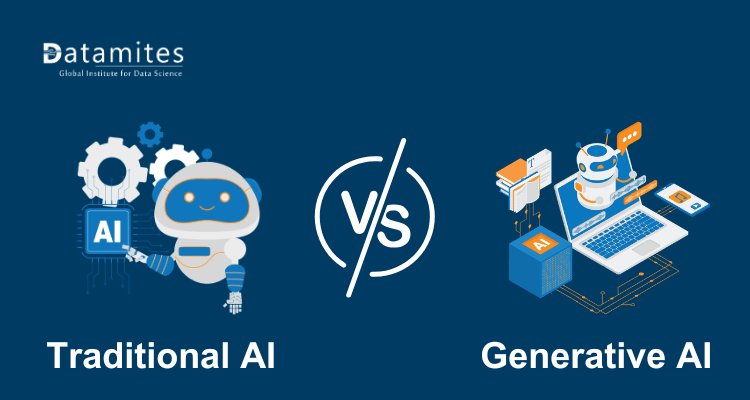
Artificial intelligence is no longer a distant concept it is embedded into products and services people use daily. But “AI” is not a single technology; it comprises different branches that work differently and solve different problems. Two major approaches dominating technological transformation today are Traditional AI and Generative AI. Understanding what sets them apart, how they work, and when to use each is essential for businesses, professionals, educators, and decision‑makers.
A recent industry analysis suggests that 2026 is the tipping point where AI transitions from experimentation to business‑critical systems embedded in operations, workflows, and consumer products a shift demanding deeper understanding of AI types.
What Is Traditional AI?
Traditional AI refers to systems and algorithms designed to perform specific analytical tasks such as classification, prediction, decision support, and automation based on structured data. These systems rely on statistical models, classical machine learning algorithms, and rule‑based logic.
Traditional AI does the following:
- Takes structured data (numbers, labeled datasets).
- discovers patterns or relationships.
- Predicts future values or classifies items.
- Responds within predefined boundaries.
Examples include systems that detect fraud in banking, predict demand in supply chains, or classify images for quality control. These models are often transparent, explainable, and reliable for well‑defined tasks.
Key characteristics of Traditional AI
- Predictive and analytical
- Uses structured data and feature engineering
- Outputs labels, scores, or decisions
- Interpretable and explainable
A 2026–2028 industry analysis by Gartner highlights that over 60% of enterprise AI applications still rely on traditional machine learning models for tasks like risk analysis, forecasting, and automation.
Traditional AI plays a foundational role in modern AI ecosystems. While newer models focus on creativity, Traditional AI ensures accuracy, control, and explainability, making it essential for industries that depend on trusted and data-driven decisions.
Refer to these articles:
- What Are Graph Neural Networks? Simple Guide for Beginners
- PyTorch vs TensorFlow: Which is Better?
- Top AI Trends That Will Shape 2026
What Is Generative AI?
Generative AI refers to artificial intelligence systems designed to produce new, original content. Unlike traditional AI, which is mainly analytical, generative AI can create text, images, code, summaries, designs, and more by learning complex patterns from data.
It uses advanced models such as large neural networks, deep learning architectures, and transformers to generate outputs that mimic human creativity and language use.
Generative AI has rapidly entered real‑world use cases, ranging from natural language tasks to creative content generation, and is influencing sectors such as marketing, education, media, and design.
Key characteristics of Generative AI
- Creative and content‑focused
- Learns from unstructured data (text, images, audio)
- Produces new outputs rather than only decision support
- Requires more computational resources
The global generative AI market was valued at approximately USD 22.21 billion in 2025 and is projected to grow to USD 324.68 billion by 2033, with a compound annual growth rate (CAGR) of roughly 40.8% during 2026–2033. (Source: Grand view research)
Core Differences Between Traditional and Generative AI
Understanding the difference between Traditional AI and Generative AI is essential for businesses, marketers, and professionals planning AI adoption in 2026 and beyond.
Traditional AI vs Generative AI: Quick Comparison Table
| Feature | Traditional AI | Generative AI |
| Purpose | Predictive, analytical | Creative, content generation |
| Input Data | Structured data | Structured + unstructured |
| Output | Scores, classifications | Text, images, audio, code |
| Explainability | High | Lower / complex |
| Complexity | Often simpler models | Large models with billions of parameters |
| Typical Use Cases | Forecasting, automation | Content generation, creative tasks |
Key Differences Between Traditional AI and Generative AI
1. Output Nature
Traditional AI focuses on decision-making outputs such as predictions, classifications, or recommendations. For instance, a banking system can flag a transaction as fraudulent based on historical patterns.
Generative AI, in contrast, creates new content. It can generate blog posts, images, videos, and even code based on user input.
Example:
- Traditional AI → Credit risk score
- Generative AI → Full financial report or summary
This shift from analysis to content creation marks a major evolution in AI capabilities.
2. Data Requirements
Traditional AI relies mainly on structured and labeled datasets, which are easier to manage but limited in flexibility.
Generative AI requires large volumes of diverse data, including text, images, and audio. It learns patterns from this data and can apply them across different tasks.
According to Gartner, by 2026, over 70% of enterprise AI projects use a mix of structured and unstructured data, largely driven by generative AI adoption.
3. Explainability
Traditional AI models are more transparent. Businesses can trace how decisions are made, which is essential in industries like healthcare and finance.
Generative AI models are more complex and often function as “black boxes,” making it harder to fully explain how outputs are generated.
Example:
- Traditional AI → Clear rules for loan approval
- Generative AI → Complex reasoning behind generated text
Explainability remains critical in regulated sectors where accountability is required.
4. Model Complexity and Architecture
Traditional AI uses simpler algorithms such as decision trees, linear regression, and rule-based systems. These models require less computing power and are easier to implement.
Generative AI relies on advanced deep learning models with billions of parameters. These systems demand high computational resources and specialized infrastructure.
A 2027 forecast by International Data Corporation estimates that spending on generative AI infrastructure will grow by 35% annually, driven by increasing demand for large-scale models.
Refer to these artilcles:
- LLM Fine-Tuning vs Prompt Engineering: Which Is Better?
- Why Agentic AI Is the Most In-Demand Skill for Data Scientists in 2026
- How AI is Transforming Customer Analytics in 2026
Use Cases of Traditional AI
Traditional AI continues to be the backbone of mission-critical systems where accuracy, consistency, and predictive decision-making are essential. While newer AI models are gaining attention, traditional AI still powers core operations across industries.
Healthcare Diagnostics
Traditional AI is widely used for disease detection, medical imaging, and patient risk analysis.
Example: IBM Watson Health analyzes patient data to support treatment decisions, while AI imaging tools detect tumors in MRI and CT scans faster than manual review.
Why It Matters: High precision and reliability make it ideal for structured healthcare data.
Market Insight (2026): Healthcare AI adoption is growing rapidly, driven by demand for predictive diagnostics and automation.
Autonomous Vehicles
Self-driving systems depend on AI models like computer vision and decision trees.
Example: Tesla Autopilot analyzes road conditions in real time, while Waymo navigates complex urban environments.
Why It Matters: Ensures fast and reliable decisions in safety-critical scenarios.
Finance and Risk Analysis
Traditional AI is widely used for fraud detection, credit scoring, and financial forecasting.
Example: PayPal uses AI to detect fraudulent transactions instantly, while banks monitor unusual activity in real time.
Why It Matters: Handles large volumes of structured financial data with high accuracy.
Market Insight (2026): Around 88% of organizations use AI in at least one function, with strong adoption in finance and operations.
Manufacturing Automation
AI powers robotics, predictive maintenance, and quality control in manufacturing.
Example: Siemens uses AI to predict machine failures, while smart factories detect defects during production.
Why It Matters: Reduces downtime, improves efficiency, and ensures consistent quality.
Use Cases of Generative AI
Generative AI is transforming industries by enabling machines to create content, simulate ideas, and automate creativity-driven tasks. It is one of the fastest-growing technologies in 2026 and beyond.
Content Creation and Marketing
Generative AI is widely used to create blogs, ads, emails, and personalized campaigns.
Example: Tools like ChatGPT and Jasper AI help marketers generate content quickly and at scale.
Why It Matters: Speeds up content production and supports personalization.
Market Insight (2026): About 71% of organizations use generative AI in at least one function, making it a key driver of marketing automation.
Personalized Learning and Tutoring
Generative AI enables adaptive learning experiences based on user needs.
Example: AI tutors generate explanations, quizzes, and study plans tailored to individual progress.
Why It Matters: Improves engagement and learning outcomes through personalization.
Entertainment and Game Design
AI is used to create game environments, characters, and scripts.
Example: Companies experiment with AI-generated storylines and visuals in gaming and media.
Why It Matters: Reduces production time and expands creative possibilities.
Design Automation
Generative AI supports rapid design and prototyping.
Example: Architects and fashion brands use AI to generate layouts, concepts, and new styles.
Why It Matters: Enables faster experimentation and innovation in design workflows.
Case Studies from Companies
- Microsoft uses generative AI in productivity tools for writing, coding, and data analysis.
- Google applies AI in search, content generation, and cloud solutions.
- Adobe integrates generative AI into creative tools for image and video editing.
Refer to these articles:
- Explainable AI: Why Black-Box Models Are Losing Trust
- Will AI Agents Replace Your Next Coworker? Exploring the Future of Work
- CrewAI vs. AutoGen vs. LangGraph: Which multi-agent framework should you learn in 2026?
How Businesses Should Choose Between Traditional AI and Generative AI
Choosing between Traditional AI and Generative AI depends on what your business is trying to achieve. Both serve different purposes, and selecting the right one can improve efficiency, reduce costs, and drive better results.
Decision Checklist
Start by identifying your core requirement:
- Choose Traditional AI when your focus is on prediction, classification, or data-driven decisions. It works best with structured data and clearly defined tasks.
- Choose Generative AI when your goal is to create content, automate communication, or enhance user experiences with dynamic outputs.
If your business needs both analysis and content creation, combining the two can deliver stronger outcomes.
Cost and Resource Considerations
Traditional AI is generally more cost-effective. It requires less computing power, smaller datasets, and is easier to deploy. This makes it suitable for businesses looking for stable and predictable solutions.
Generative AI, on the other hand, demands higher investment. It relies on advanced models, large-scale data, and strong computing infrastructure. However, it offers higher returns in areas like marketing, design, and automation where content plays a key role.
According to Gartner, by 2027, over 70% of enterprises are expected to adopt generative AI in at least one business function, showing its growing importance.
Ethical and Privacy Considerations
Traditional AI systems are easier to manage in regulated environments because their outputs are more predictable and explainable. This makes them suitable for industries like banking and healthcare.
Generative AI introduces new challenges. It can sometimes produce incorrect or biased outputs, and it raises concerns around data privacy and content authenticity. Businesses must implement strong governance and monitoring practices when using these systems.
A 2026 report by IBM highlights that 78% of organizations consider AI ethics and transparency a top priority as AI adoption increases.
Example Business Scenarios
In banking, Traditional AI is used for fraud detection and risk analysis, while Generative AI powers customer support and automated responses.
In e-commerce, Traditional AI helps with product recommendations and demand forecasting, whereas Generative AI creates product descriptions and marketing content.
In healthcare, Traditional AI supports disease prediction, while Generative AI assists in summarizing medical reports and improving documentation.
Marketing teams often rely on Traditional AI for campaign analysis and Generative AI for content creation and personalization.
McKinsey reports that generative technologies could add $2.6 trillion to $4.4 trillion annually to the global economy through creative and automated workflows.
Traditional AI and Generative AI represent two pillars of modern artificial intelligence:
Traditional AI excels at making sense of structured historical data and enabling reliable decision‑making.
Generative AI pushes automation into content creation, dialogue, and creative production.
Understanding their differences, strengths, and best use cases is crucial for businesses looking to innovate responsibly. With industry trends pushing toward value‑driven AI adoption in 2026 and beyond, strategic integration of both AI types will be key to remaining competitive and delivering real outcomes.
DataMites Institute is a leading training provider focused on building practical skills in emerging technologies like artificial intelligence and data science. With industry-aligned curriculum and expert trainers, DataMites helps learners gain real-world knowledge through hands-on projects and case-based learning.
If you are looking to start your AI career, DataMites offers a comprehensive Artificial Intelligence Course in Coimbatore, designed to equip learners with job-ready skills, certifications, and placement support to succeed in today’s competitive market.