AI Career Opportunities in Nigeria: Roles, Skills and Salaries
Explore AI career opportunities in Nigeria, including job roles, essential skills, salary expectations, hiring industries, and steps to start a career in artificial intelligence.
 Swagatam Sinha
A bank investigating suspicious transactions, an online store recommending products, and a telecom company trying to identify network problems all deal with different challenges. Artificial intelligence (AI) can help businesses address these problems, creating opportunities for professionals who know how to work with data, software and machine learning.
For people considering an AI career in Nigeria, the first question is often where to begin. You do not necessarily need to start by developing complex AI models. Experience in data analysis, programming or database management can provide a foundation for more specialized roles.
Understanding the available jobs, the industries using AI and the skills employers require can help you choose a realistic starting point. This guide explores AI career opportunities in Nigeria, salary estimates, essential skills and the steps you can take to prepare for the field.
How Is Artificial Intelligence Developing in Nigeria?
Nigeria's AI ecosystem is developing through a combination of technology investment, government initiatives, and efforts to expand technical skills.
According to UNESCO's Nigeria AI profile, the country's AI market was valued at approximately USD 1.05 billion in 2024 and is projected to reach USD 4.64 billion by 2030. This projection indicates expected market growth, although it does not tell us how many AI professionals Nigerian companies will employ.
Infrastructure is another part of the picture. In August 2026, the Federal Ministry of Communications, Innovation and Digital Economy announced Nigeria's National Digital Cloud Policy. It aims to encourage investment in cloud computing, data centers, and related infrastructure. These resources can support organizations developing and running data-intensive applications, including AI systems.
Nigeria has also improved its position in responsible AI governance. The Federal Ministry reported in July 2026 that the country ranked first in Africa and 38th globally in the second edition of the Global Index on Responsible AI, compared with 80th globally in 2024. This ranking measures responsible AI governance rather than the number of available jobs, but it provides context for the country's approach to AI development.
Global investment offers additional context. Gartner's September 2026 forecast puts worldwide AI spending at approximately USD 2.67 trillion in 2026, rising to USD 3.64 trillion in 2027. This includes spending on AI infrastructure, software and services across international markets. It should not be interpreted as a forecast of Nigerian employment.
For someone planning an AI career, these developments provide useful background. However, market growth alone does not guarantee an entry-level position. Employers still need candidates who can demonstrate relevant technical knowledge and apply it to practical problems.
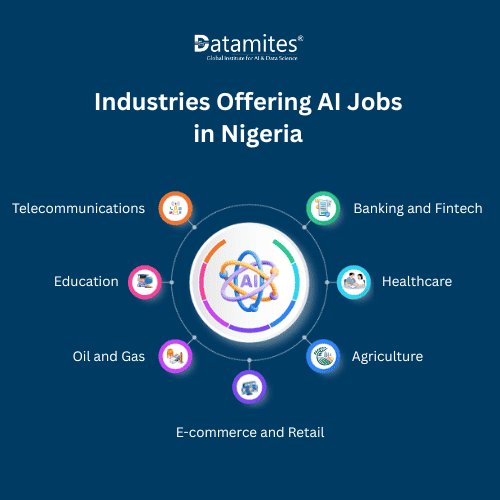
Which Industries Are Creating AI Career Opportunities in Nigeria?
The type of AI work available depends partly on the problems a business needs to solve. Financial services may focus on fraud detection, while agricultural businesses may be interested in crop monitoring or production forecasts. These differences can help you decide which industry and technical skills to explore.
1. Banking and Financial Technology
Banks and fintech companies handle large volumes of payments, customer records and transaction data. AI and machine learning can help identify unusual activity, assess patterns associated with fraud and support customer service.
Potential roles include data analyst, machine learning engineer, data scientist, and AI engineer. People interested in this sector should understand data privacy, model accuracy, and the risks of making financial decisions based on incorrect predictions.
2. Telecommunications
Telecommunications companies use customer and network data to understand service usage, investigate network problems and improve customer experiences.
A September 2026 study by KPMG Nigeria, citing Nigerian Communications Commission data, reported 157 million internet subscribers in May 2026 and data consumption exceeding 1.5 million terabytes. The figures show the scale of digital activity, although they do not establish how many AI jobs are available.
Relevant career paths include data scientist, machine learning engineer and data engineer. Domain knowledge is useful because a model must be evaluated against real operational requirements, not just its technical performance.
3. Healthcare
Hospitals, health technology companies and healthcare providers generate information through appointments, patient records, diagnostic processes and administrative systems.
AI applications may help organize records, support appointment management or assist trained professionals with analyzing medical information. Healthcare projects require particular care because patient privacy and clinical oversight are essential.
People interested in this area can explore health data analysis, software development and machine learning applications designed for healthcare settings.
4. Agriculture
Agriculture offers practical problems that can be explored with data. Weather records, soil measurements, crop images and market prices can help farmers and agricultural businesses make better-informed decisions.
AI applications may support crop disease identification, yield forecasting, weather analysis, and supply chain planning. Beginners could build a small project that analyses publicly available weather or crop data before progressing to more complex models.
5. Oil and Gas
Oil and gas companies collect equipment, maintenance, production and operational data. Machine learning can help identify unusual readings, estimate equipment failures and support maintenance planning.
Relevant career paths include data scientist, machine learning engineer, and data engineer. Domain knowledge is useful because a model must be evaluated against real operational requirements, not just its technical performance.
6. E-commerce and Retail
Online retailers can use data to understand purchasing behavior, recommend products and improve customer support. AI tools can also help customers compare products or find information more quickly.
Visa's 2026 Stay Secure study found that 88% of surveyed Nigerian consumers had used AI to assist with shopping, while 97% felt AI-powered tools made online shopping faster and easier. These results describe consumer responses to a survey, not the percentage of all Nigerian shoppers.
This sector can offer relevant project ideas for aspiring AI professionals, including recommendation systems, product categorization, customer feedback analysis, and support chatbots.
7. Education and Digital Learning
Educational institutions and learning platforms may use AI to organize learning resources, answer routine questions and analyze student engagement. These tools can help with administration and learning support, but they need appropriate safeguards around student information and the accuracy of generated responses.
Software developers, data analysts and AI application developers may contribute to these systems.
Across these industries, the main opportunity is not simply knowing how AI works. Employers need people who can connect technical methods with a genuine business or operational problem.
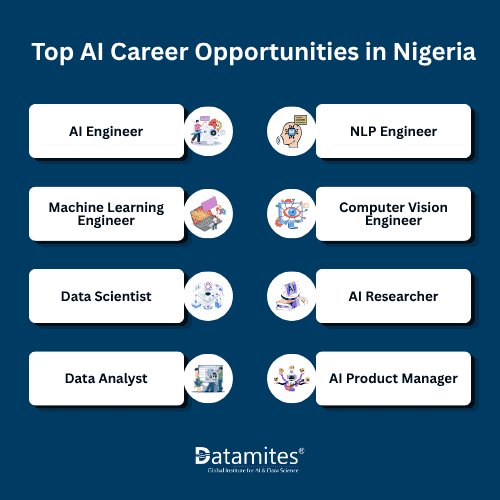
AI Career Opportunities in Nigeria: Roles You Can Pursue
AI is not one job title. The responsibilities vary depending on whether a professional builds applications, develops models, analyzes data, or decides how a product should be used.
| Career role | Main responsibilities |
| AI Engineer | Develops AI applications and integrates models into software or business processes. |
| Machine Learning Engineer | Builds, tests and deploys machine learning models, then monitors their performance. |
| Data Scientist | Uses statistics, programming and machine learning to investigate data and answer business questions. |
| Data Analyst | Examines data, prepares reports and dashboards, and identifies trends that support decisions. |
| NLP Engineer | Develops applications that process human language, such as text classification and conversational systems. |
| Computer Vision Engineer | Works on systems that interpret images or video, including object detection and image classification. |
| AI Researcher | Investigates methods, tests new approaches and evaluates improvements to AI models. |
| AI Product Manager | Defines product requirements, coordinates teams and evaluates whether an AI feature meets user and business needs. |
These roles can overlap, particularly in smaller teams. For example, an AI engineer at a small company may work on data preparation, model integration and application testing, while a larger organization may assign each task to a different specialist.
For beginners, data analysis or software development can provide a practical starting point. People who already have programming or mathematics experience may be ready to explore machine learning more directly.
Refer to these articles:
- How AI Is Changing the Future of Product Development Strategy
- Leveraging AI for HR and People Analytics: Tools and Techniques
- Top AI Trends That Will Shape 2026
What Skills Do Employers Look for in AI Professionals?
You do not need to master every AI tool before applying for your first relevant role. Focus on the foundations required for your chosen career, then build on them through practical work.
Programming and Working with Data
Python is widely used in data analysis and machine learning. SQL is useful for retrieving information from databases, while Git helps developers track changes to their code. Understanding data cleaning, debugging and basic data structures also makes it easier to work on real projects.
Learners who want to focus on data analysis can consider an online data science course in Nigeria to build their knowledge of Python, SQL, statistics and data visualization. Before enrolling, review the curriculum and check whether it includes practical exercises.
Statistics and Machine Learning
Data scientists and machine learning engineers need to understand concepts such as probability, statistical testing, model evaluation and overfitting. They should be able to explain why a model performs well on one dataset but may not work as reliably on new data.
Start with basic regression and classification before moving on to more complex techniques. Learning how to evaluate a model is just as important as learning how to train one.
Generative AI and Application Development
People developing generative AI applications may work with large language models, APIs, embeddings and retrieval-augmented generation (RAG). These tools can support applications such as document search, question-answering systems and customer support assistants.
A working application should be tested for accuracy, privacy and reliability. Simply connecting a model to an interface is not enough to demonstrate that it is suitable for business use.
Software Engineering and Cloud Basics
AI applications often depend on databases, APIs, testing and deployment. Cloud platforms can provide the computing resources needed to run applications and manage data.
A beginner does not need to master every cloud service. It is more useful to understand how an application is deployed, how errors are handled and how performance is monitored.
Communication and Responsible AI
An AI professional may need to explain to a bank manager why a fraud detection model flagged a transaction or why a prediction needs further review. Being able to explain these results clearly helps teams decide when to trust a model and when a person should make the final decision.
They also need to consider data protection, bias and the consequences of incorrect predictions. These concerns are particularly important in finance, healthcare and other areas where automated decisions can affect people directly.
Data science is a useful starting point for anyone interested in working with AI. Learning Python, SQL, statistics and data visualization helps you understand how to work with data and identify patterns that can be useful in solving business problems.
If you are based in Abuja and want to learn these skills, an online data science course in Abuja can help you get started. Look for a programme that combines the basics with practical projects so you can gain experience working with data before moving on to more advanced AI concepts.
AI Career Salaries in Nigeria: What Should You Expect in 2026?
AI-related salaries in Nigeria vary by job role, experience, company and technical skills. A data analyst may focus on reporting and business insights, while an AI engineer may be responsible for developing and integrating AI applications. These differences can affect how much employers pay.
The following table presents reported monthly salary estimates for selected data science and AI roles in Nigeria.
| Role | Reported median monthly salary | Reported monthly range |
| Data Analyst | ₦267,000 | ₦158,000 to ₦402,000 |
| Data Scientist | ₦292,000 | ₦157,000 to ₦507,000 |
| Machine Learning Engineer | ₦242,000 | ₦176,000 to ₦308,000 |
| AI Engineer | ₦400,000 | ₦250,000 to ₦1,600,000 |
Source: Glassdoor salary estimates.
These figures provide a general reference rather than a guaranteed salary for every professional. Actual earnings can vary with experience, employer requirements and the complexity of the work. Check the reporting period and number of salary submissions for each role when comparing the estimates.
Refer to these articles:
- LLM Fine-Tuning vs Prompt Engineering: Which Is Better?
- Traditional RAG vs Agentic RAG - What’s the Difference?
- What is Simple Linear Regression
What Can Help You Qualify for Better-Paying Roles?
Rather than focusing only on salary figures, look at the requirements in current job advertisements. Some employers prioritize strong software development, while others seek experience with machine learning, data pipelines or cloud deployment.
Building a project from start to finish can help demonstrate these skills. For example, a candidate interested in machine learning could develop a model, evaluate its results, document its limitations and make it available through a simple application. The value lies in showing how the work was done and what the results mean.
How to Start an AI Career in Nigeria
If you are starting from scratch, focus on one career path first. For example, learn Python and SQL, practice analyzing datasets, and then build a project that answers a specific question. If your goal is to become an AI engineer in Nigeria, start by developing programming skills, understanding machine learning fundamentals, and learning how to integrate AI models into applications. Once you understand the basics, you can decide whether to continue with data analysis or move towards machine learning and AI application development.
1. Choose a role to work towards
Decide whether you are more interested in analyzing data, building software, training models or managing technology products. Read job advertisements for that role to understand the usual requirements.
2. Learn the relevant foundations
For many technical roles, Python and SQL are useful starting points. Data analysis roles also require statistics and visualization, while machine learning roles need a stronger understanding of model development and evaluation.
3. Complete a project connected to a real problem
Choose a manageable idea related to an industry you understand. You could analyse customer feedback, build a basic product recommendation system or create a model that identifies unusual patterns in sample transaction data. Use public or synthetic data rather than exposing personal or confidential information.
4. Document your work
Keep your code in a GitHub repository and explain the problem, dataset, methods, results and limitations. A clear explanation of what went wrong and how you improved the project can be as useful as a successful final result.
5. Apply for roles that match your current skills
Look for internships, graduate programmes and junior data or software positions where the responsibilities fit your experience. Tailor your CV to the role and describe your contribution to each project accurately.
6. Compare learning options carefully
If you prefer a structured curriculum, an online artificial intelligence course in Nigeria is one option to consider. Compare the subjects covered, project work, learning format, duration and fees instead of choosing a programme based on its title alone.
Learners in the Federal Capital Territory can also compare an online artificial intelligence course in Abuja with other available programmes. The most suitable option is one that fits their current knowledge, schedule and budget while giving them opportunities to practice the skills they want to develop.
AI career opportunities in Nigeria cover several fields, from data analysis and software development to machine learning and AI product management. The right starting point depends on your existing skills and the type of problems you want to work on. Review job requirements, build a relevant project and use the results to identify what you need to learn next.
For learners who prefer structured training, DataMites offers programmes in artificial intelligence and data science. With more than 12 years of experience and over 200,000 learners globally, the institute provides learning programmes that cover technical concepts and practical projects. Review the curriculum, learning format, duration and fees to decide whether a programme fits your learning needs and career goals.