How to Become an AI Engineer in Nigeria
Learn how to become an AI engineer in Nigeria, including essential skills, learning steps, practical projects, career opportunities, training options, and salary expectations.
 Swagatam Sinha
Artificial intelligence (AI) is finding practical uses in areas such as financial services, customer support, business analytics, agriculture, and software development. As organizations explore AI applications, professionals who can work with data, develop machine learning models, and integrate AI into software can build skills relevant to these changes.
For students, recent graduates, IT professionals, and people considering a career change, the main question is where to start. Becoming an AI engineer requires more than learning a few tools. You need to understand programming, work with data, build machine learning models, and learn how to turn those models into applications that solve real problems.
This guide explains how to become an AI engineer in Nigeria, the skills to prioritize, ways to gain practical experience, available learning routes, and what to know about salaries and career opportunities.
What Does the AI Engineering Job Market Look Like in Nigeria?
Nigeria's AI ecosystem is receiving attention through skills development, research, and responsible AI initiatives. In July 2026, the Federal Ministry of Communications, Innovation and Digital Economy reported that Nigeria ranked first in Africa and 38th globally in the 2026 Global Index on Responsible AI, with a score of 45.93. The ranking reflects aspects of responsible AI development, but it does not measure AI engineering job vacancies.
AI skills can be useful across several Nigerian industries. Banking and fintech businesses can apply AI to fraud detection and risk assessment, while telecommunications companies can use it for customer analysis and automated support. Other potential applications include crop analysis in agriculture, administrative automation in healthcare, and product recommendations in retail.
These are potential applications rather than confirmation of current hiring demand. Candidates should review job descriptions to identify the skills employers actually require.
AI Engineering Jobs to Explore in Nigeria
Depending on their experience, candidates can consider roles such as junior machine learning engineer, AI or machine learning intern, Python developer working on AI applications, and software developer specializing in AI integrations. Some positions require previous development experience, so building projects and a technical portfolio can help demonstrate practical ability.
Refer to these articles:
- Agentic AI vs Generative AI: What’s the Difference?
- How Do Big Data and AI Work Together?
- What is Artificial General Intelligence (AGI)?
Is AI Engineering a Good Career Choice in Nigeria?
AI engineering may suit people who enjoy programming, analyzing problems, and building applications that use data. Nigeria's AI readiness and workforce development efforts provide context for the field. UNESCO's 2026 AI Readiness Assessment Methodology report for Nigeria examines the country's readiness to develop and govern AI responsibly, including considerations beyond the technology itself.
The global outlook also highlights the importance of developing adaptable technical skills. The World Bank's World Development Report 2026: The Promise of Artificial Intelligence examines AI's potential effects on employment and productivity. Its estimates suggest that generative AI could affect jobs differently across developing economies, with some roles exposed to automation and others benefiting from productivity improvements. These findings apply broadly to low- and middle-income countries, not specifically to Nigerian AI engineering jobs.
For aspiring AI engineers, the practical priority is to learn Python, data handling, machine learning, model evaluation, and application deployment. Communication and the ability to assess AI outputs are also important. These skills can support work across different industries, but employment depends on individual experience and employer requirements.
What Do You Need to Start a Career in AI Engineering?
Starting a career in AI engineering requires a mix of programming skills, mathematical knowledge, and practical experience. Understanding the basic requirements can help you choose the right learning path based on your background.
Educational Background and Entry Requirements
A degree in computer science, software engineering, mathematics, or statistics can provide a strong foundation. However, people from other educational backgrounds can also enter this field by learning programming and building practical projects.
Your learning path depends on your current skills. Software developers may already have programming experience, while beginners can start with the basics.
Essential Programming and Maths Skills
Python is a good starting language because it is widely used in machine learning and data analysis. Begin with variables, loops, functions, and data structures. Basic knowledge of algebra, statistics, probability, and linear algebra will also help you understand how machine learning models work.
You do not need to master every topic at the beginning. Focus on the fundamentals and build your knowledge through regular practice.
Can Beginners Enter AI Engineering Without IT Experience?
Yes. Beginners can start by learning Python, practicing with small datasets, and developing simple machine learning projects. Progress gradually to more advanced concepts as your skills improve.
Follow a clear learning plan and apply what you learn through practical projects rather than relying only on certificates.
Refer to these articles:
- How Does Artificial Intelligence Help Astronomy?
- What is Retrieval-Augmented Generation (RAG)?
- What is lemmatization in NLP?
How to Become an AI Engineer in Nigeria
Becoming an AI engineer in Nigeria requires programming knowledge, practical experience, and an understanding of machine learning. Follow these steps to build the skills needed to work towards an entry-level role.
Step 1: Learn Python Programming
Start with Python basics, including variables, loops, functions, and data structures. Practise writing simple programs, then learn NumPy and Pandas to work with data.
Step 2: Learn SQL and Data Handling
Learn to retrieve, clean, and organize data using SQL and Pandas. Practise with sales records or customer datasets to understand how data is prepared for analysis.
Step 3: Understand Machine Learning
Study regression, classification, decision trees, and clustering. Use examples such as predicting product demand from past sales to understand how models identify patterns and make predictions.
Step 4: Practice Model Training and Testing
Use Scikit-learn to train and evaluate models. Learn about accuracy, precision, recall, and overfitting to assess how well a model performs on new data.
Step 5: Learn to Build Applications
Understand how APIs connect software systems and how Flask or FastAPI can make models accessible through applications. You can then explore deep learning and generative AI based on your interests.
Step 6: Build Practical Projects
Develop projects that solve specific problems, such as sales forecasting or customer analysis. Document your approach, results, and limitations to demonstrate your technical skills.
Step 7: Create a Portfolio and Apply for Jobs
Upload your projects to GitHub with clear explanations and instructions. Prepare for technical interviews and explore junior AI engineer, machine learning, Python developer, and internship opportunities in Nigeria.
Which AI Engineering Skills Should You Learn First?
Start with the basics before moving to advanced topics. A useful learning order includes:
- Programming fundamentals: Python, SQL, statistics, and data structures.
- Machine learning: Data preparation, model training, and evaluation.
- Software development: APIs, Git, testing, and deployment.
- Advanced topics: Deep learning, natural language processing, computer vision, and generative AI.
Focus on skills that match your career goals. For example, language models are useful for document-based applications, while computer vision is relevant to image-related projects.
Refer to these articles:
- PyTorch vs TensorFlow: Which is Better
- How AI is Transforming Cybersecurity
- What’s the Difference Between Gen AI, Agentic AI and AI Agents
How to Gain AI Engineering Experience Without a Job
You can gain practical experience by working on personal projects and contributing to open-source initiatives before applying for AI engineering roles in Nigeria.
Learners in Abuja can combine independent practice with structured training to build their technical skills. When comparing an online artificial intelligence course in Abuja, check whether it covers Python, machine learning, model evaluation, and practical projects. Choose a program that gives you opportunities to apply what you learn rather than focusing only on theory.
Work on Local Business Problems
Build projects that address practical needs, such as sales forecasting for retailers, customer query tools, crop classification, or transaction anomaly detection. Use public or synthetic datasets and explain your project's limitations.
Contribute to Open-Source Projects
Help with bug fixes, documentation, or testing to gain experience with coding, version control, and teamwork.
Create a GitHub Portfolio
Upload your projects with clear explanations of the problem, methods, and results. Be prepared to explain your code during technical interviews.
Where Can You Study AI Engineering in Nigeria?
There are several ways to learn AI engineering in Nigeria, depending on your budget, current knowledge, and preferred learning format. You can study independently, join a structured training program, or explore local skills development initiatives. An online artificial intelligence course in Nigeria may be worth considering if you need a flexible schedule alongside your studies or current job.
- Self-study: Learn Python, machine learning, and related concepts using online tutorials and official documentation.
- Structured training: Compare courses based on their syllabus, practical projects, fees, learning format, and certificate terms.
- Local initiatives: Check the National Centre for Artificial Intelligence and Robotics (NCAIR) and its Skills and Capacity Building page for relevant programs.
Whichever route you choose, practice coding regularly and complete projects independently.
Career Opportunities After Learning AI Engineering
Once you have developed the required skills, consider entry-level roles such as:
- Junior machine learning engineer
- AI or machine learning intern
- Python developer working on AI applications
- Junior data analyst
- Software developer working on AI integrations
Search company career pages and job platforms for suitable openings.
Check each vacancy's experience requirements and responsibilities before applying, as some positions require previous industry experience.
AI Engineer Salary in Nigeria
The salary of an AI engineer in Nigeria depends on work experience, technical skills, company size, job location, and the type of projects handled. Professionals working for international companies may also earn differently than those employed by local organizations.
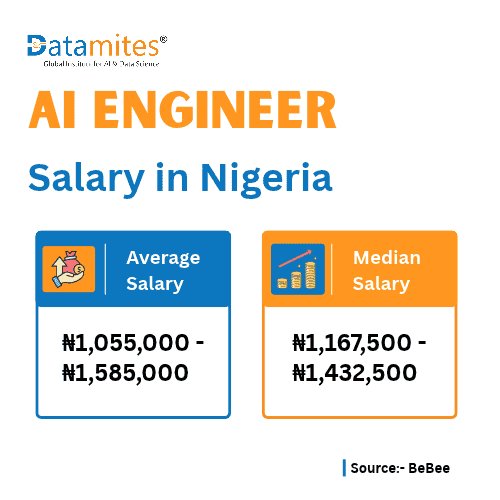
According to BeBee's AI Engineer Salary in Nigeria, which uses data from 138 job listings, the estimated annual salary ranges from ₦1,055,000 to ₦1,585,000, with a median salary of ₦1,280,000 per year. This is equivalent to approximately ₦87,917 to ₦132,083 per month, with a median of around ₦106,667.
These figures provide a general estimate rather than a fixed salary for every AI engineer in Nigeria. Actual earnings can vary depending on experience, programming skills, employer requirements, and the responsibilities of the role. Before accepting a position, candidates should compare these estimates with current job vacancies and the salary offered by the employer.
How Long Does It Take to Become an AI Engineer in Nigeria?
The time it takes to become an AI engineer in Nigeria depends on your current skills, learning schedule, and career goals. If you already know Python or have a software development background, you may find it easier to move into machine learning and application development. Beginners may need more time to build these skills from the ground up.
A practical learning plan starts with Python programming, mathematics, and data handling. Once you understand these basics, move on to machine learning, model testing, and building applications. Working on real-world projects and learning how to deploy them will help you prepare for the technical requirements of AI engineering roles.
Your weekly study time also matters. Regular practice, solving technical problems, and documenting your projects can help you make steady progress. Instead of focusing only on how many courses you complete, check whether you can build a working application, explain your approach, evaluate its results, and identify areas for improvement.
Becoming an AI engineer in Nigeria requires a strong foundation in Python, data handling, machine learning, and application development. Start with the fundamentals, practice through hands-on projects, and build a portfolio that demonstrates your technical skills. You can then apply for entry-level roles that match your knowledge and experience.
Nigeria's developments in AI governance, technical education, and workforce skills offer useful context for people considering this career. However, your readiness for a role will depend largely on your practical knowledge, problem-solving ability, and understanding of how AI applications work.
For those looking to develop their technical skills, DataMites is a globally renowned institute with over 12 years of trust and more than 200,000 learners worldwide. Along with AI courses, it offers training in data science, data analytics, data engineering, Python development, and machine learning. Learners can compare the course content, practical projects, duration, and learning format to find a program that suits their interests and career plans.