AI Engineer vs Machine Learning Engineer in Ghana
Compare AI Engineer and Machine Learning Engineer careers in Ghana, including job roles, salary estimates, skills, industry applications and career preparation in 2026.
 Swagatam Sinha
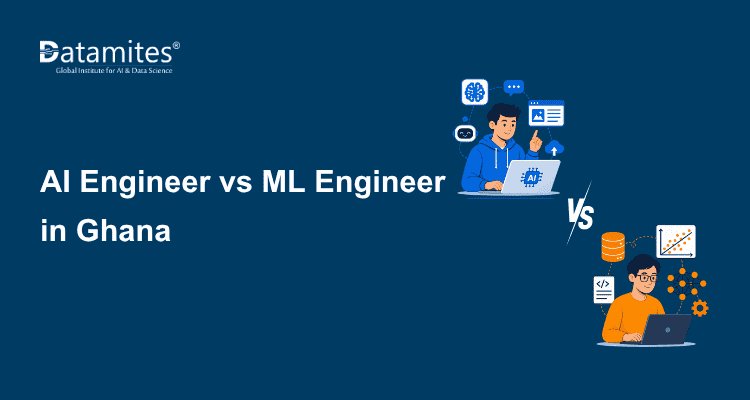
A fintech company in Accra wants to identify suspicious mobile money transactions. Another business plans to introduce an AI assistant to handle customer inquiries. Both projects use artificial intelligence, but the technical work behind them is different. A machine learning engineer may develop a model to identify unusual transactions, while an AI engineer may build and integrate the assistant into a business application.
As businesses in Ghana explore automation and data-driven services, interest in these technical roles is growing. However, AI engineering and machine learning engineering are not the same career. Understanding their responsibilities, required skills, and practical applications can help learners choose a suitable direction.
This guide explains the differences between AI engineers and machine learning engineers in Ghana, including their roles, industry applications, salary estimates, and ways to prepare for these careers in 2026.
How Is Ghana's AI Sector Developing in 2026?
Ghana is taking steps to strengthen its artificial intelligence ecosystem through national policy, infrastructure and skills development.
On April 24, 2026, the country launched its National Artificial Intelligence Strategy for 2025–2035. The Ministry of Communication, Digital Technology and Innovations identifies responsible AI adoption, workforce readiness, digital infrastructure, and research as important priorities.
The government has also announced a proposed US$250 million investment in a national AI computing center. According to the Ghana News Agency, the center is intended to support AI research and development.
These developments indicate the country's interest in building local AI capabilities. They may create opportunities for businesses and technology professionals as adoption expands. However, policy announcements and planned infrastructure investments should not be treated as evidence of an immediate increase in job vacancies.
For anyone planning to enter this field, the practical approach is to understand the skills required for each role, gain project experience and follow current job listings in Ghana.
Refer to these articles:
- AI in Cybersecurity: How Companies Are Fighting AI-Powered Threats
- Small Language Models vs Large Language Models
- What Is AI Governance and Why It's Becoming Essential
What Does an AI Engineer Do in Ghana?
An AI engineer develops software applications that use artificial intelligence to perform tasks, process information or support business decisions. The role often involves connecting existing AI models, APIs, databases, and software components to create applications that people can use.
In Ghana, possible applications include automated customer support, document processing, intelligent search and business workflow automation.
Some common responsibilities include:
- Developing AI applications using Python and other programming tools.
- Connecting AI models and services through APIs.
- Building chatbots and customer support applications.
- Integrating language models into existing software.
- Testing applications for accuracy, security and reliability.
- Deploying applications and monitoring their performance.
For example, a financial services company may want an assistant that answers customer questions using approved product information. An AI engineer can build the application, connect it to the relevant documents, and test whether it provides suitable responses. The system must also handle questions it cannot answer and protect customer information.
The role therefore requires more than knowing how to use an AI tool. It involves software development, integration, testing and maintaining an application after deployment.
What Does a Machine Learning Engineer Do in Ghana?
A machine learning engineer develops and maintains models that identify patterns in data. These models can classify information, predict outcomes, detect unusual activity or recommend actions based on the data provided.
The work usually begins with understanding the problem and preparing suitable data. The engineer then selects an appropriate algorithm, trains the model, evaluates its results and deploys it when it meets the required performance standards.
Typical responsibilities include:
- Collecting, cleaning, and preparing datasets.
- Selecting relevant features for model development.
- Training and evaluating machine learning models.
- Testing models using data they have not previously seen.
- Deploying models into business applications.
- Monitoring performance and updating models when necessary.
Consider a fintech company that wants to identify potentially suspicious mobile money transactions. A machine learning engineer could train a classification model using historical transaction records. The model would then be tested to see whether it identifies suspicious activity accurately without flagging too many legitimate transactions.
Other possible applications include customer churn prediction, agricultural forecasting, credit-risk analysis, and retail demand planning.
AI Engineer vs Machine Learning Engineer: Key Differences
Both roles involve artificial intelligence, programming, and problem-solving. The main difference is the type of system each professional is responsible for developing.
| Comparison | AI Engineer | Machine Learning Engineer |
| Main focus | Building applications that use AI | Developing and maintaining ML models |
| Typical work | AI integration, APIs and application development | Data preparation, model training and evaluation |
| Common tools | Python, APIs, language models and RAG tools | Python, Scikit-learn, TensorFlow and PyTorch |
| Example project | Customer support assistant | Transaction-risk prediction model |
| Core strengths | Software development and AI integration | Statistics, experimentation and model development |
These differences are not fixed across every organization. Some AI engineers also train models, while machine learning engineers may work on complete applications. When reviewing a vacancy, read the responsibilities and technical requirements rather than relying only on the job title.
Refer to these articles:
- What’s the Difference Between Gen AI, Agentic AI and AI Agents
- What Are Graph Neural Networks? A Simple Guide for Beginners
- Explainable AI: Why Black‑Box Models Are Losing Trust
Where Could AI and Machine Learning Professionals Work in Ghana?
AI and machine learning have potential applications across several parts of Ghana's economy. The type of work will depend on each organization's operations, available data, and technology requirements.
Banking, Fintech, and Digital Payments
Banks and fintech companies can use machine learning to examine transaction patterns, assess credit risk and identify unusual activity. AI applications may also support customer inquiries, document processing, and internal workflows.
For example, a machine learning model could help flag transactions that require further review, while an AI application could help customers find information about banking services.
Telecommunications and Digital Services
Telecommunications companies handle large volumes of customer and network data. Predictive models can help identify customers who may discontinue a service or estimate demand across different locations. AI-based applications can also support customer service and information retrieval.
Agriculture and Agritech
Agricultural organizations may use historical production records, weather information, and other datasets to study crop conditions and estimate yields. Machine learning can support forecasting, while computer vision may help analyze crop images where suitable data is available.
The usefulness of these applications depends on data quality and testing under local conditions.
Healthcare, Retail and Logistics
Healthcare organizations may explore AI for administrative tasks, resource planning, and selected image-analysis applications. Retail businesses can use demand forecasting and customer analysis to support inventory decisions. Logistics companies may apply predictive models to delivery planning and operational efficiency.
Applications involving healthcare decisions require appropriate professional oversight and careful evaluation.
These examples show where the technologies may be applied. They should not be interpreted as confirmation that every sector currently has a large number of vacancies for AI engineers or machine learning engineers.
AI Engineer vs Machine Learning Engineer Salary in Ghana
Salary is one factor to consider when comparing these careers. However, earnings can vary according to experience, technical responsibilities, employer, and the type of organization.
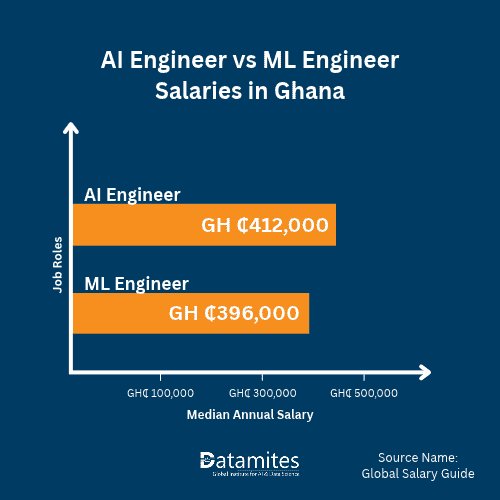
According to the Global Salary Guide, the estimated median annual salaries for these roles in Ghana are:
AI Engineer Salary in Ghana
The guide estimates a median annual salary of GH₵412,000 for AI engineers. These professionals develop AI-based applications and integrate models into software systems. Their responsibilities may include API integration, application development, testing and deployment.
Machine Learning Engineer Salary in Ghana
The estimated median annual salary for machine learning engineers is GH₵396,000. Their work generally involves preparing data, developing predictive models, evaluating results and maintaining machine learning systems.
What Should You Know About These Salary Figures?
The difference between the two estimates is relatively small. These figures should be treated as indicative estimates rather than guaranteed earnings or verified nationwide salary averages. The Global Salary Guide uses a model based on US occupational salary benchmarks, World Bank economic indicators, and exchange rates, rather than a nationwide survey of Ghanaian salaries.
Candidates should also compare current job advertisements and employer offers. A role's experience requirements and actual responsibilities can provide a more useful indication of its compensation.
Which Skills Are Useful for AI and Machine Learning Roles in Ghana?
The two careers share some technical foundations, but each requires a different level of focus in certain areas.
Python, SQL and Software Development
Python is widely used in AI and machine learning projects. SQL helps professionals retrieve and manage information from databases, while Git supports version control and collaboration.
AI engineers should also understand software development, APIs and application integration. Machine learning engineers need to work confidently with datasets and prepare information for model training.
Statistics and Machine Learning
Statistics, probability, and data interpretation are particularly important for machine learning engineers. They need to understand how algorithms work, how to select relevant features and how to evaluate model performance.
AI engineers should also understand the limitations of the models they integrate. This is important when an application generates responses or provides information that users may rely on.
Frameworks and Deployment Tools
Machine learning engineers may work with tools such as Scikit-learn, TensorFlow, and PyTorch to develop and evaluate models.
AI engineers may use language model APIs, natural language processing tools, retrieval-augmented generation (RAG) and computer vision services to develop applications.
Both roles benefit from knowledge of cloud platforms, testing, deployment, and performance monitoring.
Responsible AI and Data Protection
Professionals working with customer, financial, healthcare or public-service information need to consider privacy, data access, security and bias. Ghana's National AI Strategy also places importance on responsible AI adoption and data governance.
Understanding these issues helps professionals build systems that are suitable for real business use, rather than focusing only on technical performance.
Refer to these articles:
- AI Sovereignty: The New Mandate for Data Governance in the Cloud Era
- Traditional RAG vs Agentic RAG - What’s the Difference?
- What is Lemmatization in NLP?
AI Engineer or Machine Learning Engineer: Which Career Should You Choose?
The right career depends on the kind of technical work you enjoy and the skills you want to develop.
For learners based in Accra, an online artificial intelligence course in Accra can offer a flexible way to study AI concepts while managing other commitments. Before selecting a programme, compare its topics and practical work with the requirements of your preferred role.
Choose AI Engineering If You Enjoy Building Applications
AI Engineering may suit people who enjoy software development and connecting different technologies to solve practical problems. Projects may include customer support assistants, document-processing applications and tools that use language models.
Start by developing your Python skills and understanding APIs, application development, testing and deployment.
Choose Machine Learning Engineering If You Enjoy Working with Data
Machine Learning Engineering may be a better fit for people who enjoy statistics, experimentation and finding patterns in datasets. Projects can include fraud detection, customer churn prediction and demand forecasting.
Build a foundation in Python, SQL, statistics, feature engineering and model evaluation.
Can You Move Between These Careers?
Yes. The two roles share programming, AI fundamentals, testing and deployment practices. An AI Engineer can develop stronger skills in model development, while a Machine Learning Engineer can gain experience in APIs and application development.
A move between the roles will depend on the technical requirements of the position. Practical projects can help demonstrate that you have developed the skills needed for the new responsibilities.
How Can You Prepare for AI or Machine Learning Jobs in Ghana?
A structured learning plan can help you move from basic concepts to practical work. The following steps can be useful for beginners and professionals changing career direction.
1. Build your technical foundation: Start with Python, SQL, basic statistics and data handling. These subjects provide a foundation for both career paths.
2. Select a career direction: Explore AI application development if you prefer software projects. Choose machine learning if you are more interested in data, algorithms and predictive models.
3. Work on practical projects: For an AI Engineering portfolio, build a document-based assistant that answers questions using a set of approved documents. This can help you practise Python, API integration, information retrieval and application testing. For a Machine Learning portfolio, develop a transaction-classification project using synthetic or publicly available data. Compare different models and explain their precision, recall and limitations.
4. Document your work: Use GitHub or a portfolio to explain the problem, dataset, tools, development process and results. Include limitations and possible improvements rather than presenting only the final output.
5. Review job descriptions: Check platforms such as LinkedIn Jobs, Jobberman Ghana and MyJobMag Ghana, along with employer career pages. Search for titles such as Junior AI Developer, Python Developer, Machine Learning Engineer, AI Application Developer and Data Scientist. Read the requirements carefully because similar job titles can involve different responsibilities.
6. Practise explaining your projects: Be prepared to describe how your application or model works, how you tested it, what problems you encountered and where it may not perform well.
A portfolio cannot guarantee employment, but it gives employers examples of your technical knowledge and problem-solving approach. Learners who prefer a structured learning route can consider an online artificial intelligence course in Ghana to develop relevant concepts and practise technical skills.
AI Engineering and Machine Learning Engineering offer different ways to work with artificial intelligence. AI Engineers focus more on developing applications that use AI, while Machine Learning Engineers concentrate on building and maintaining models that learn from data. Both roles require programming, practical problem-solving and an understanding of responsible AI.
Ghana's National AI Strategy reflects the country's plans for developing its AI ecosystem, but actual employment opportunities will depend on business adoption and employer requirements. Aspiring professionals should review current vacancies, compare the skills requested and build projects that demonstrate their abilities.
DataMites Institute is a globally recognised training institute with more than 12 years of trust and over 200,000 learners globally. Its programmes cover Artificial Intelligence, Machine Learning, Data Science, Data Analytics and Python development.
For learners in Ghana, exploring a structured programme can be one way to develop technical knowledge and work on practical projects. Before selecting a course, review its curriculum, learning format, duration and project work to make sure it supports your intended career direction.