Small Language Models vs Large Language Models: Which Should You Use
Small Language Models (SLMs) offer efficiency, lower costs, and faster deployment, while Large Language Models (LLMs) deliver broader capabilities for complex tasks. Explore their differences, benefits, and use cases to choose the right model for your needs.
 Priyanka BR
Artificial intelligence is making language models more accessible, but choosing between Small Language Models and Large Language Models can be challenging. An AI language model can differ significantly in performance, computing requirements, cost, speed, and deployment. While Large Language Models are designed for complex tasks and broad language understanding, Small Language Models can deliver efficient results for focused applications.
The choice between a small language model vs large language model depends on factors such as task complexity, computing resources, privacy, response speed, and budget. Understanding the key differences between an SLM vs LLM can help developers, businesses, and AI professionals select the right language model for their specific requirements.
What Are Small Language Models and Large Language Models?
Small Language Models (SLMs) and Large Language Models (LLMs) are AI systems that can understand, process, and generate human language. Both can support tasks such as text generation, summarization, question answering, content analysis, and conversational AI. The main difference is their scale, which influences their capabilities, resource requirements, and deployment options.
Small Language Models
Small Language Models are compact AI systems designed to perform language-related tasks with relatively fewer computational resources. Their efficiency makes them suitable for focused applications where speed, lower resource consumption, privacy, or local deployment is important. This growing interest is also reflected in the market, with Grand View Research projecting the global small language model market to reach USD 20.7 billion by 2030, growing at a CAGR of 15.1%. This growth highlights the increasing demand for practical and efficient AI solutions across different applications.
Examples of SLMs
- Microsoft Phi
- Google Gemma
- TinyLlama
- Mistral 7B
- Meta Llama smaller variants
- Qwen smaller variants
Large Language Models
Large Language Models are developed at a much larger scale and are designed to handle a broad range of language-based tasks. They can support applications involving reasoning, coding, content generation, translation, research, and conversational AI. Their broader capabilities make them suitable for complex and varied workloads, although they generally require greater computing resources and infrastructure.
Examples of LLMs
- OpenAI GPT
- Meta Llama
- Mistral Large
- Google Gemini
- Anthropic Claude
- Qwen Large Models
Refer to these articles:
- Will AI Agents Replace Your Next Coworker? Exploring the Future of Work
- Explainable AI: Why Black-Box Models Are Losing Trust
- LLM Fine-Tuning vs Prompt Engineering: Which Is Better?
Small Language Models vs Large Language Models: Key Differences
The difference between Small Language Models and Large Language Models becomes clearer when they are evaluated across practical factors such as model size, performance, computing needs, speed, cost, and deployment. Rather than focusing only on the number of parameters, it is more useful to understand how each approach affects real-world AI applications.
| Factor | Small Language Models | Large Language Models |
| Model size | Relatively compact | Significantly larger |
| Computing needs | Lower | Higher |
| Response speed | Generally faster | Can require more processing time |
| Cost | Usually more economical to operate | Typically higher infrastructure and usage costs |
| Deployment | Suitable for local and edge environments | Often deployed through cloud or high-capacity infrastructure |
| Task range | Best suited to focused tasks | Better suited to broad and complex tasks |
| Privacy | Can support local processing | May use cloud-based processing |
| Customization | Often practical for specific domains | Can provide broader general-purpose capabilities |
Performance and Efficiency
Which is better for faster AI responses, an SLM or an LLM?
SLMs can be advantageous when an application needs quick responses and predictable performance for a defined task. LLMs generally provide greater flexibility for applications that involve varied instructions, complex reasoning, or multiple language-based workflows. However, performance should always be evaluated against the specific task rather than model size alone.
Cost and Computing Requirements
Are small language models cheaper to run than large language models?
The smaller architecture of an SLM can reduce memory and processing requirements, making it easier to operate with limited infrastructure. LLMs typically demand greater computational capacity, particularly for large-scale inference. This difference can have a direct impact on infrastructure planning and operating costs.
Deployment and Scalability
When should you use a small language model instead of a large language model?
SLMs can be deployed on local devices, private infrastructure, or edge environments where keeping data closer to its source is important. LLMs are often better suited to centralized systems that need broad capabilities across many applications and users. The appropriate choice therefore depends on the required scale, infrastructure, and level of model capability.
Advantages and Limitations of Small and Large Language Models
Choosing between different AI language model approaches involves balancing capability, efficiency, and practical requirements. Both Small Language Models and Large Language Models can be effective, but their strengths become more valuable in different situations.
Advantages of Small Language Models
- Efficient and economical: Small models generally require fewer computing resources, which can make them practical for organizations working with limited infrastructure or focused workloads.
- Faster processing: Their compact architecture can support quicker responses, making them useful for applications where low latency is important.
- Easy to specialize: A smaller language model can be adapted for specific business tasks, such as classification, summarization, document processing, or internal assistants.
- Flexible deployment: SLMs can be suitable for local and edge environments, giving organizations greater control over where their AI workloads are processed.
Limitations of Small Language Models
The reduced scale of an SLM can become a limitation for highly complex tasks. Smaller models may not provide the same breadth of contextual understanding, reasoning ability, or general-purpose performance required by demanding applications.
Advantages of Large Language Models
- Broader capabilities: A large LLM model can handle diverse workloads, including coding, content generation, translation, reasoning, research assistance, and conversational applications.
- Greater task flexibility: Large models can work across different types of instructions and workflows, making them suitable for general-purpose artificial intelligence applications.
- Strong ecosystem: Many open source LLM models are available for organizations that want greater control over model customization, deployment, and development.
Limitations of Large Language Models
The greater capabilities of LLMs can also introduce higher infrastructure requirements, operational complexity, and resource consumption. Organizations may need to carefully manage computing capacity, usage costs, data governance, and deployment considerations.
The small language model vs large language model decision therefore depends on the application's objectives rather than model size alone. Understanding the specific advantages and limitations is an important part of evaluating SLM vs LLM options.
Which Language Model Should You Choose for Different Use Cases?
Choosing between Small Language Models and Large Language Models depends mainly on what the application needs from the model. Smaller models are generally suitable when efficiency, speed, and focused performance are priorities, while larger models are more appropriate for demanding applications that require broader capabilities.
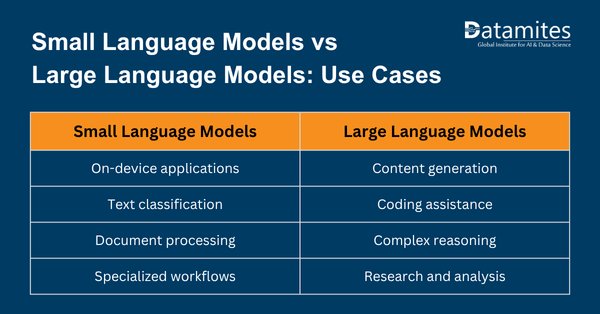
The best approach is to match the model with the complexity of the task, available computing resources, privacy requirements, and expected performance. In some applications, organizations may also combine both model types, using the most suitable model for each individual workload. This makes SLM vs LLM a practical decision based on requirements rather than model size alone.
Small Language Models vs Large Language Models: Which Is Right for You?
There is no single best option between Small Language Models and Large Language Models. Choose a Small Language Model when efficiency, faster responses, local deployment, privacy, or a focused business task is the priority. It can be a practical choice for organizations seeking useful AI capabilities without extensive computing infrastructure. A Large Language Model, on the other hand, is better suited to applications that require broader capabilities, complex instructions, advanced reasoning, or support across multiple workflows.
The growing importance of Large Language Models is also reflected in market growth. According to Fortune Business Insights, the global large language model market was valued at USD 7.84 billion in 2025 and is projected to reach USD 137.85 billion by 2034, growing at a CAGR of 37.52%. Ultimately, the right choice depends on the task, infrastructure, budget, privacy requirements, and expected scale, helping organizations find the right balance between capability and efficiency.
The growing use of language models is creating demand for professionals who understand how modern AI systems are developed and applied. DataMites Institute provides AI and machine learning courses with practical projects, structured learning, and industry-relevant training to help learners develop job-ready skills.
Refer to these articles:
- Traditional RAG vs Agentic RAG - What’s the Difference?
- LLMs vs. SLMs: Key Differences and How to Choose the Right Model
- AI Sovereignty: The New Mandate for Data Governance in the Cloud Era
Learners can build expertise through training options such as Artificial Intelligence Engineer, Artificial Intelligence Expert, Certified NLP Expert, R Programming Courses, and Artificial Intelligence Foundation. The learning covers key areas including Python, machine learning, deep learning, NLP, generative AI, computer vision, and AI automation, with selected programs offering IABAC certification and NASSCOM FutureSkills certification.
With a growing training presence across India, DataMites Institute has more than 50 offline training centers, offering artificial intelligence courses in Pune, along with training facilities in Bangalore, Hyderabad, Chennai, Ahmedabad, Delhi, Coimbatore, and Mumbai. The institute has also trained over 200,000 learners, helping students and professionals access practical, industry-focused AI education across different locations.
For learners from Delhi and nearby regions who prefer classroom-based learning, DataMites Delhi provides access to practical AI and machine learning training with hands-on projects and structured guidance. Students and working professionals from surrounding areas can also explore the center to build industry-relevant skills in a guided learning environment.