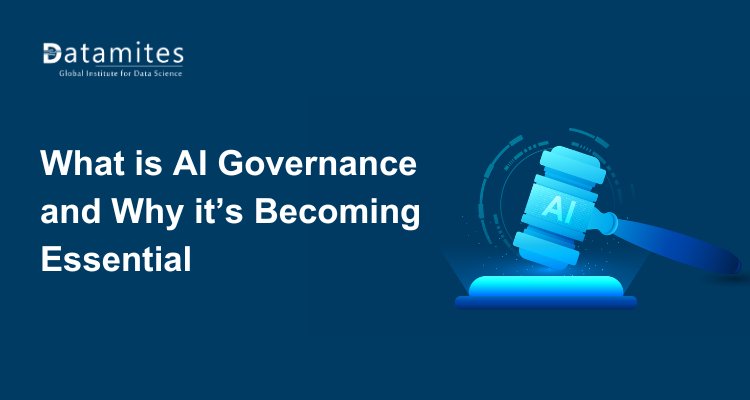
What Is AI Governance and Why It's Becoming Essential
AI governance is the framework of policies, processes, and controls that ensure AI is used responsibly, ethically, and compliantly. It helps organizations manage risks, build trust, and meet evolving regulations.
 Prerana B A
Artificial intelligence is transforming industries by automating processes, improving decision-making, and driving innovation. From healthcare and finance to retail and manufacturing, AI adoption continues to grow rapidly. According to McKinsey & Company, over 70% of organizations have adopted AI in at least one business function, highlighting its expanding role across sectors.
However, the rise of AI has also increased concerns around algorithmic bias, data privacy, security, transparency, and accountability. As organizations face greater scrutiny from regulators, customers, and stakeholders, AI Governance has become a critical business priority for ensuring responsible, compliant, and trustworthy AI adoption.
What Is AI Governance?
AI Governance refers to the frameworks, policies, processes, and controls that guide the responsible development, deployment, monitoring, and management of artificial intelligence systems within an organization.
The primary objective of AI governance is to ensure that AI technologies operate in a manner that is ethical, transparent, secure, compliant, and aligned with organizational goals and societal expectations.
When asking, 'What is AI governance?', organizations should view it as a structured approach to managing AI-related risks while maximizing the value and benefits of AI innovation.
Core Objectives of AI Governance
Effective AI governance focuses on several key principles:
- Ensuring Responsible AI practices
- Promoting AI Accountability across teams
- Enhancing AI Transparency in decision-making
- Strengthening AI Security and data protection
- Supporting regulatory compliance
- Minimizing AI-related risks
- Building Trustworthy AI systems
Why AI Governance Is Becoming Essential
As artificial intelligence becomes increasingly integrated into business operations, organisations need effective oversight to ensure AI systems are used responsibly. With AI influencing decisions across industries such as healthcare, finance, retail, and manufacturing, AI governance plays a critical role in managing risks, ensuring compliance, promoting transparency, and building trust among stakeholders.
Key Reasons AI Governance Is Becoming Essential
- Rapid AI Adoption: Organizations across industries are deploying AI to automate processes, improve decision-making, and enhance customer experiences, increasing the need for proper oversight.
- Managing AI Risks: AI systems can introduce challenges such as algorithmic bias, inaccurate predictions, security vulnerabilities, and unintended consequences that require continuous monitoring and risk management.
- Increasing Regulatory Requirements: Governments worldwide are introducing AI regulations and compliance standards, making governance frameworks necessary for meeting legal and regulatory obligations.
- Protecting Data Privacy: AI models rely heavily on data, and governance helps ensure responsible data collection, storage, usage, and protection to safeguard sensitive information.
- Enhancing Transparency and Explainability: Organizations need explainable AI systems that allow stakeholders to understand how decisions are made, improving accountability and trust.
- Strengthening AI Accountability: Governance establishes clear roles, responsibilities, and decision-making processes to ensure accountability throughout the AI lifecycle.
- Building Trustworthy AI Systems: Customers, employees, investors, and regulators are more likely to trust AI solutions that operate fairly, ethically, and transparently.
- Supporting Responsible AI Practices: AI governance helps organizations align AI development with ethical principles and business values while minimizing potential harm.
- Improving AI Security: Governance frameworks include controls and monitoring mechanisms that protect AI systems from cyber threats, model manipulation, and unauthorized access.
- Enabling Sustainable Innovation: By balancing innovation with risk management and compliance, AI governance allows organizations to scale AI initiatives confidently and responsibly.
As AI continues to evolve and influence critical business functions, AI governance is no longer optional. It has become a strategic necessity for organizations seeking to maximize AI benefits while maintaining compliance, accountability, transparency, and stakeholder trust.
Refer to these articles:
- Traditional RAG vs Agentic RAG — What’s the Difference?
- LLMs vs. SLMs: Key Differences and How to Choose the Right Model
- AI Sovereignty: The New Mandate for Data Governance in the Cloud Era
Key Components of an Effective AI Governance Framework
An effective AI Governance Framework provides the structure, policies, and controls needed to ensure AI systems are developed, deployed, and monitored responsibly. It helps organizations manage risks, maintain compliance, and build trust while maximizing the value of AI initiatives.
AI Policies and Standards
Organizations should establish clear AI policies, ethical guidelines, and governance standards that define how AI systems are designed, used, and managed. These policies promote consistency, accountability, and responsible AI practices across the organization.
Risk Management and Monitoring
Effective AI Risk Management involves identifying, assessing, and mitigating potential risks throughout the AI lifecycle. Continuous monitoring helps detect issues such as model drift, bias, security vulnerabilities, and performance degradation before they impact business operations.
Data Governance
Since AI systems rely heavily on data, strong data governance is essential. This includes maintaining data quality, ensuring data privacy, managing access controls, and implementing data lifecycle management practices to support reliable and compliant AI operations.
Compliance and Auditing
Regular AI Auditing and compliance reviews help organizations meet regulatory requirements and internal governance standards. Proper documentation, audit trails, and reporting processes improve transparency and demonstrate accountability.
Organizations often align their governance programs with established standards such as the NIST AI Risk Management Framework (AI RMF), ISO/IEC 42001, the EU AI Act, and OECD AI Principles to support compliance and accountability.
Human Oversight
Human oversight ensures that critical AI-driven decisions remain subject to human review and judgment. Governance committees, approval workflows, and human-in-the-loop systems help maintain control, reduce risks, and support ethical AI decision-making.
As AI continues to reshape industries, AI Governance is becoming essential for managing risks, ensuring compliance, and promoting responsible AI use. Strong governance frameworks help organizations build trust, maintain accountability, and drive sustainable AI innovation.
Leading AI Governance Frameworks and Standards
Organizations developing AI governance programs often rely on established frameworks and standards to guide implementation and compliance efforts.
NIST AI Risk Management Framework (AI RMF)
Developed by the National Institute of Standards and Technology, the NIST AI RMF helps organizations identify, assess, manage, and monitor AI-related risks. The framework focuses on trustworthy AI principles, including validity, safety, security, accountability, transparency, and fairness.
ISO/IEC 42001
International Organization for Standardization and the International Electrotechnical Commission introduced ISO/IEC 42001 as the first international management system standard specifically designed for artificial intelligence. It provides organizations with a structured approach to establishing, implementing, maintaining, and continually improving AI management systems.
European Union AI Act
The European Union AI Act is one of the world's first comprehensive AI regulations. It adopts a risk-based approach that categorizes AI systems according to their potential impact and establishes compliance obligations for high-risk AI applications.
OECD AI Principles
The Organisation for Economic Co-operation and Development AI Principles provide globally recognized guidelines for responsible AI development. They emphasize transparency, accountability, human-centered values, fairness, and sustainable AI innovation.
By aligning governance programs with these frameworks, organizations can strengthen compliance, improve risk management, and build greater trust in AI systems.
Benefits of AI Governance for Organizations
Organizations implementing strong AI governance frameworks gain several advantages.
- Improved Regulatory Compliance: Governance programs help organizations stay aligned with evolving AI regulations and compliance requirements.
- Reduced Business Risks: Proactive governance minimizes operational, legal, financial, and reputational risks associated with AI deployment.
- Enhanced AI Reliability: Continuous monitoring improves model accuracy, consistency, and performance over time.
- Greater Transparency and Accountability: Clear governance structures promote AI Accountability and improve stakeholder confidence.
- Increased Customer and Stakeholder Trust: Trustworthy AI practices strengthen brand reputation and support long-term customer relationships.
- Sustainable AI Innovation: Rather than restricting innovation, effective governance enables organizations to scale AI responsibly and confidently.
As AI adoption grows, AI Governance is essential for ensuring responsible, transparent, and compliant AI use. Strong governance helps organizations manage risks, build trust, and drive sustainable AI innovation.
Challenges in Implementing AI Governance
Despite its benefits, implementing AI governance presents several challenges.
Organizations often face:
- Lack of standardized frameworks
- Rapidly evolving regulations
- Difficulty balancing innovation with control
- Limited governance expertise
- Complexity of Machine Learning Governance
- Challenges monitoring large-scale and generative AI systems
Addressing these obstacles requires cross-functional collaboration between technical teams, legal departments, compliance professionals, and business leaders.
Emerging Trends Shaping the Future of AI Governance
As AI adoption continues to grow, several trends are shaping how organizations govern and manage AI systems responsibly.
Global Regulatory Developments
Governments worldwide continue introducing new AI regulations, making governance capabilities increasingly important.
Regulations such as the EU AI Act and emerging governance standards like ISO/IEC 42001 are influencing how organizations design and manage AI governance programs worldwide.
Automated AI Monitoring Tools
Organizations are adopting specialized tools that automate governance, monitoring, risk detection, and compliance reporting.
Responsible AI by Design
Rather than addressing governance after deployment, businesses are embedding Responsible AI principles directly into development processes.
Explainable and Transparent AI Models
Demand for Explainable AI is driving innovation in interpretable machine learning techniques.
Governance for Generative AI Systems
The rapid rise of generative AI technologies has created new governance challenges related to content generation, intellectual property, misinformation, and security.
Enterprise-Wide AI Governance Platforms
Many organizations are moving toward centralized Enterprise AI Governance platforms that provide visibility across all AI assets, models, and workflows.
Refer to these articles:
- Will AI Agents Replace Your Next Coworker? Exploring the Future of Work
- Explainable AI: Why Black-Box Models Are Losing Trust
- How AI is Transforming Customer Analytics in 2026
The Future of AI Governance
As AI becomes increasingly integrated into critical business operations, AI Governance will evolve from a compliance requirement into a strategic business capability. Organizations will embed governance controls throughout the AI lifecycle, from data collection and model development to deployment, monitoring, and ongoing oversight.
The need for stronger governance is becoming more evident. A 2026 IBM study found that 77% of technology leaders believe current AI governance frameworks are inadequate, while organizations experience an average of 54 AI-related incidents annually. Businesses that prioritize Trustworthy AI, transparency, ethics, and accountability will be better positioned to manage risks, build trust, and drive sustainable AI innovation.
AI is transforming industries by driving innovation, efficiency, and growth, but it also introduces new risks and responsibilities. Implementing effective AI Governance helps organizations balance innovation with ethics, compliance, transparency, security, and accountability. As AI technologies and regulations continue to evolve, strong governance frameworks will be essential for ensuring responsible, trustworthy, and sustainable AI adoption.
This is an excellent time to start a career in artificial intelligence. Enrolling in an industry-focused artificial intelligence course in Chennai, Hyderabad, Bangalore, Pune, Coimbatore, Ahmedabad, or Mumbai can help learners build practical skills in machine learning, deep learning, natural language processing, computer vision, generative AI, and AI tools through hands-on projects and real-world case studies. As organizations continue adopting AI-driven technologies and automation, skilled professionals are becoming increasingly valuable across industries.
To support this growing demand, DataMites Training Institute offers a comprehensive Artificial Intelligence course designed to provide practical, industry-relevant learning. The program covers Python programming, machine learning, deep learning, NLP, computer vision, and generative AI through live projects, internships, and capstone assignments. Accredited by IABAC® and NASSCOM FutureSkills, the course also includes placement assistance and flexible learning options to help learners build successful careers in AI.
DataMites offers artificial intelligence courses in Pune, Chennai, Bangalore, Mumbai, Hyderabad, Ahmedabad, Coimbatore, and other major cities across India. It also provides flexible online training programs, enabling learners worldwide to access the same industry-focused curriculum, hands-on experience, expert mentorship, and career support.