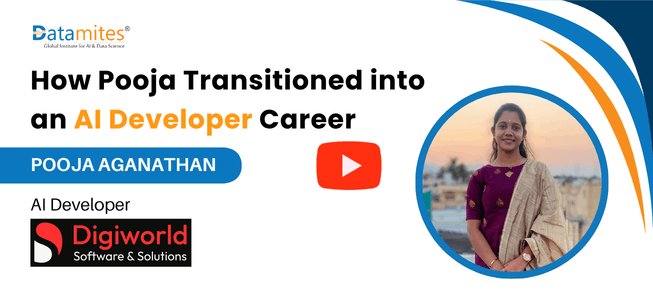
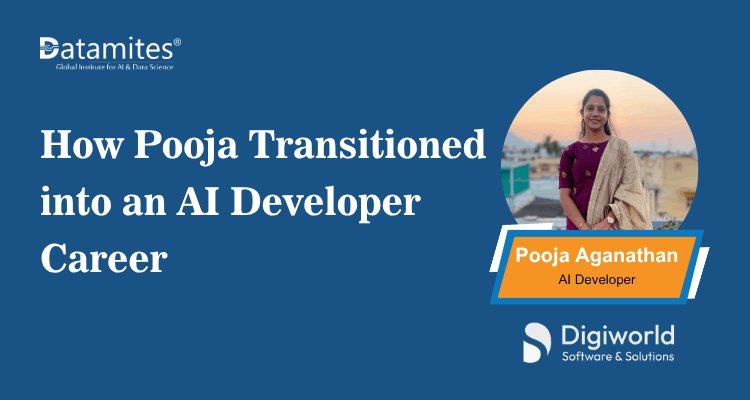
How Pooja Transitioned into an AI Developer Career
Pooja’s journey shows how practical learning and focused skill development helped her transition into an AI Developer career and prepare for new opportunities in Artificial Intelligence.
 Priyanka BR
Meet Pooja, an IT graduate who decided to transition from her corporate career into the technical and analytical world of data science and Artificial Intelligence. Moving into a new field required her to build the right skills, gain practical exposure, and prepare herself for technical interviews.
Her learning journey with DataMites helped her gain structured knowledge, work on practical projects, and become more confident in applying concepts to real-world situations. But what challenges did she face during this transition, and how did DataMites help her prepare for the next step in her career?
Let’s explore Pooja’s journey, learning experience, project work, interview preparation, and the lessons she gained along the way.
How DataMites Helped Pooja Become an AI Developer
This Q&A explores Pooja’s career transition into Artificial Intelligence and her experience with DataMites training, practical projects, mock interviews, and placement preparation. She also shares valuable lessons from her interview experience and advice for aspiring AI professionals.
Q1: Can you tell us about yourself and your career journey?
I am Pooja from Coimbatore. I completed my B.Tech in Information Technology in 2022 and gained experience in a corporate environment. Later, I decided to transition into data science and build a more technical artificial intelligence career. After completing my learning and placement preparation, I was placed as an AI Developer at Digiworld Software Solutions.
Q2: Why did you decide to transition into AI and data science?
I wanted to move into a more technical and analytical career. After gaining experience in the corporate environment, I felt that data science and related fields would give me the opportunity to work more deeply with technology, data, and problem-solving. So, I decided to build the required technical skills and transition into this field.
Q3: Why did you choose DataMites for your learning journey?
I was looking for a structured way to learn rather than studying different topics randomly. I wanted learning to be not only concept-based but also practical. I wanted to understand how the concepts were applied to real-world data and projects. That structured learning approach was one of the main reasons I chose DataMites.
Q4: What did you learn during your DataMites course?
During my learning journey, I worked on Python, SQL, statistics, and Machine Learning. Along with the technical concepts, I also worked on practical projects and interview preparation. This helped me understand the fundamentals and then apply them through projects instead of simply memorizing definitions.
Q5: How was your experience with the DataMites offline training in Coimbatore?
I attended the offline batch in Coimbatore, and my overall learning journey was very helpful. Since I was transitioning into data science, I wanted a structured learning environment where I could understand both concepts and their practical applications. The projects helped me understand the concepts better, and I was happy with the learning experience at DataMites.
Q6: How many projects did you complete at DataMites?
I completed five projects in total, including one client project. The projects involved real-world-style datasets, and some of them had more than one million records. Working with these datasets gave me an opportunity to understand how the concepts I learned could be implemented in practical situations.
Q7: How was your experience working on the client project?
The client project was very useful as I was new to data science. Working with real-world datasets and practical tasks helped me apply what I learned and better understand data science in practice.
Q8: How did mock interviews help you prepare for the actual interview?
The mock interview gave me real interview experience before the actual interview. I cleared it on my first attempt, and the feedback helped me structure my answers, explain concepts clearly, and identify areas for improvement.
Q9: How did you prepare for your interviews?
I started preparing alongside my learning. I used different resources, including YouTube channels, DataMites textbooks, and my preparation notes. I used these resources to understand concepts, definitions, and practical examples. I also focused on connecting theoretical knowledge with real-world AI applications.
Q10: How did the DataMites placement team help you?
The placement team was very supportive throughout my placement journey. Whenever I reached out to them, they responded and helped me from the beginning until the final stages. I would also like to thank Jani and the DataMites placement team for their support. Their guidance was very useful and valuable throughout my journey.
Q11: What kind of technical questions were asked during the interview?
I was asked questions related to Python programming, SQL, Power BI, Machine Learning, AI applications, and prompt engineering. They wanted to understand whether I could explain concepts practically rather than simply giving textbook definitions. I was also asked how SQL could be connected with Power BI, and I had to explain the practical approach.
Q12: Did DataMites help you with resume preparation?
Yes. The team helped me with my resume preparation. I revised my resume three to four times based on their feedback. on what the resume should look like and how it should be prepared for interviews. Since the resume is the first step toward getting shortlisted, this support was very useful for me.
Q13: What skills should students focus on while preparing for technical interviews?
I feel students should focus more on practical Python and SQL rather than only studying definitions. For Python, it is important to practice programming questions and solve problems yourself. The same applies to SQL. There are many websites and resources available for practicing programming questions, so students should spend more time actually writing and solving programs.
Q14: What advice would you give to students preparing for Artificial Intelligence interviews?
My advice is not to wait until you receive interview calls before starting preparation. Start preparing alongside your learning. Make sure you understand every project you put on your resume because interviews can go very deep into your projects. Also, do not focus only on completing the syllabus. Try to understand every concept properly and connect it with a practical example.
Refer to these articles:
- Small Language Models vs Large Language Models: Which Should You Use?
- AI in Cybersecurity: How Companies Are Fighting AI-Powered Threats
- AI Answer Engines vs Traditional Search: How Google Rankings Are Changing
Pooja’s Key Takeaways on Building a Career in Artificial Intelligence
Pooja’s journey shows how structured learning, practical exposure, and consistent interview preparation can support a successful transition into Artificial Intelligence.
- Background: Pooja completed her B.Tech in Information Technology in 2022 before gaining corporate experience.
- Career Transition: She decided to move into a more technical and analytical field.
- Learning Choice: She chose DataMites for its structured approach to learning data science and Artificial Intelligence.
- Technical Skills: She learned Python, SQL, statistics, and Machine Learning.
- Practical Projects: Working on projects helped her connect technical concepts with real-world applications.
- Client Project: She completed a client project involving large datasets and practical data-related tasks.
- Mock Interview: She cleared her mock interview on the first attempt and used the feedback to improve her preparation.
- Self-Learning: She used DataMites textbooks, preparation notes, and YouTube resources to strengthen her knowledge.
- Resume Support: DataMites helped her improve her resume and prepare it for interview opportunities.
- Interview Skills: Her interviews covered Python, SQL, Power BI, Machine Learning, AI applications, and prompt engineering.
- Career Preparation: Her experience shows why learners exploring Top IT Courses should look beyond theory and focus on practical skills, projects, and interview readiness.
- Placement Support: The placement team guided her throughout the interview and placement process.
- Career Achievement: Her consistent preparation helped her secure an AI Developer role.
- Advice: Pooja recommends understanding concepts deeply, practicing programming regularly, and preparing for interviews alongside learning.
Refer to these artciles:
- How Angel Started Her AI/ML Engineer Career as a Fresher
- How Did Jayanth Transition into an AI & ML Engineer Career?
- How Thennarasu Started His AI Developer Career as a Fresher
Pooja’s journey shows how structured learning and consistent preparation can support a successful career transition into Artificial Intelligence. She joined the Artificial Intelligence Course in Coimbatore at DataMites to strengthen her technical and analytical skills and gain practical knowledge. Through hands-on projects, mock interviews, and placement guidance, she improved her understanding of Python, SQL, Machine Learning, and AI concepts, helping her prepare for opportunities in the AI industry.
DataMites Institute offers a 9-month Artificial Intelligence program that blends strong theoretical foundations with practical, project-based learning. Participants work on hands-on exercises, real-world projects, and relevant AI tools to develop industry-ready skills. The program features learning paths such as AI Engineer, AI Specialist, AI for Product Managers, AI Foundation, and Certified NLP Professional, along with IABAC and NASSCOM FutureSkills certifications to validate their learning.
As Artificial Intelligence continues to shape industries and create technology-focused career opportunities, practical skills are becoming increasingly valuable. DataMites Institute has 50+ offline centres across India, offering classroom-based Artificial Intelligence Courses in Delhi, Ahmedabad, Chennai, Hyderabad, Bangalore, Pune, Mumbai, and many other locations. With expert-led sessions, hands-on exercises, real-world projects, and industry-focused training, learners can build practical skills relevant to evolving AI career opportunities.