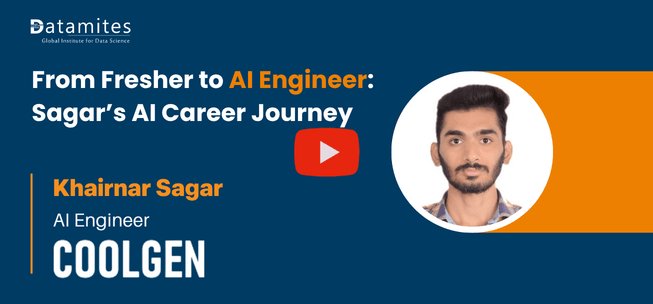
From Fresher to AI Engineer: Sagar’s AI Career Journey
Sagar’s journey shows how a fresher can become an AI Engineer through consistent learning, practical projects, and guided mentorship. It highlights how building strong AI fundamentals and staying dedicated can lead to a successful career transformation.
 Priyanka BR
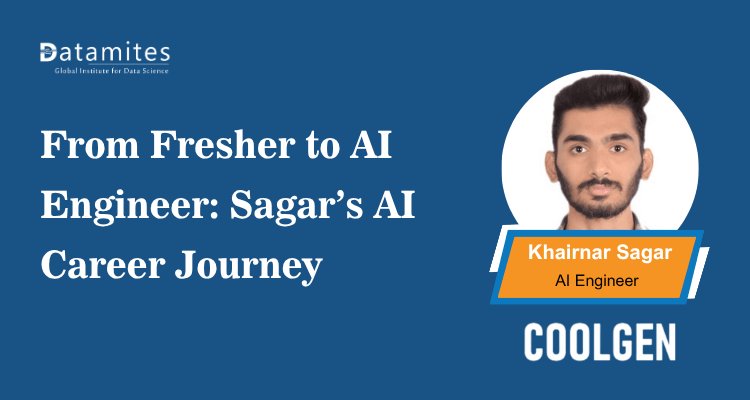
Meet Sagar, a software developer who transformed his curiosity about Artificial Intelligence into a promising career by taking the right steps, choosing the right mentorship, and staying consistent with his learning journey.
His transition was not simple. From strengthening his understanding of machine learning concepts to working on real-world AI projects, Sagar proved that consistent effort and determination can overcome any challenge. The turning point in his journey came through a structured, hands-on learning experience at DataMites, where he learned how to convert theoretical knowledge into job-ready skills.
Today, Sagar’s journey stands as an example for aspiring professionals who want to move into Artificial Intelligence. His experience shows how dedication, guided learning, and practical exposure can help turn career ambitions into real achievements.
How Sagar Strengthened His AI Journey with DataMites
Sagar’s journey shows how a software developer can successfully build a strong foundation in Artificial Intelligence through structured learning, hands-on projects, and consistent practice. By choosing the Best IT courses, along with proper guidance and practical exposure, he developed strong technical skills and confidence, which helped him move forward in his AI career as an AI Engineer.
1. Can you introduce yourself and your background?
My name is Sagar. I have completed my Bachelor’s degree in Computer Science and Engineering, and I have around 2 to 3 years of experience working as a software developer before transitioning into data science and AI.
2. What made you shift from software development to data science?
While working as a developer, I wanted to move into a field that involved more analytics, predictions, and decision-making. Artificial Intelligence offers opportunities to work with real-world data and solve complex problems, which motivated me to switch.
3. How did you find data science and AI training programs?
I searched online and found the program through Google. After reading positive reviews, I felt confident and decided to contact the team to get started. My learning journey officially began on July 10, 2024.
4. Since you are from a programming background, was Python easy for you?
Yes, Python Programming was not new to me. However, I wanted to gain deeper knowledge and understand how it is applied specifically in AI, especially in real-time analytics and machine learning projects.
5. How was your overall learning experience?
The experience was very structured and beginner-friendly. Even someone without a coding background can understand the concepts. I gained both theoretical knowledge and practical exposure, which helped me build confidence, which eventually helped me move into an AI Engineer role at Coolgen Solutions.
6. Did mentors support you during your learning journey?
Yes, the mentors were very supportive at DataMites. They explained concepts clearly and were always available to help. Their guidance played an important role in improving my understanding throughout the learning journey.
7. Can you tell us about your project experience?
During the internship, we worked on multiple projects. Whenever I had confusion, especially about selecting machine learning models, the team helped me. They also provided feedback on how to improve accuracy and performance.
8. Were these projects individual or team-based?
We worked on projects as a team. This helped me learn collaboration and understand different approaches to solving problems.
9. What approach did you follow for real-time projects?
I followed a step-by-step process:
- Understanding project requirements
- Performing data analysis
- Handling missing values, duplicates, and outliers
- Feature selection
- Applying machine learning Algorithms
This structured approach helped me build better models.
10. Did you receive feedback during project work?
Yes, I received continuous feedback. The team evaluated my work and suggested improvements, which helped me enhance my performance.
11. How did you prepare for interviews?
I practiced daily and worked on multiple projects. I also attended mock interviews, which helped me understand the real interview environment and improve my weak areas.
12. How many mock interviews did you attend?
I attended around three mock interviews, and they closely matched real interview patterns. They helped me understand question types better and significantly improved my confidence, especially after clearing the third one.
13. What kind of questions were asked in interviews?
The interview process had multiple stages:
- Python coding questions
- Machine learning concepts like regression and model evaluation
- Statistics topics such as descriptive and inferential statistics
SQL queries and data handling
14. What was the selection process like?
The process included:
- Online assessment (MCQs)
- Technical rounds
- HR interviews
After clearing all rounds, I received offer letters.
15. What role did resume preparation play in your success?
Resume guidance was very helpful. I learned how to highlight key skills and optimize my resume for ATS systems, which increased my chances of getting shortlisted.
16. How much time did you dedicate to practice?
I practiced around 8 to 9 hours daily. Consistent practice is very important in Artificial Intelligence because it helps retain concepts and improves problem-solving skills.
17. How many projects did you complete overall?
I worked on around 10 to 12 projects during my learning journey. These included both guided and self-practice projects from online platforms. This consistent practice helped me strengthen my concepts and improve real-world problem-solving skills.
18. What advice would you give to beginners?
Focus on consistent practice, work on real-world projects, and keep learning continuously. Data science requires both theoretical understanding and hands-on experience, so balancing both is very important.
Refer to these articles:
- The Future of Coding: Can AI Replace Software Engineers?
- Explainable AI: Why Black-Box Models Are Losing Trust
- Why Agentic AI Is the Most In-Demand Skill for Data Scientists in 2026
Key Artificial Intelligence Career Insights from Sagar’s Journey at DataMites
Sagar’s journey offers valuable insights for anyone planning to build a career in Artificial Intelligence and related fields. His experience shows how structured learning, continuous practice, and the right guidance can help transform a working professional into a job-ready AI Engineer.
- Sagar demonstrated that consistent learning and daily practice help in building a strong technical foundation and improving confidence over time
- His prior experience in software development, especially with Python, made it easier for him to understand advanced AI concepts and apply them effectively
- He focused on developing industry-relevant skills such as Python, SQL, machine learning models, and data handling tools required for real-world applications
- Working on multiple projects helped him apply theoretical concepts practically and understand how AI solutions are built for real business problems
- Guidance from trainers played an important role in simplifying complex topics and improving his overall learning experience
- Support from the PAT team helped him improve his resume and prepare effectively for interviews and job opportunities
- Regular practice, including working on projects and mock interviews, helped him build confidence for technical rounds
- His journey highlights that practical implementation and strong fundamentals are essential for succeeding in AI roles
- Overall, Sagar’s experience shows that with structured learning, consistent effort, and proper mentorship, learners can confidently move toward a successful career in Artificial Intelligence
Refer to these articles:
- From Computer Engineering to AI Developer: Akash’s AI Career Success Story
- How Prathmesh Cracked His First AI Engineer Job as a Fresher from Nagpur
- Aradhya’s Journey from B.Tech Computer Science Fresher to AI/ML Engineer
Sagar’s journey clearly reflects how the right combination of structured learning, consistent practice, and real-world exposure can shape a successful career in Artificial Intelligence. At DataMites, he built a strong foundation in machine learning and AI concepts and strengthened it further through hands-on internship projects, steadily developing both technical expertise and practical confidence.
DataMites Training Institute provides a well-structured 9-month Artificial Intelligence program designed to develop industry-ready skills through practical tools, live projects, and a strong focus on ethical AI practices. Recognized as a leading IT course, it offers multiple career pathways including AI Engineer, AI Specialist, AI Foundation, and NLP, allowing learners to select the most suitable direction. Backed by certifications from IABAC and NASSCOM FutureSkills, the program equips learners with the expertise needed to take on real-world roles in Artificial Intelligence and machine learning.
DataMites Institute offers strong placement support through mock interviews, resume building, and career guidance to help learners become job-ready. Along with flexible learning options, offline classroom training is also available for better hands-on experience. For learners in Tamil Nadu, DataMites provides an Artificial Intelligence course in Coimbatore, ensuring quality training with direct support to build a strong career in Artificial Intelligence.
DataMites also maintains a strong offline presence across more than 30 cities in India, making quality AI education accessible to learners nationwide. DataMites Institute offers programs in major tech hubs such as Artificial Intelligence Courses in Mumbai, Bangalore, Hyderabad, Pune, Chennai, Coimbatore, and Delhi, giving learners the flexibility to choose their preferred location while receiving consistent, industry-relevant training.