How Thennarasu Started His AI Developer Career as a Fresher
Thennarasu shares how structured learning, practical projects, and expert guidance helped him transition from a fresher into an AI Developer role. His journey highlights the steps he took to build technical confidence and begin his career in Artificial Intelligence.
 Priyanka BR
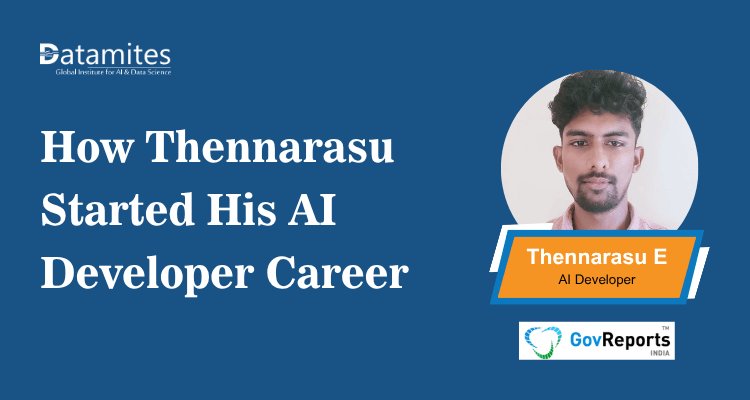
Meet Thennarasu from Coimbatore, an Artificial Intelligence and Data Science graduate who took an important step toward his dream career with DataMites. After completing his studies, he focused on building practical skills and gaining industry-oriented knowledge in Artificial Intelligence.
With the right learning environment and guidance, Thennarasu strengthened his confidence and prepared himself to enter the competitive AI job market. His efforts eventually helped him secure an AI Developer role at Impact standard business reporting pvt Ltd.
His journey reflects the impact of dedication, practical learning, and the right guidance in turning career aspirations into meaningful opportunities. Let’s explore how Thennarasu’s commitment and learning journey helped him move closer to his Artificial Intelligence career goals.
How Thennarasu Launched His AI Career with DataMites
Thennarasu’s journey as an Artificial Intelligence and Data Science graduate highlights the importance of practical learning and focused preparation. With structured training and guidance from DataMites, he strengthened his skills and confidence to begin his career in Artificial Intelligence.
Q1: Could you tell us a little about your background and yourself?
I completed my education with a specialization in Artificial Intelligence and Data Science. After completing my studies, I joined DataMites in Coimbatore with the guidance of the trainers. I am now placed as an AI Developer at Impact standard business reporting pvt Ltd.
Q2: What did you find most valuable about your training at DataMites?
In college, I mainly learned theoretical concepts. At DataMites, I learned how to approach a project from the beginning to the end. I understood what things we need to do at every stage and how to solve problems when an error occurs. They taught me everything step by step, and that helped me a lot.
Q3: How many hours did you spend studying every day?
I used to spend nearly four to five hours per day studying. I followed a regular routine and dedicated this time to my learning and preparation.
Q4: How was your experience learning Python?
In college, we did programming, but at DataMites, I learned how to approach a program properly. I started understanding what to do and why we are doing it. Initially, I felt Python was difficult to understand, but after I started applying it practically, I found it easier to learn.
Q5: How did practical learning change your understanding of programming?
Earlier, I was mainly focused on studying concepts and writing examinations. After getting practical exposure, I started understanding the purpose behind the programming and how to approach a problem. This made programming much easier for me to understand.
Q6: How was your first mock interview experience?
It was my first interview experience, so I felt nervous initially. They asked me to introduce myself and asked questions related to my projects, statistics, SQL, and Data Science. I thought it would be very difficult because I had heard from previous students that we had to study a lot. However, I successfully cleared the mock interview on my very first attempt.
Q7: What was it like going through the actual interview process?
Initially, I thought the actual interviews would be similar to the mock interview and that they would ask simple questions. But during the first two interviews, they asked more in-depth questions. I could answer some questions, but for some of them, I could not completely fulfill their expectations. So, I took notes about those areas, prepared myself, and continued attending opportunities. Finally, I cracked the interview and got selected.
Q8: What type of programming questions did they ask?
They asked both straightforward programming questions and scenario-based questions. So, it was not only about writing programs. They also wanted to know how I would approach a particular situation and solve the problem.
Q9: Which projects did you highlight on your resume?
I included the projects that I completed at DataMites. I also worked on some projects myself using Retrieval-Augmented Generation (RAG) concepts, and I included those projects in my resume as well. This helped me showcase both my training projects and the additional work I had done independently.
Q10: How was your resume preparation experience?
It was quite easy because I received help from the team. They guided me during the resume preparation process and helped me present my skills and projects properly.
Q11: What strategy did you follow while preparing for Artificial Intelligence and Data Science?
Initially, I was a little confused about how to approach everything. One of my friends supported me a lot throughout my journey. Whenever I had a doubt, I used to call him, and he guided me. Along with the basic Data Science concepts, I also focused on advanced areas such as RAG and LangChain.
Q12: What motivated you to explore advanced Artificial Intelligence concepts?
I wanted to learn beyond the basic concepts and focused on advanced areas such as RAG and LangChain. Having a strong Python foundation also helped me understand these concepts better.
Q13: How do you see the future of Artificial Intelligence?
I think Artificial Intelligence is going to become a major part of almost everything. Because technology is changing continuously, we need to keep learning about Artificial Intelligence and continuously update our skills to stay relevant in the industry.
Q14: What is the biggest lesson you learned from your journey?
The biggest lesson is that we need to continuously learn and adapt. The technology we use today may change in the future, and new opportunities will come with those changes. So, instead of being afraid of change, we need to understand what is happening, improve our skills, and adapt ourselves to the changing industry.
Q15: What would you like to say to other students who want to build a career in Artificial Intelligence?
I would say that having a basic understanding is not enough. We should practise the concepts and understand how to apply them practically. We also need to work on practical projects, prepare for interviews, learn from our mistakes, and continuously strengthen our technical skills. Most importantly, we should stay disciplined and focused throughout the learning journey.
- How is Artificial Intelligence Changing the World?
- What Are the Top Job Roles in Artificial Intelligence?
- Introduction to Artificial Intelligence - Key Concepts and Applications
Thennarasu’s Key Takeaways on Building a Career in Artificial Intelligence
Thennarasu’s journey highlights how practical learning, consistent preparation, and discipline can help freshers take their first steps toward a career in Artificial Intelligence. His experience offers useful insights for learners looking to strengthen their technical skills and prepare for opportunities in the AI industry.
- Educational Background: Thennarasu completed his studies in Artificial Intelligence and Data Science.
- Practical Learning: He gained practical exposure at DataMites and learned how to approach projects from start to finish, showing the importance of choosing the Best IT Courses for building practical, industry-relevant skills.
- Python Skills: He strengthened his understanding of Python by learning how and why programming concepts are applied.
- Project Experience: He included projects completed during his DataMites learning journey in his resume.
- Advanced Concepts: He explored RAG, LangChain, and other Generative AI concepts.
- Interview Preparation: He participated in mock interviews covering self-introduction, statistics, SQL, and Data Science topics.
- Technical Interviews: He faced programming, theoretical, and scenario-based questions during company interviews.
- Continuous Improvement: After encountering difficult interview questions, he made notes, prepared further, and continued attending opportunities.
- Study Routine: He dedicated around four to five hours each day to learning and preparation.
- Discipline: He maintained a structured routine and preferred studying during the early morning hours.
- Career Mindset: He believes learners should remain patient, focused, and avoid getting distracted by external pressure.
- Future Learning: He emphasizes the importance of continuously learning and adapting as Artificial Intelligence continues to evolve.
Refer to these articles:
- How Prathmesh Cracked His First AI Engineer Job as a Fresher from Nagpur
- From B.Tech Graduate to AI/ML Engineer: Shyama’s Inspiring Success Journey
- Aradhya’s Journey from B.Tech Computer Science Fresher to AI/ML Engineer
Thennarasu’s journey shows how practical learning and consistent preparation can help freshers build a career in Artificial Intelligence. He joined the Artificial Intelligence Course in Coimbatore at DataMites to strengthen his technical skills and gain industry-oriented knowledge. Through structured training, hands-on projects, and expert guidance, he improved his understanding of Python, Data Science, and advanced Artificial Intelligence concepts, helping him prepare for opportunities in the AI industry.
DataMites Institute provides a 9-month Artificial Intelligence program designed to combine conceptual understanding with practical application. Learners gain experience through hands-on exercises, industry-based projects, and exposure to current AI technologies. The program includes career-focused options such as AI Engineer, AI Specialist, AI for Product Managers, AI Foundation, and Certified NLP Professional, with IABAC and NASSCOM FutureSkills certifications to support skill development and professional growth.
With Artificial Intelligence transforming businesses and expanding technology-focused career opportunities, practical skills are increasingly important for aspiring professionals. DataMites Institute delivers classroom-based Artificial Intelligence Courses in Delhi, Hyderabad, Ahmedabad, Coimbatore, Bangalore, Pune, and Mumbai, offering mentor-led learning, practical exercises, project-based training, and industry-oriented exposure to help learners develop relevant skills for evolving AI career opportunities.