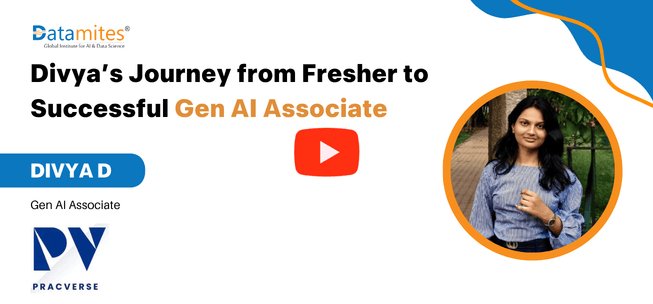
Divya’s Journey from Fresher to Successful Gen AI Associate
Discover Divya’s journey from fresher to AI Associate at Pracverse Pvt. Ltd. and learn how DataMites’ AI training, hands-on projects, internship, and placement support helped launch her career.
 Prerana B A
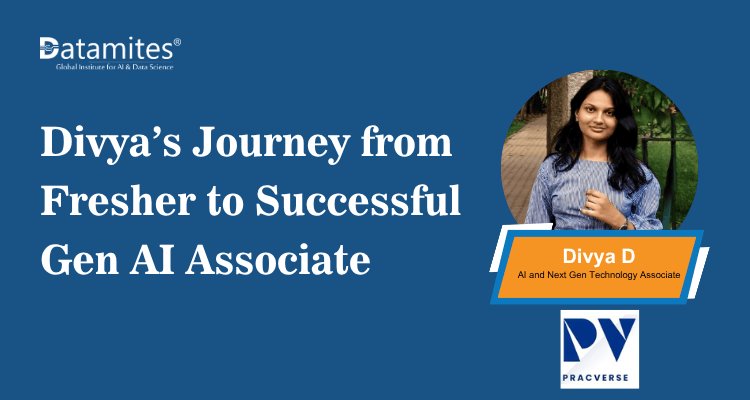
Artificial intelligence is creating exciting career opportunities for aspiring professionals. For Divya, her curiosity about technologies like ChatGPT sparked an interest in Artificial Intelligence (AI) and Machine Learning (ML), motivating her to pursue a career in this rapidly growing field. With the right training, hands-on experience, and consistent preparation, she turned her ambition into reality by securing a job as an AI Associate at Pracverse Pvt. Ltd.
In this DataMites success story, discover how DataMites helped Divya develop her technical skills through structured training, hands-on projects, internship experience, mock interviews, and placement support. Read on to explore her AI career journey, interview preparation strategies, and valuable advice for aspiring AI professionals looking to build a successful career in artificial intelligence.
How DataMites Helped Divya Become an AI Associate
Let’s explore Divya’s journey with DataMites, how she prepared for AI job interviews, and the role of practical training and placement support in helping her become an AI associate.
Q1. Can you introduce yourself and share your success story?
My name is Divya, and I recently got a job as an AI Associate through the DataMites placement team. I have always wanted to work in a field related to artificial intelligence and machine learning. The courses, technical training, practical examples, problem-solving exercises, and projects at DataMites helped me develop the skills required for this role. During the interview, I found it easier to explain the concepts because I had already learned them during my training.
Q2. How did you develop an interest in artificial intelligence?
My interest in AI began when technologies like ChatGPT became popular. I became curious about how these systems were built and wanted to understand how I could create similar applications. While researching top IT courses, I discovered various career paths, including AI Engineering, Machine Learning Engineering, Data Analytics, Natural Language Processing, and Computer Vision. This exploration increased my interest in AI and motivated me to learn more.
Q3. How was your learning experience at DataMites, and how did the trainers support you?
My learning experience at DataMites was comfortable and supportive. The trainers explained concepts from the basics, starting with Python and gradually moving to other topics, including SQL and big data. Their step-by-step teaching approach and practical examples helped me understand technical concepts more easily, build a strong foundation, and apply my knowledge to projects.
Q4. How important were hands-on projects during your training?
Hands-on projects were very important because they allowed me to apply the concepts I learned during the lectures. Working on projects helped me understand how theoretical knowledge translates into practical implementation. It also improved my technical skills and gave me valuable experience that I could discuss during interviews.
Q5. How many projects did you complete during your internship at DataMites?
During the internship, we were required to complete at least four projects. We could select projects based on our interests and were also encouraged to explore our own ideas. If we faced difficulties, we could seek guidance. The self-paced approach allowed me to revisit concepts, work through challenges, and improve my project implementation.
Q6. Did the internship help you prepare for job interviews?
Yes, the internship helped me significantly. I believe practical experience is just as important as theoretical knowledge. Working on projects helped me understand concepts more deeply and explore real-world AI applications. It also improved my ability to apply technical knowledge to practical problems, which was valuable when answering technical questions during interviews.
Q7. How did mock interviews help you improve your interview performance?
I attended a couple of mock interviews. My first mock interview was not very successful, but it helped me identify my mistakes and understand where I needed improvement. I worked on those areas and learned from the feedback and experience. Gradually, my performance improved, and I became more confident about attending actual interviews.
Q8. What study materials did you use to prepare for your interviews?
I mainly relied on the notes provided by my trainers. These notes helped me revise the concepts covered during the training. Once I understood the fundamentals, I also explored additional resources to learn more about specific topics. The training gave me a foundation that made further learning easier.
Q9. How did the DataMites placement team support you in your job search?
The placement team helped me access interview opportunities and provided support throughout the process. They also assisted with resume preparation and remained available to guide me. Their support helped me navigate the placement process and prepare for opportunities relevant to my skills.
Q10. What was the interview process like for your AI Associate position?
The selection process consisted of two interview rounds. The first round began with a self-introduction, followed by Python coding questions. The second round included additional technical questions and a discussion about the company and how my skills aligned with its requirements. The interviews focused on my technical understanding and ability to apply my knowledge.
Q11. What types of AI and technical questions were asked during your interviews?
The interviewers asked Python coding questions and basic questions about artificial intelligence. They wanted to understand what AI means, how it can be applied to different tasks, and how it could benefit the company's products and business. Being familiar with the fundamentals helped me explain my answers more confidently.
Q12. What skills do you think employers look for in AI and data science candidates?
Employers look for strong technical knowledge, problem-solving abilities, creativity, and the ability to apply what we have learned in practice. They also assess how candidates approach unfamiliar problems, handle challenges, and develop effective solutions. It is important to understand AI concepts rather than simply memorize answers.
Q13. What advice would you give to students preparing for AI interviews?
I recommend starting with the trainer's notes, examples, projects, and other learning materials provided during the course. Students should focus on the projects they have implemented and understand the concepts behind each step. Practicing projects improves problem-solving skills and builds confidence. A strong foundation, combined with practical experience, can make interview preparation more effective.
Q14. What are your future career goals in artificial intelligence?
I want to continue improving my knowledge and skills in artificial intelligence. My goal is to grow professionally and move into a more advanced position, such as an AI engineer, as I gain more experience. I look forward to learning new technologies and contributing to meaningful AI applications.
Refer to these articles:
- How Sharanya Started Her Generative AI Career as a Fresher
- How Abhijeet Started His ML Engineer Career as a Fresher
- How Andal Cracked Her First ML Engineer Job as a Fresher
Key Takeaways from Divya’s AI Success Story
Divya’s journey offers several valuable lessons for aspiring AI professionals who want to turn their interest in technology into a career.
- Build strong fundamentals: Develop a clear understanding of Python, SQL, AI, machine learning, and other relevant technical concepts.
- Learn by doing: Work on practical projects to understand how theoretical concepts are implemented.
- Use internships effectively: Treat internships as opportunities to gain hands-on experience and strengthen problem-solving skills.
- Practice mock interviews: Identify your weaknesses, learn from feedback, and improve your confidence with each attempt.
- Prepare using structured study materials: Revise training notes and explore additional resources to deepen your understanding.
- Understand your projects thoroughly: Be ready to explain the concepts, implementation, challenges, and decisions behind your work.
- Develop problem-solving skills: Learn to approach unfamiliar problems logically, experiment with solutions, and learn from mistakes.
- Understand business applications of AI: Be prepared to explain how AI can address practical challenges and support a company's products or operations.
Refer to these articles:
- What is a Confusion Matrix in Machine Learning?
- Supervised vs. Unsupervised Learning: What’s the Difference?
- Reinforcement Learning: Basics and Applications
Divya’s journey from a curious learner to a successful AI associate highlights how structured training, hands-on projects, and interview preparation can help aspiring professionals begin their careers in artificial intelligence. Through DataMites’ internship experience and placement assistance, she took an important step toward her career goals. Her story highlights the value of choosing the right artificial intelligence training in Bangalore and developing practical, job-ready skills.
As businesses increasingly adopt AI to improve efficiency, automate tasks, and enhance decision-making, the importance of AI skills continues to grow. According to Grand View Research, India’s artificial intelligence market is projected to grow from US$22.85 billion in 2025 to US$325.34 billion by 2033, registering a 38.1% CAGR.
DataMites Institute offers a 9-month Artificial Intelligence program that combines essential AI concepts with practical learning through projects, assignments, and hands-on exercises. The program helps learners develop skills for career opportunities such as AI Engineer, Artificial Intelligence Specialist, and NLP Professional. With 50+ training centers across India, DataMites makes industry-relevant AI education accessible to learners in multiple locations. Students can explore artificial intelligence courses in Pune, Hyderabad, Chennai, Delhi, Bangalore, Mumbai, Coimbatore, Ahmedabad, Nagpur, and Kolkata, gaining practical experience and expert mentorship to build technical skills aligned with industry expectations.