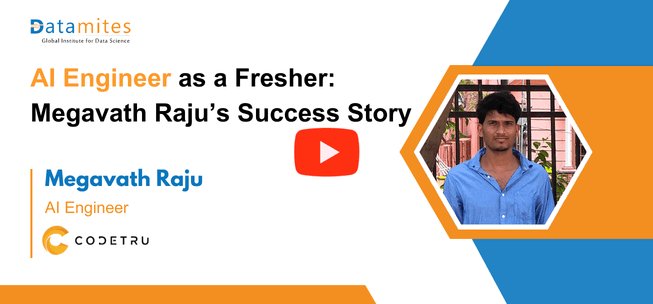
How to Become an AI Engineer as a Fresher – Megavath Raju’s AI Career Success Story
Megavath Raju’s journey from a fresher to a successful AI engineer highlights the skills, training, and strategies that propelled his career. It provides actionable insights for beginners aiming to enter the field of Artificial Intelligence.
 Priyanka BR
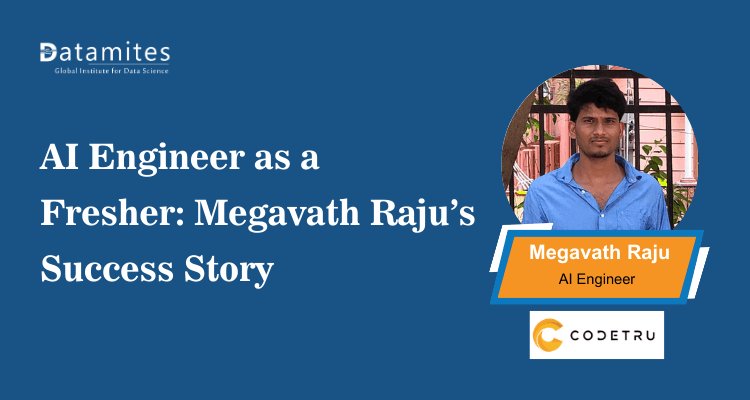
Breaking into Artificial Intelligence without a strong programming background may sound difficult, but Megavath Raju’s journey proves it is completely possible with the right direction and determination. Coming from the aeronautical department, he made a bold decision to shift his career path and pursue opportunities in AI.
Starting from the basics, he focused on building his coding skills, understanding core AI concepts, and working on practical projects to strengthen his confidence. The real transformation happened when he enrolled in structured training at DataMites, where hands-on learning and mentorship helped him bridge the gap between theory and real-world application.
For anyone planning to enter the AI field from a non-traditional background, Megavath Raju’s story is a clear reminder that consistent effort, guided learning, and practical exposure can turn ambition into a successful AI career.
How Megavath Raju Launched His AI Career with DataMites
Megavath Raju’s journey shows how understanding AI for beginners through structured learning, practical projects, and consistent effort can pave the way for a successful career. His story offers freshers clear guidance on building skills and confidence to step confidently into the AI industry.
Q1: Can you introduce yourself and tell us a bit about your background?
Good afternoon, everyone! My name is Megavath Raju, and I live in Hyderabad. I completed my graduation in 2023 in the aeronautical department. Although I come from a core technical background, I did not have any prior exposure to programming or data science. After graduation, I wanted to move into a fast-growing technology field, and that’s when I chose data science.
Q2: What motivated you to choose AI as a career?
I was looking for a career that would evolve over the next few years. Data science stood out as a growing field with multiple opportunities. The idea of working with data, deriving insights, and contributing to meaningful projects motivated me to take this step, which eventually led me to enroll in the CDS course at DataMites to build the right skills and foundation.
Q3: How many interviews did you attend before securing your first job?
I attended around six interviews. In the first few, I was rejected at the screening stage. I successfully cleared all rounds in three interviews, and finally, I was selected as a Python/AI Engineer at Codetru. Each interview helped me gain more confidence and experience, which ultimately prepared me to secure my first job.
Q4: How did your statistics background help you in AI?
Though I had learned statistics during graduation, I did not know how to apply it to real-world problems. DataMites helped me understand practical applications, like choosing which formulas or techniques to apply in different scenarios.
Q5: How did you find learning Python for the first time?
Python is very beginner-friendly. Its simple syntax made it easier for someone from a non-technical background to understand. While writing code for real requirements was challenging at first, focusing on logic before coding helped me gradually improve.
Q6: How was your experience with machine learning?
At first, I didn’t even know what machine learning was. During the course, I learned multiple machine learning algorithms, both for regression and classification tasks. Applying them to projects helped me understand when and how to use each algorithm effectively.
Q7: Did you work on projects individually or as a team?
I worked in a team of five. We divided the work into subsets and regularly discussed our approaches. This collaborative learning helped me understand multiple ways to solve the same problem.
Q8: How useful were these projects during interviews?
Some companies asked about my projects, while others gave tasks based on real use cases. The projects helped me explain concepts and showcase my practical skills to potential employers.
Q9: How did mock interviews help you?
I attended three mock interviews. Initially, my communication skills were weak, and I couldn’t explain my thoughts clearly. By the third mock interview, I was able to communicate effectively while demonstrating strong technical knowledge.
Q10: What interview tips would you give to freshers?
Follow the data science curriculum thoroughly. Focus on fundamentals, complete your projects, and revise consistently. External questions aren’t necessary if you have a solid understanding of core concepts.
Q11: How was the support from the PAT (Placement Assistance Team) at DataMites?
The PAT team guided me in building a resume from scratch and highlighting my knowledge effectively. Their guidance was invaluable, especially for a fresher like me, and helped me prepare thoroughly for interviews.
Q12: What was your daily study routine like?
I attended offline batches and practiced in my free time. I didn’t fix strict hours, but worked consistently day-to-day for four to five months, revising and applying what I learned. This consistent effort helped me build strong fundamentals.
Q13: Do you have tips to get placed faster?
Be consistent, revise regularly, and make use of all resources, including YouTube channels provided by DataMites. Avoid overthinking and focus on mastering the core curriculum.
Q14: Did coding exercises during interviews pose a challenge?
Yes, coding in real-time during interviews can be stressful. Practicing Python extensively before interviews helped me execute tasks confidently, even under pressure.
Q15: Any final advice for aspiring data scientists from non-technical backgrounds?
Focus on fundamentals, practice consistently, and don’t fear new challenges. Collaborative projects, mock interviews, and guided learning can bridge the gap between theory and real-world applications. Persistence and a structured approach will eventually lead to success.
Refer to these articles:
- Green AI Guide: Quantization and FinOps to Reduce LLM Costs
- What is a Confusion Matrix in Machine Learning?
- What is an AI Agent? Guide to Intelligent Agents in AI
Megavath Raju’s Key Takeaways on Starting a Career in AI
His journey highlights the value of strong fundamentals, consistent practice, and structured mentorship in building a successful career in Artificial Intelligence.
- Megavath’s transition shows that career direction is defined more by learning strategy than by academic specialization. Even though he came from the aeronautical department without prior coding exposure, he approached AI with structure and discipline, which made the shift achievable.
- He demonstrated that understanding concepts is not enough in the AI field. What truly creates impact is the ability to apply algorithms to practical scenarios. His focus on implementation over memorization strengthened his technical confidence during interviews.
- One of the most important turning points in his journey was improving communication. Initially, expressing technical thoughts clearly was a challenge, but refining this skill helped him convert technical knowledge into interview performance.
- Megavath treated mock interviews as serious preparation artificial intelligence tools rather than optional practice sessions. By exposing himself to deep technical questioning and real-time coding simulations, he reduced performance pressure in actual client interviews.
- His experience with team-based projects expanded his analytical thinking. Observing different approaches to the same problem improved his problem-solving maturity, which is critical for AI and Python engineering roles.
- Early interview rejections did not slow him down. Instead, they served as feedback mechanisms. Each attempt clarified employer expectations and helped him refine his preparation strategy.
- Consistency played a central role in his success. Rather than relying on last-minute revision, he built strong fundamentals during his learning phase, which later reduced stress during placement rounds.
- Finally, Megavath positioned himself strategically by aligning his skills, resume, and technical preparation with industry requirements. That alignment ultimately helped him secure his role as a Python/AI Engineer and successfully launch his AI career.
Refer to these articles:
- From Fresher to AI/ML Engineer: Suchismita’s Inspiring Success Story
- How Working Professionals Can Switch to an AI/ML - Mehvish’s AI Career Success Story
- How Nakshatra Secured Her First AI Engineer Job as a Fresher
Megavath Raju’s journey proves that a successful career in Artificial Intelligence depends on strategic preparation, consistent practice, and the right mentorship. With strong fundamentals and real project experience, becoming a Python or AI Engineer is absolutely achievable. If you are serious about entering the field, choose the best IT course in Hyderabad that offers structured training and practical exposure, and commit to learning with focus and consistency.
If Megavath Raju’s journey inspires you to start your own AI career, choosing the right training is essential. He completed his course with DataMites in Hyderabad, where practical learning and structured guidance prepared him for the industry. For those exploring artificial intelligence classes in Hyderabad, selecting a program with strong fundamentals, hands-on projects, and placement support can make all the difference.
DataMites Training Institute offers a 9-month Artificial Intelligence course designed to help learners build strong, industry-ready AI skills. The program covers core AI concepts, practical tools, real-time projects, and responsible AI practices to prepare students for real job roles. It includes specialized courses such as AI Engineer, AI Expert, AI for Product Managers, AI Foundation, and Certified NLP Expert. Accredited by IABAC and NASSCOM FutureSkills, DataMites provides recognized certifications along with hands-on training, making it easier for students to start a successful career in Artificial Intelligence.
Along with Hyderabad, DataMites Institute has 30+ offline centers across India, making quality AI training accessible to more learners. You can also explore the Artificial Intelligence Course in Pune, Bangalore, Chennai, Mumbai, Ahmedabad, Coimbatore, and Delhi, where structured learning, real-time projects, and placement support help you confidently step into the AI industry.