Is Data Analytics a Good Career Option for Non-IT Students in Delhi?
Discover why Data Analytics is an excellent career option for non-IT students in Delhi. Learn about required skills, career opportunities, salary prospects, training programs, and how aspiring professionals can successfully transition into the growing analytics industry.
 Kriti Maurya
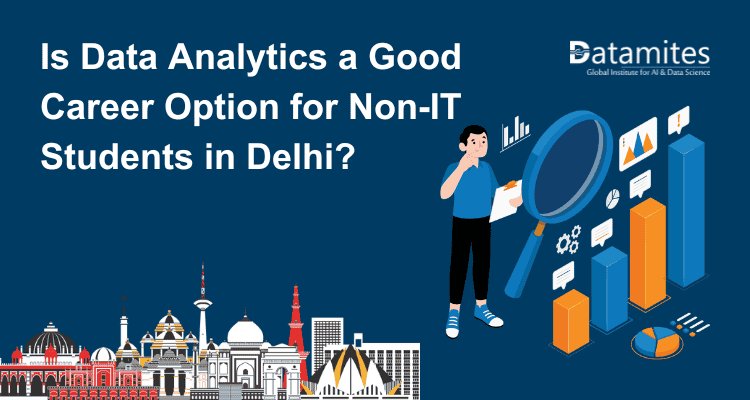
Choosing a career in data analytics can feel intimidating for students without an engineering or computer science background. Many commerce, arts, management, and science graduates assume that employers only hire candidates with advanced programming knowledge. However, the analytics industry has evolved differently.
One trend we've consistently seen across hiring platforms is that employers increasingly prioritize candidates with project portfolios over candidates who have only completed theoretical certifications. This demand has opened new opportunities for graduates from commerce, arts, management, and science backgrounds to enter the analytics industry. Delhi offers aspiring data analysts access to industry-focused training, hands-on projects, and certifications that build the skills needed to thrive in its rapidly growing, data-driven job market.
Understanding the Growing Demand for Data Analysts in Delhi
Delhi has emerged as a key center for technology, finance, healthcare, retail, and e-commerce industries. One important reason demand continues to rise is that organizations now generate far more business data than they can manually interpret. Companies therefore require professionals who can identify meaningful patterns and convert raw information into business decisions.
For example, retailers use analytics to forecast inventory demand, hospitals analyze patient data to improve treatment outcomes, and banks rely on fraud detection models that monitor millions of daily transactions. As these organizations digitize their operations, they increasingly require professionals who can convert raw data into actionable business decisions rather than simply generate reports.
According to The Insight Partners, the global data analytics market is projected to grow from US$ 88.38 billion in 2025 to US$ 300.5 billion by 2034, at a CAGR of 16.53%, driven by increasing adoption of AI, cloud technologies, and data-driven business strategies. The rapid growth of analytics reflects its evolution from a support function to a core driver of business strategy. Today, organizations use predictive analytics and AI to improve decision-making, optimize operations, and solve complex business challenges.
The Delhi Government's initiatives, including the Unified Citizen Data Platform and widespread adoption of e-Governance systems, demonstrate how data is becoming central to decision-making and public administration. Delhi's digital transformation and e-Governance initiatives are driving demand for analytics professionals in both private and public sectors, creating opportunities to improve citizen services, analyze data, and support evidence-based policymaking.
The Economic Times mentions that India's projected salary growth of 9.1% reflects sustained investment in digital transformation and analytics capabilities. For aspiring professionals, this means analytics is not only creating more jobs but also offering stronger long-term earning potential compared with many traditional career paths.
As per the projection obtained from Naukri, entry-level Data Analysts salary in Delhi typically earn between ₹4 LPA and ₹6 LPA, mid-level professionals can earn ₹7 LPA to ₹12 LPA, while experienced analysts and specialists may command salaries above ₹15 LPA. Professionals who expand into business intelligence, cloud analytics, or AI-powered analytics often experience faster salary growth than those who rely only on years of experience
Since businesses now prioritize predictive decision-making over descriptive reporting, data analysts play a strategic role by forecasting demand, identifying risks, detecting fraud, personalizing customer experiences, and supporting AI-driven business decisions and automation.
Refer to these Articles:
- How Students in Delhi Can Build a Data Analytics Career Without Experience
- How BSc Graduates Can Successfully Transition into Data Analytics in Delhi
- MBA vs MCA: Which Career is Better for Data Analytics in Delhi
How Non-IT Students Can Transition into Data Analytics
Data analytics has become one of the most accessible career paths for individuals from non-technical backgrounds. With growing demand for analytics professionals across industries, non-IT students can successfully transition into this field by developing relevant skills, gaining practical experience, and enrolling in data analytics courses in Delhi to build industry-ready expertise.
Understand the Fundamentals of Data Analytics
Beginners should focus on understanding why data is collected, how business questions are translated into analytical problems, and how insights influence decisions. This business-first approach makes technical concepts easier to understand.
Build Skills That Employers Actually Test During Interviews
Recruiters rarely hire candidates because they know Python alone. They hire candidates who can demonstrate how they used Python, SQL, or Power BI to solve a business problem. Excel helps organize and analyze business data, SQL retrieves information from databases, Python automates analysis, while Tableau and Power BI help communicate insights through dashboards. Understanding this progression prevents beginners from feeling overwhelmed.
Gaining Hands-On Learning on Real-Time Projects
Practical experience is crucial in data analytics. Working on real-world projects, case studies, and datasets helps learners apply theoretical concepts, strengthen problem-solving abilities, and gain the confidence needed to handle business challenges effectively. Recruiters often use portfolios to evaluate whether candidates can solve real business problems rather than simply complete classroom exercises. Even small projects that demonstrate structured thinking can strengthen an entry-level application.
Choosing the Right Data Analytics Training Program
Instead of choosing a course based only on data analytics course fee in Delhi or certification, evaluate whether it offers real datasets, industry case studies, mentorship, portfolio development, mock interviews, and placement support. These factors have a greater impact on job readiness. Selecting a quality training program involves evaluating the curriculum, practical learning opportunities, internship support, placement assistance, and trainer expertise.
Career Paths for Non-IT Graduates in Data Analytics
Non-IT graduates can pursue various analytics roles based on their educational backgrounds. Commerce graduates may enter financial analytics, marketing students can explore customer analytics, while economics and science graduates often excel in business intelligence and data-driven roles.
For example, commerce graduates often understand financial reporting, marketing graduates interpret customer behavior, while science graduates are comfortable working with data and research. These existing strengths can become valuable assets when building a data analytics career and learning analytics tools and techniques.
Common Challenges Non-IT Students Face and How to Overcome Them
One of the biggest hurdles for non-IT students is the transition from structured classroom assignments to open-ended business problems. Unlike academic exercises, real-world datasets are often incomplete, inconsistent, and require significant cleaning before meaningful analysis can begin.
Most beginners struggle not because analytics is too technical, but because real-world datasets are incomplete, inconsistent, and require problem-solving rather than textbook answers. Project-based learning gradually builds confidence in handling these situations
This is why project-based learning is so important. Working with realistic datasets helps learners develop confidence in handling ambiguity, a skill that employers value more than memorizing theoretical concepts.
Some common challenges include:
- Understanding statistics without a mathematics background
- Writing SQL queries for the first time
- Working with messy datasets instead of textbook examples
- Developing confidence to explain insights during interviews
The good news is that these challenges become manageable through guided practice, real-world projects, and regular feedback rather than theoretical study alone. Industry recruiters increasingly emphasize business storytelling i.e. Strong communication skills enable data analysts to translate insights into business decisions, making them as valuable as technical expertise over technical complexity. A dashboard that clearly explains customer churn or sales performance often creates more value than a highly sophisticated model that stakeholders cannot understand. As analytics becomes integrated into business decision-making, communication skills are becoming just as valuable as technical expertise.
For non-IT students, the greatest challenge is often building confidence to solve real business problems using data. While many learners initially explore IT Courses in Delhi, success in data analytics ultimately depends on continuous learning, practical experience, and strong problem-solving abilities.
Building a successful Data Analyst career in Delhi requires more than certification. Employers seek professionals with practical skills, real-world project experience, and strong analytical abilities. Choosing industry-focused training with mentorship, internships, portfolio development, and placement support improves career prospects.
Refer to these Articles:
- How Data Analytics Builds a Strong Foundation for Future Tech Careers
- How AI and Data Analytics Integration Leads to Better Decision-Making
- Top Feature Selection Techniques for Data Analysts
DataMites Institute is a leading training provider offering programs in Power BI, Data Science, Artificial Intelligence, Machine Learning, Data Analyst course in Delhi and Python. With IABAC and NASSCOM FutureSkills certifications, the training focuses on practical learning through projects and hands-on assignments. DataMites has also received the Best Skill Development EdTech award from BW Businessworld for its contribution to skill development and career-focused learning. Learners also receive internship opportunities and career support to build job-ready skills.
DataMites Delhi also maintains classroom training centers across major Indian cities, including Bangalore, Mumbai, Pune, Hyderabad, Chennai, Kolkata, Coimbatore, Ahmedabad, Chandigarh, Mangalore and several other locations, making quality professional training accessible to learners across the country.