How to Get Into AI Marketing? A Beginner’s Career Guide
Learn how to get into AI marketing with this beginner-friendly career guide. Explore essential AI marketing skills, tools, career paths, and practical steps to build expertise and start a successful career in AI-powered marketing.
 Kriti Maurya
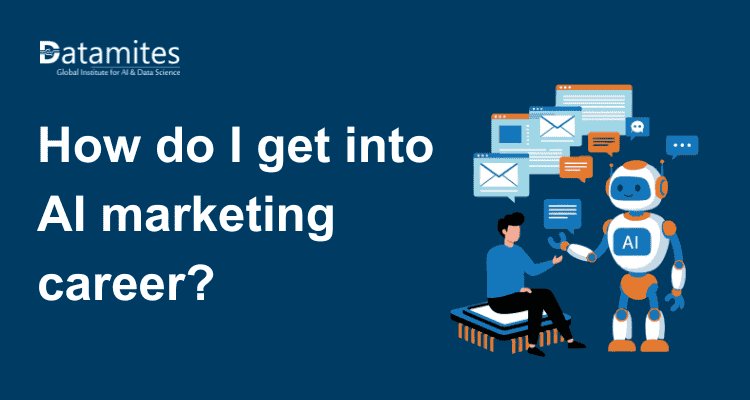
Artificial intelligence is changing how businesses understand customers, create content, optimize campaigns, and make marketing decisions. From predictive analytics and personalized recommendations to generative AI and marketing automation, AI-powered marketing is becoming an important part of modern digital strategies. This shift is also creating new opportunities for professionals who understand both marketing and artificial intelligence.
For individuals wondering how to get into AI marketing, the path does not necessarily require an advanced technical degree or extensive programming experience. A strong foundation in marketing, an understanding of AI concepts, practical experience with AI tools, analytical thinking, and a portfolio of projects can provide a strong starting point. This guide explains the skills, career opportunities, learning path, and practical steps required to build an AI marketing career.
According to HubSpot research, AI is playing an increasingly important role in modern marketing, with 67% of marketers expecting it to significantly reshape marketing jobs and workflows by 2030.
AI marketing uses artificial intelligence to improve customer analysis, content creation, segmentation, personalization, campaign optimization, forecasting, and automation. Unlike traditional marketing, AI can process large datasets, identify patterns, and generate insights quickly. It enhances marketers’ capabilities by supporting efficient workflows, data-driven decisions, personalized experiences, and effective marketing strategies.
What Does an AI Marketer Do?
An AI marketer combines marketing expertise with artificial intelligence, analytics, and automation tools to improve marketing outcomes. The exact responsibilities vary depending on the organization and role, but several activities are common across AI marketing positions.
- Customer and Audience Analysis: AI marketers analyze customer behavior, demographics, preferences, interactions, and purchase patterns. AI and analytics tools can help identify customer segments and uncover patterns that may be difficult to detect through manual analysis.
- AI-Assisted Content Creation: Generative AI can assist marketers with content ideation, outlines, drafts, variations, personalization, and creative concepts. However, professional marketers remain responsible for fact-checking, brand consistency, originality, editorial quality, and audience relevance.
- Campaign Optimization: AI can analyze campaign data and help identify ai marketing trends in engagement, conversions, customer acquisition, and spending. Marketers can use these insights to refine targeting, messaging, channels, and budgets.
- Marketing Automation: Another important responsibility involves automating repetitive activities such as email workflows, lead nurturing, customer communications, and reporting. Understanding automation is therefore one of the valuable AI marketing skills for professionals entering this field.
- Predictive Marketing: AI can support forecasting and predictive analysis by identifying patterns in historical data. Marketers may use these capabilities for demand forecasting, customer retention, lead scoring, and campaign planning.
- Measuring Marketing Performance: AI marketers also monitor key performance indicators such as conversion rates, customer acquisition cost, engagement, return on investment, and customer lifetime value. Analytical thinking is essential because AI-generated recommendations still need human evaluation and business context.
Refer to the article below:
- Top AI Product Manager Trends Shaping
- How AI-Driven Strategies Transforming Traditional Finance
- Popular AI Tools in Healthcare
Essential AI Marketing Skills for Beginners
Professionals starting with AI marketing for beginners should focus on building a combination of marketing, technical, analytical, and strategic capabilities rather than learning every AI technology.
Some important AI marketing skills for beginners include:
- Digital marketing fundamentals
- Search engine optimization
- Content marketing
- Social media marketing
- Marketing analytics
- Customer segmentation
- Generative AI fundamentals
- Prompt engineering
- Marketing automation
- Data interpretation
- AI-assisted content strategy
- Critical thinking and fact-checking
- Data privacy and responsible AI
Marketing fundamentals should come first. Understanding customers, positioning, messaging, conversion funnels, and campaign objectives helps professionals use AI tools strategically instead of treating them simply as content-generation software.
How to Get Into AI Marketing?
If you are researching how to get into AI marketing, a structured learning approach can make the transition more manageable. You do not need to master advanced AI engineering before beginning. Instead, develop skills progressively.
1. Learn Marketing Fundamentals
Start with core areas such as digital marketing, SEO, content marketing, email marketing, social media, paid advertising, and marketing analytics.
A marketer who understands these fundamentals can better evaluate where AI can create business value. For example, AI can support content production, but understanding search intent and audience needs is still essential for developing an effective SEO strategy.
2. Understand Artificial Intelligence
Learn the fundamentals of artificial intelligence, machine learning, generative AI, large language models, natural language processing, predictive analytics, and automation.
The objective at this stage is AI literacy rather than becoming a machine learning engineer. You should understand what different technologies can do, where they can be applied, and what their limitations are.
3. Learn Relevant AI Tools
Experiment with AI tools used for content development, research, customer insights, analytics, automation, SEO, advertising, and creative production.
Rather than learning dozens of platforms superficially, focus on understanding how a smaller set of tools can solve real marketing problems.
4. Develop Data and Analytics Skills
Data is central to modern marketing. Learn how to interpret campaign metrics, customer behavior, conversion data, and business performance.
Basic knowledge of spreadsheets, dashboards, statistics, and data visualization can strengthen your profile. Professionals with stronger analytical capabilities can move beyond content generation and contribute to strategic marketing decisions.
5. Practice AI Marketing Strategies
Apply what you learn to practical scenarios. For example, create an AI-assisted customer segmentation strategy, develop a personalized email campaign, analyze campaign performance, or design an automated lead-nurturing workflow.
Practical application demonstrates whether you can use AI to solve marketing problems rather than simply operate an AI tool.
6. Build a Portfolio
A portfolio can help demonstrate your capabilities to recruiters and employers. Include three to five well-documented projects showing the marketing objective, data or inputs used, AI tools applied, methodology, results, and recommendations.
Projects can cover different areas such as SEO, customer analytics, content strategy, campaign optimization, or marketing automation.
AI Marketing Career Path
The AI marketing career path can vary depending on an individual's education, previous experience, specialization, and organization. Some professionals enter from digital marketing, while others transition from analytics, content, SEO, product marketing, or business roles.
Professionals can also specialize in specific areas. For example, an SEO professional may move toward AI-assisted search and content strategy, while a marketing analyst may specialize in predictive marketing and customer analytics.
The growing adoption of AI is also influencing the types of AI marketing jobs available. Potential roles include AI Marketing Specialist, Marketing Automation Specialist, AI Marketing Analyst, AI Content Strategist, Marketing Data Analyst, Growth Marketing Specialist, and AI Marketing Consultant.
The career path is not necessarily linear. Building transferable skills in marketing, analytics, AI, and business strategy can create opportunities across industries.
Common Mistakes to Avoid When Starting AI Marketing
Beginners can make faster progress by avoiding several common mistakes.
- Learning tools without learning marketing: AI Tools for Marketing are useful only when they support a clear marketing objective.
- Relying entirely on AI-generated content: AI outputs require human review for accuracy, originality, relevance, tone, and brand alignment.
- Ignoring analytics: Modern marketing requires the ability to measure results and translate data into decisions.
- Collecting certifications without practical work: Certifications can demonstrate structured learning, but projects provide evidence of practical application.
- Ignoring responsible AI: Privacy, accuracy, transparency, and ethical considerations should be part of every AI marketing workflow.
Refer to these articles:
- How Knowledge-Augmented Generation (KAG) Is Solving AI Hallucinations
- Will AI Agents Replace Your Next Coworker? Exploring the Future of Work
- Explainable AI: Why Black-Box Models Are Losing Trust
Best Way to Start a Career in AI Marketing
The best way to start a career in AI marketing is to combine structured learning with continuous practical application. Instead of attempting to learn everything simultaneously, follow a progressive approach:
Step 1: Build a foundation in digital marketing.
Step 2: Learn fundamental AI concepts.
Step 3: Develop essential AI marketing skills for beginners.
Step 4: Practice with AI tools and real marketing scenarios.
Step 5: Learn marketing analytics and automation.
Step 6: Develop practical AI marketing strategies.
Step 7: Build a project-based portfolio.
Step 8: Gain relevant certifications or formal training.
Step 9: Apply for internships, entry-level roles, or internal opportunities.
Step 10: Continue learning as AI technologies and marketing platforms evolve.
For professionals already working in marketing, the transition can begin by introducing AI into existing workflows. For students and freshers, internships, projects, and entry-level marketing roles can provide practical exposure.
What Is the Future of AI Marketing?
The future of AI marketing is expected to move beyond simple content generation toward increasingly integrated, data-driven, and automated marketing systems. AI can support marketers throughout the customer journey, from identifying potential audiences to personalization, campaign execution, performance analysis, and retention.
At the same time, human expertise will remain important. Strategy, creativity, empathy, brand understanding, ethical judgment, and business decision-making cannot be reduced to simply operating an AI tool. According to MarketsandMarkets, the global AI analytics market is projected to grow from USD 13.5 billion in 2023 to USD 38.8 billion by 2028, representing a compound annual growth rate (CAGR) of 23.3%.
Professionals who combine these human capabilities with AI literacy and analytical skills can build a more adaptable career profile. Continuous learning will be particularly important because AI marketing tools, platforms, and workflows are evolving rapidly.
Learning how to get into AI marketing starts with understanding that successful AI marketers need more than technical tools. A strong foundation in marketing, AI literacy, analytics, automation, critical thinking, and practical experience provides a more sustainable path into this growing field.
Whether you are a student, fresher, marketer, working professional, content specialist, or marketing manager, you can begin by developing relevant AI marketing skills, experimenting with practical applications, and building a portfolio that demonstrates measurable marketing thinking.
Refer to the article below:
- Applications of AI in Marketing and Real Use Cases
- A Complete Guide to AI in Marketing
- How AI Help Business in Marketing and Customer Behavior Analysis
For learners looking for structured guidance, DataMites offers AI-focused professional training designed to help learners understand AI applications, develop practical skills, and work on real-world scenarios. A structured AI for Marketing learning path can help aspiring professionals build the knowledge required to adapt to the evolving world of AI-powered marketing.
DataMites offers an industry-focused AI in Marketing Course designed for professionals who want to develop expertise in AI-powered marketing and business strategies. The program also provides specialized learning options in AI for Finance, AI Product Management, and Generative AI for Business Leaders, helping learners explore AI applications across different business functions.
The Certified AI Professional in Marketing Analytics program is accredited by IABAC, adding industry-recognized credentials to the learning experience. With training centers across Pune, Bangalore, Hyderabad, Mumbai, Coimbatore, Chennai, Delhi, Ahmedabad, and other locations, DataMites makes AI-focused professional education accessible to learners across India.