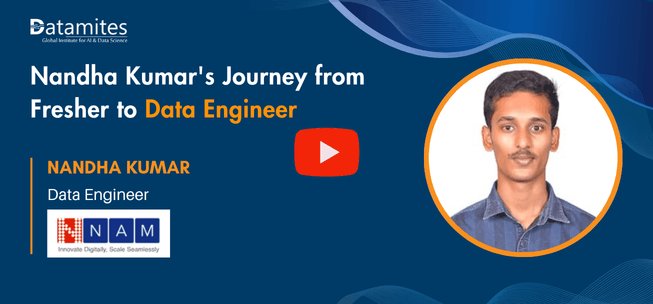
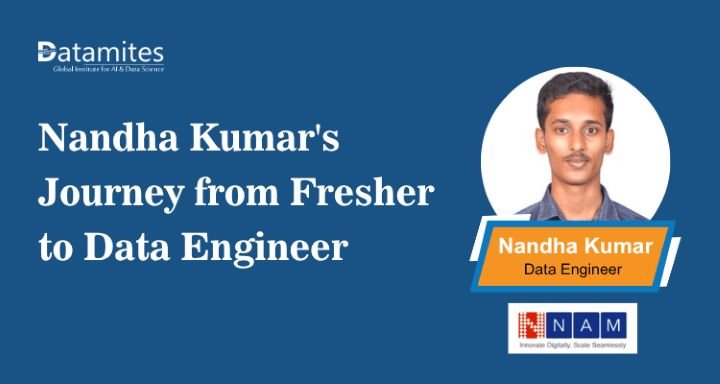
Nandha Kumar's Journey from Fresher to Data Engineer
Read how Nandha Kumar transformed from a B.Tech Data Science graduate into a Data Engineer through hands-on learning, projects, and interview preparation.
 Prerana B A
Breaking into the data industry can be challenging, especially for fresh graduates facing limited campus placement opportunities. However, with the right guidance, practical learning, and determination, it is possible to build a successful career in data science and data engineering.
In this DataMites success story, Nandha Kumar, a B.Tech graduate in Data Science, shares how he strengthened his technical skills through structured training, real-world projects, mock interviews, and continuous practice. His journey highlights the importance of mastering Python, SQL, machine learning fundamentals, and hands-on project experience in securing his first Data Engineer opportunity, demonstrating how the right guidance and consistent effort can help aspiring professionals launch a successful career in the data industry.
From Fresher to Data Engineer : Nandha Kumar's Journey
Nandha Kumar transformed from a fresher into a Data Engineer through dedicated learning, hands-on projects, and consistent practice. His journey highlights how strong fundamentals and practical experience can open doors to a successful career in the data industry.
1. Can you introduce yourself?
My name is Nandha Kumar, and I completed my B.Tech in Data Science. I joined the Certified Data Science program in June 2023 to strengthen my practical knowledge and improve my career opportunities. The learning journey helped me bridge the gap between academic concepts and real-world applications.
2. Why did you decide to enroll in a Data Science training program after graduation?
Although I had a Data Science degree, my college had limited placement opportunities. Most students couldn't secure jobs in Data Science or Data Analytics. My friends and I searched for professional training institutes that could provide industry exposure, practical learning, and placement support. That's what motivated me to enroll in the program.
3. How was your learning experience throughout the course?
It was a structured learning experience. We started with Python fundamentals, gradually moved into Machine Learning, SQL, and other important technologies. Whenever students faced difficulties, additional classes and revision sessions were arranged, ensuring everyone understood the concepts thoroughly.
4. Which subjects were covered during your training?
The course included:
- Python Programming
- Statistics
- Machine Learning
- SQL
- Capstone Projects
- Client Projects
- Mock Interviews
- Practical Assignments
The curriculum focused heavily on practical implementation rather than just theory.
5. What impressed you most about the training?
The biggest advantage was the practical exposure. Every concept was reinforced through assignments, assessments, capstone projects, and client projects. Working on real datasets helped me understand how data science is implemented in actual business scenarios.
6. How helpful were the client projects?
The client projects were one of the best learning experiences. We worked with real business datasets and industry-like environments. It helped us understand practical challenges, database management, and collaborative problem-solving.
7. How important were mock interviews in your preparation?
Mock interviews played a significant role. They helped me identify my strengths and weaknesses before attending actual interviews. I also received valuable feedback on technical concepts, communication skills, and project explanations.
8. What was your first interview experience like?
It was my first successful interview after completing the course. Initially, there was an online assessment consisting of multiple-choice questions, mainly focused on SQL and Python. After clearing that round, I attended technical interviews followed by an HR discussion.
9. What kind of questions were asked during the technical interview?
The interview mainly focused on:
- Python programming
- SQL queries
- Machine Learning algorithms
- Data Science fundamentals
- Project discussions
- Problem-solving approaches
Since the role was for a Data Engineer, SQL carried more weight during the interview.
10. How many interview rounds did you attend?
The recruitment process included:
- Online MCQ Screening Test
- Technical Interview
- Coding Discussion
- HR Interview
Some candidates attended additional coding rounds depending on the company's requirements.
11. What advice would you give to beginners who find Data Science difficult?
Master the fundamentals first. Python should become second nature because it's used extensively in Data Science. Statistics is also important, but consistent Python practice makes learning much easier. Once your basics are strong, advanced concepts become easier to understand.
12. Is Python difficult for students from non-technical backgrounds?
Initially, yes. Students from non-programming backgrounds may find Python challenging. However, compared to languages like Java or C, Python is much easier to learn. With consistent practice and conceptual understanding, anyone can become comfortable with it.
13. How much self-learning is required beyond classroom sessions?
A training program can teach around 60–80% of the concepts, but the remaining learning depends on the student's own effort. Practicing regularly, solving coding problems, revising concepts, and exploring additional resources are essential for success.
14. How did teamwork help during projects?
We worked in teams of four members. The collaborative environment helped us divide responsibilities, solve problems faster, and learn from each other's approaches. Practice sessions also gave us direct access to mentors whenever we faced technical challenges.
15. Which skills are most important for aspiring Data Engineers?
For Data Engineering roles, the most important skills include:
- Strong SQL knowledge
- Python programming
- Database concepts
- Data processing fundamentals
- Problem-solving ability
- Logical thinking
SQL is especially important because Data Engineers work extensively with databases.
16. What are your career goals for the next few years?
My immediate goal is to gain industry experience as a Data Engineer. Eventually, I want to transition into a Data Scientist role. Working as a Data Engineer will help me understand data pipelines, infrastructure, and real-world workflows, making me a more complete Data Science professional.
17. What Advice Would You Give to Aspiring Data Scientists?
Never stop practicing. Build a strong foundation in Python and SQL, work on real-world projects, participate in mock interviews, and continuously improve your skills. Confidence comes naturally once you gain practical experience and successfully crack your first interview.
Refer these articles :
- Career Growth in Data Science: Som Kumar’s Journey
- From Fresher to Data Scientist: Akshay's Inspiring Journey
- Siddharth's Journey From Beginner to Data Science Professional
Key Findings from Nandha Kumar's Success Story
Nandha Kumar's journey highlights the importance of mastering fundamentals, gaining hands-on project experience, and staying consistent with practice. His success shows that combining technical skills with interview preparation and continuous learning can significantly improve career opportunities in the data industry.
- Strong educational foundation: Nandha Kumar completed a B.Tech in Data Science, giving him basic theoretical knowledge before pursuing professional training.
- Limited campus placements motivated further learning: Due to fewer placement opportunities in his college, he decided to enhance his skills through a specialized Data Science program.
- Hands-on learning bridged the gap between theory and practice: Practical assignments, capstone projects, and client projects helped him apply classroom concepts to real-world scenarios.
- Python and SQL were the most valuable technical skills: He emphasized that strong proficiency in Python and SQL played a major role in interview success, particularly for Data Engineer roles.
- Fundamentals are the key to success: According to Nandha Kumar, mastering the basics of Python, SQL, and Machine Learning makes learning advanced concepts much easier.
- Self-learning is equally important: While training provided around 60–80% of the required knowledge, he stressed that the remaining learning must come through consistent self-study and practice.
- Mock interviews boosted confidence: Practice interviews helped him improve technical communication, identify knowledge gaps, and prepare effectively for actual interviews.
Refer these articles :
- Binomial Distribution: A Beginner’s Guide for Data Science
- How Generative AI is Changing the Role of Data Scientists
- Cross Entropy in Data Science: Concepts and Applications
Nandha Kumar's journey demonstrates that practical learning, continuous practice, and perseverance can help fresh graduates overcome placement challenges and build rewarding careers in the data industry. His experience emphasizes the value of mastering core concepts, participating in hands-on projects, and preparing thoroughly through mock interviews. For aspiring data professionals, his story serves as a reminder that success is achieved through consistent effort, curiosity, and a willingness to keep learning.
Starting a career in the data industry requires strong fundamentals, practical experience, and continuous learning. Nandha Kumar's journey demonstrates how structured training, hands-on projects, and consistent practice helped him transition from a fresher to a Data Engineer. According to GlobeNewswire, the global Data Science and Machine Learning Platforms Market is expected to grow from USD 94.2 billion in 2022 to USD 466.3 billion by 2032, driven by AI, automation, and data-driven decision-making. Building expertise through top IT courses such as Data Science, Artificial Intelligence, Machine Learning, and Data Analytics can prepare aspiring professionals for rewarding careers in this rapidly growing field.
Nandha Kumar's journey from a fresher to a Data Engineer highlights the importance of structured learning, hands-on projects, and continuous practice. Through DataMites' industry-focused training, he strengthened his skills in Python, SQL, Machine Learning, and real-world project implementation. With internships, mock interviews, certifications like IABAC® and NASSCOM FutureSkills®, and career support, DataMites helps learners become industry-ready. Enrolling in a Data Science course in Indore can help aspiring professionals build the skills needed to pursue rewarding careers in the growing data and AI industry.
Whether you're a fresher, a working professional, or someone planning a career transition like Nandha Kumar, DataMites makes quality Data Science education accessible. With both online and offline training centers, DataMites offers Data Science courses in Jaipur along with programs across major cities in India. Through structured learning, real-world projects, expert mentorship, mock interviews, and globally recognized IABAC® and NASSCOM FutureSkills® certifications, learners gain the practical skills and confidence needed to succeed in the industry. Nandha Kumar's journey demonstrates that with the right guidance, hands-on learning, and consistent effort, aspiring professionals can successfully launch a career in the data industry.