How AI Helps HR Teams Predict Workforce Needs
Learn how AI helps HR teams predict workforce needs by forecasting staffing demand, identifying skill gaps, predicting employee attrition, and improving recruitment planning for better workforce decisions and business growth.
 Prerana B A
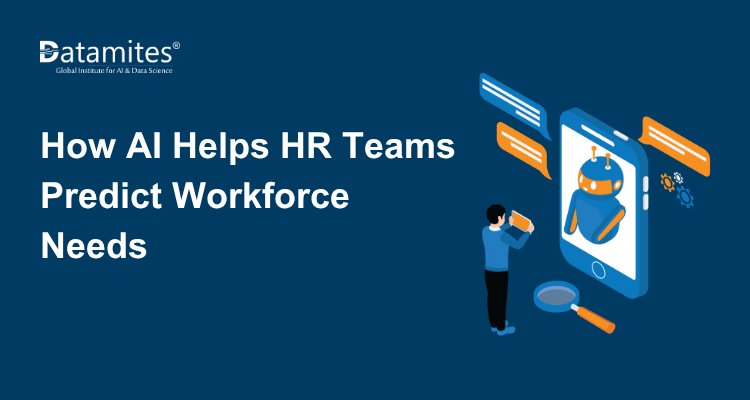
Organizations need the right people, skills, and capabilities to meet changing business goals. However, relying only on historical headcount reports and managers’ estimates can make it difficult to anticipate future staffing requirements. AI in workforce planning helps HR teams analyze employee data, business trends, and changing skill requirements to make better-informed decisions about future workforce needs.
Rather than replacing HR expertise, artificial intelligence (AI) can help professionals identify patterns earlier, prepare for talent shortages, and develop more effective workforce planning strategies.
The need for better planning is becoming increasingly clear. The World Economic Forum’s Future of Jobs Report estimates that 39% of workers’ core skills will change by 2030. This highlights why organizations need to assess existing capabilities and prepare employees for evolving roles.
What Is AI-Powered Workforce Planning?
AI-powered workforce planning uses workforce data, machine learning, and predictive analytics to estimate future staffing and skill requirements. Unlike traditional planning, which relies on historical reports and manual estimates, AI can analyze larger datasets and update forecasts as business needs change.
For example, a retail company can analyze sales trends, seasonal demand, and employee availability to estimate staffing needs for new branches. However, forecast accuracy depends on data quality and changing business conditions.
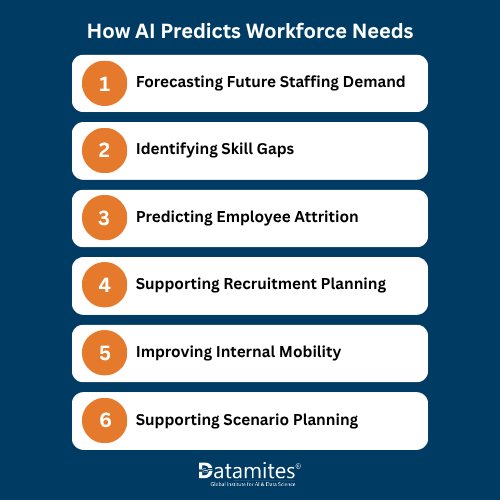
How AI in Workforce Planning Helps HR Teams Predict Workforce Needs
AI in workforce planning helps HR teams predict staffing needs, identify AI for HR skills, and anticipate workforce changes. By analyzing employee data and business trends, AI supports better recruitment, training, and workforce decisions.
Forecasting Future Staffing Demand
AI can examine business growth, workload patterns, seasonal demand, and historical staffing levels to estimate future hiring requirements.
For instance, a customer service company expecting a rise in customer enquiries could use workload forecasts to estimate staffing needs across different shifts. HR can then plan recruitment before service quality is affected.
Identifying Skill Gaps
AI-powered HR analytics can compare employees’ current capabilities with the skills required for upcoming projects or business priorities.
Suppose a company plans to introduce AI-powered customer support. HR could map existing employee skills against the capabilities needed to manage AI tools, review outputs, and handle complex customer issues. This helps determine whether to recruit specialists, train existing employees, or combine both approaches.
The WEF's report reinforces this need for skills-based planning as technology and business requirements continue to evolve.
Predicting Employee Attrition
Predictive analytics in HR can examine historical turnover patterns, role changes, workforce trends, and other appropriate organizational data to identify potential retention risks.
For example, if a department experiences repeated turnover during a particular period, HR could investigate workload, career development opportunities, and management practices before deciding on an intervention.
Such models should support organizational improvements, not label individual employees as likely to resign or trigger automatic employment decisions.
Supporting Recruitment Planning
AI can help HR teams estimate upcoming vacancies, prioritize recruitment activities, and plan recruiter capacity based on anticipated business demand.
A growing technology company, for example, could compare its project pipeline with existing technical capabilities to estimate which positions may need to be filled first. Recruiters can prepare job descriptions, sourcing strategies, and hiring timelines in advance.
Improving Internal Mobility
AI can help identify employees whose existing skills may match open positions, emerging projects, or future responsibilities.
A finance employee with strong analytical skills, for instance, might be suitable for a business analytics role after targeted training. Internal mobility insights help organizations consider reskilling and redeployment before automatically looking outside the company.
Supporting Scenario Planning
Workforce forecasting can model different possibilities, such as business expansion, restructuring, automation, or changes in customer demand.
HR leaders can compare scenarios to understand how each might affect staffing levels, budgets, and skill requirements. This allows them to prepare alternative plans rather than relying on a single prediction.
Refer to these articles:
- The Growing Demand for AI-Skilled Healthcare Professionals
- How to Use AI for Customer Segmentation
- Key Challenges and Opportunities in AI Product Management
Benefits of AI in Workforce Planning
When implemented responsibly, AI can help organizations make workforce decisions using clearer evidence rather than relying entirely on manual estimates.
Key benefits include:
- Better staffing decisions: Connect workforce requirements with business goals and projected workloads.
- Early identification of talent shortages: Recognize emerging skills gaps before they affect important projects.
- More targeted budgets: Direct recruitment and employee training investments toward identified needs.
- Stronger succession planning: Identify critical roles and develop potential internal candidates.
- Improved workforce visibility: Bring employee skills, vacancies, turnover patterns, and staffing forecasts into a more consistent view.
- Less manual analysis: Automate parts of data processing and reporting so HR professionals can focus on interpreting insights and taking action.
Research supports the growing relevance of these capabilities. According to SHRM's Talent Trends research, 43% of surveyed organizations used AI in HR tasks in 2025, compared with 26% in 2024. The survey covered 2,040 US HR professionals. This measures overall AI adoption in HR, not workforce forecasting specifically, but it illustrates the increasing role of AI in HR operations.
The actual benefits of workforce forecasting still depend on reliable data, appropriate tools, and regular evaluation. AI cannot guarantee lower recruitment costs or prevent employee turnover.
Real-World Examples of AI in Workforce Planning
Organizations can use AI and workforce analytics to understand employee skills, identify talent gaps, and prepare for changing business requirements. The following examples distinguish documented skills-planning initiatives from predictive workforce forecasting.
KPMG: Identifying Future Skills
According to the Australian HR Institute's case study, KPMG uses its Workforce.ai approach to map future skills and roles, helping identify skill gaps and reskilling opportunities.
Key takeaway: AI-supported skills planning helps HR prepare employees for changing business needs.
Wipro: Skills Mapping Across Countries
According to EDLIGO's case study, Wipro used talent analytics to map employee skills across 16 countries, helping identify capability gaps and inform workforce development.
Key takeaway: Skills mapping supports better training and workforce planning.
ManpowerGroup: AI-Powered Workforce Forecasting
According to Microsoft's case study, ManpowerGroup Talent Solutions uses Microsoft technologies to support workforce forecasting, skills matching, scenario planning, and budget decisions.
Key takeaway: AI helps HR teams assess future talent requirements and plan workforce needs.
Deloitte: Addressing Workforce Skill Gaps
Deloitte's 2025 Global Human Capital Trends research found that 66% of surveyed managers and executives said their most recent hires were not fully prepared for their roles.
This is a research finding that supports skills-based planning, not a documented example of Deloitte using AI to forecast its own staffing needs.
Challenges of Using AI for Workforce Forecasting
AI can improve workforce analysis, but HR teams must account for several risks.
- Poor data quality: Incomplete employee records or outdated skills profiles can produce unreliable predictions.
- Algorithmic bias: Historical hiring and promotion patterns may reproduce existing inequalities.
- Employee privacy: Workforce data must be collected, accessed, and used appropriately, with suitable safeguards.
- Business uncertainty: Unexpected market changes, reorganizations, or new technologies can make earlier forecasts inaccurate.
- Overreliance on automation: Managers may accept recommendations without checking whether they make sense in context.
HR teams should validate forecasts against actual outcomes, review models for bias, restrict access to sensitive information, and explain how insights influence workforce decisions. Human oversight is particularly important when predictions could affect hiring, promotions, performance reviews, or job security.
Refer to these articles:
- LLM Fine-Tuning vs Prompt Engineering: Which Is Better?
- Top AI Trends That Will Shape
- PyTorch vs TensorFlow: Which is Better?
How HR Teams Can Implement AI in Workforce Planning
HR teams can implement AI in workforce planning by following a structured approach that improves forecasting, identifies skills gaps, and supports data-driven decisions.
- Define Workforce Planning Objectives: Identify business needs such as headcount forecasting, employee attrition prediction, and skills gap analysis.
- Audit HR Data: Collect and organize employee records, hiring trends, turnover rates, skills inventories, and business forecasts to improve data accuracy.
- Select the Right AI Tools: Choose workforce planning software and AI for HR tools that support predictive analytics, headcount forecasting, and scenario modeling.
- Ensure Data Privacy and Governance: Protect sensitive employee information, monitor algorithmic bias, and maintain transparency in AI-driven decisions.
- Pilot a Use Case: Test AI-powered workforce forecasting in one department or use skills analytics to identify training needs before expanding implementation.
- Measure Forecast Accuracy: Track forecast errors, recruitment costs, attrition prediction accuracy, and progress in closing skills gaps.
- Maintain Human Oversight: Ensure HR professionals review AI recommendations before making important hiring, promotion, or workforce allocation decisions.
- Monitor and Improve: Update workforce data, evaluate model performance, and refine forecasts as business needs and labor-market conditions change.
- Align AI with Business Strategy: Collaborate with HR, finance, IT, and business leaders to align workforce forecasts with organizational goals and budgets.
HR professionals who want to build their understanding of these applications can explore the AI for HR courses. Before publication, confirm the specific course page and current curriculum with the provider.
AI in workforce planning helps HR teams forecast staffing needs, identify skill gaps, and prepare for changing business requirements through better recruitment, training, and internal mobility decisions.
However, effective forecasting depends on reliable data, responsible AI use, and human judgment. HR teams can start with one workforce challenge, evaluate results, and refine their planning strategies over time.
DataMites Institute offers an industry-oriented AI for HR and People Analytics course that helps HR professionals understand AI applications in workforce planning and data-driven decision-making. The program covers AI fundamentals, people analytics, talent acquisition, employee engagement, performance management, and workforce planning. DataMites also offers specialized AI programs for professionals in healthcare, finance, marketing, product management, and other fields.
Learners can choose flexible formats, including online classes, classroom training, and project-based internships. The AI for HR certification offers certification options, including IABAC-accredited certification and the Certified AI Professional in People Analytics certification. With 50+ offline centres across India, including Bangalore, Chennai, Hyderabad, Pune, Mumbai, Ahmedabad, Coimbatore, and Delhi, DataMites provides learning options to suit different professional needs.