How Praveen Started His Career as an AI/ML Engineer
Discover how Praveen started his AI/ML career through DataMites training, hands-on projects, technical skill development, and placement assistance.
 Prerana B A
Building a career in Artificial Intelligence (AI) and Machine Learning (ML) requires strong technical skills, practical experience, and continuous learning. With structured training and hands-on projects, graduates can prepare for opportunities in this evolving field.
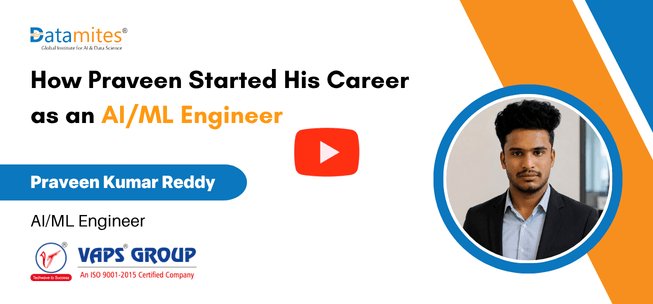
Praveen Kumar Reddy's DataMites success story highlights his journey from an electronics and communication engineering graduate to a professional working in DevOps and MLOps. After discovering AI and ML during his final-year internship, he joined the DataMites Certified Data Scientist course to strengthen his technical knowledge. Through DataMites’ placement assistance, he secured a position at Vaps Technosoft Pvt. Ltd. In this interview, he shares his learning experience, interview preparation tips, and advice for aspiring AI and ML professionals.
Praveen’s AI and Machine Learning Career Journey: A Success Story
Praveen’s AI and Machine Learning career journey highlights the value of practical training and continuous learning. In this interview, he shares his learning experience, project insights, interview preparation tips, and advice for aspiring AI professionals.
Q1. Could you briefly introduce yourself and describe your current professional role?
My name is Praveen Gunadi, and I am from Andhra Pradesh. My academic background is in electronics and communication engineering. Currently, I work in DevOps and MLOps, with responsibilities that include project management. I am also exploring opportunities to advance my career in AI engineering.
Q2. What inspired you to pursue artificial intelligence and machine learning?
I was always interested in computer science. Although I chose Electronics and Communication Engineering for my bachelor's degree, I wanted to explore the computer science field. During my final-year IBM internship project, I gained some basic knowledge of Python and machine learning. That experience encouraged me to learn more about AI and ML and explore career opportunities in these areas.
Q3. Did you have any prior coding knowledge before joining DataMites?
Yes, I had some basic coding knowledge from my final-year project and IBM internship. I had been introduced to Python and machine learning, but I wanted to develop a stronger understanding of these subjects. Joining DataMites helped me build on that foundation and study the concepts in greater depth.
Q4. How was your learning experience at DataMites?
My learning experience was good. I found the curriculum well-structured, with concepts introduced step by step. We started with Python basics and progressed to libraries such as NumPy and Pandas, followed by machine learning algorithms and deep learning. The curriculum also covered SQL, cloud fundamentals, and Big Data concepts, which helped me develop a broader technical foundation.
Q5. Which technical skills did you learn during your Certified Data Scientist course?
I learned Python programming, NumPy, Pandas, machine learning algorithms, and deep learning. I also gained exposure to SQL, cloud fundamentals, and Big Data. These topics helped me understand different aspects of data science and build a foundation for exploring more advanced AI technologies.
Q6. How did you prepare for AI and machine learning interviews?
I focused on Python programming, particularly basic coding exercises, loops, and logical problem-solving. I also prepared for questions related to NumPy Pandas, Matplotlib, and data visualization. For machine learning, I concentrated on understanding how algorithms work, the logic behind models, and the process of splitting datasets into training and testing sets.
Q7. What qualities do you look for when interviewing candidates?
I look for confidence, logical thinking, problem-solving ability, and basic technical knowledge. Technical skills are important, but a candidate should also demonstrate a willingness to take responsibility and work through challenges. I value people who can approach problems logically and contribute positively to a team's progress.
Q8. What types of questions do you ask candidates during interviews?
I often ask situational questions to understand how candidates respond to workplace challenges. For example, I might ask how they would handle a deadline that needs to be met that day or manage a team when some members are unable to complete their tasks on time. Their responses help me assess their decision-making, confidence, and approach to teamwork.
Q9. Which AI tools do you use in your day-to-day work?
I commonly use ChatGPT and AI-powered development tools such as Kiro and Antigravity. These tools help me work more efficiently, especially when handling development tasks. I choose the tool according to the task, but I make sure I understand the underlying logic rather than relying entirely on generated output.
Q10. Why is coding knowledge still important when using AI development tools?
Understanding coding logic is essential even when AI tools are available. These tools can generate code quickly, but developers must understand how the code works to debug errors and make the necessary changes. Without that knowledge, identifying problems and ensuring that the output works correctly can become difficult.
Q11. What types of AI projects should aspiring professionals include in their portfolios?
I recommend exploring projects involving Retrieval-Augmented Generation (RAG), database integration, and different AI models. Instead of developing only a basic chatbot that sends prompts to an API, candidates should try building applications that retrieve relevant information from a database and use it to generate responses. Projects that focus on answer verification and reducing AI hallucinations can also demonstrate a deeper understanding of AI applications.
Q12. How can RAG and multiple AI models improve an AI application?
RAG allows an application to retrieve relevant information from a knowledge source or database before generating an answer. This helps the application respond using information related to the user's query. Another approach is to compare responses from different AI models to identify inconsistencies and potential inaccuracies. These techniques can make AI projects more useful and demonstrate practical problem-solving skills.
Q13. How do you see artificial intelligence evolving over the next five years?
I believe AI adoption will continue to expand across industries, including education. I have observed organizations and schools exploring artificial intelligence tools, chatbots, and robotics. As more businesses and educational institutions experiment with these technologies, there will be increasing opportunities for professionals who understand how AI works and how it can be applied to practical problems.
Q14. What are your long-term career goals in the technology industry?
Although I am currently exploring AI engineering opportunities, I am also interested in becoming a cloud architect in the future. I believe it is important to continue learning as technology evolves and to understand how different technologies can be applied in practical work environments.
Q15. What advice would you give to aspiring AI and machine learning professionals?
Start with Python and build a strong understanding of machine learning and deep learning fundamentals. Practise coding regularly, work on meaningful projects, and develop logical thinking. Use AI tools to support your learning, but make sure you understand the concepts and code. Continuous learning and practical experience can help you prepare for long-term career growth.
Refer to these articles:
- Divya’s Journey from Fresher to Successful Gen AI Associate
- How Sharanya Started Her Generative AI Career as a Fresher
- How Rakghitha Started Her AI Developer Career as a Fresher
Key Findings from Praveen Kumar Reddy’s Success Story
Praveen Kumar Reddy’s journey highlights how structured training, practical projects, and continuous learning can support career development in AI and machine learning. Exploring the top IT courses can help aspiring professionals identify relevant technical training and build industry-ready skills.
- Educational Background: Praveen is an electronics and communication engineering graduate who developed an interest in computer science.
- Early Exposure to AI and ML: His final-year IBM internship project introduced him to Python and basic machine learning concepts.
- DataMites Training: He joined the DataMites Certified Data Scientist course to strengthen his skills in Python, machine learning, and deep learning.
- Placement Achievement: Through DataMites’ placement assistance, he secured a position at Vaps Technosoft Pvt. Ltd.
- Consistent Learning: He dedicates around two hours daily to studying and practicing technical concepts.
- Interview Preparation: He focused on Python, NumPy, Pandas, Matplotlib, data visualization, and machine learning fundamentals.
- Practical Project Experience: His resume included an IBM internship project and around four projects completed during DataMites training, including a capstone project.
- Essential Hiring Skills: He values confidence, logical thinking, technical knowledge, responsibility, and teamwork when evaluating candidates.
- Effective Use of AI Tools: He uses ChatGPT, Kiro, and Antigravity to improve productivity while emphasizing the importance of understanding and debugging AI-generated code.
Advice for Aspiring Professionals: He recommends building strong technical fundamentals, practicing coding consistently, developing meaningful AI projects, and continuing to learn as technology evolves.
Refer to these articles:
- Green AI Guide: Quantization and FinOps to Reduce LLM Costs
- The Future of Coding: Can AI Replace Software Engineers?
- LLMs vs. SLMs: Key Differences and How to Choose the Right Model
Praveen’s journey demonstrates how structured training, consistent practice, and hands-on projects can prepare aspiring professionals for careers in artificial intelligence and machine learning. Through the DataMites Certified Data Scientist course, he strengthened his Python, machine learning, and deep learning skills while gaining practical experience. His story highlights the importance of logical thinking and continuous learning. Aspiring professionals can explore artificial intelligence training in Ahmedabad to build technical skills and apply their knowledge to real-world projects.
After completing the course, Praveen Kumar Reddy secured a position at Vaps Technosoft Pvt. Ltd. The growing demand for AI skills is reflected in market projections. According to IMARC Group, the global AI market was valued at USD 143.0 billion in 2025 and is projected to reach USD 949.0 billion by 2034, growing at a CAGR of 22.70% from 2026 to 2034.
DataMites Institute offers a 9-month Artificial Intelligence program that combines essential AI concepts with practical learning through projects, assignments, and hands-on exercises. The program helps learners develop skills for career opportunities such as AI Engineer, Artificial Intelligence Specialist, and NLP Professional. With 50+ training centers across India, DataMites makes industry-relevant AI education accessible to learners in multiple locations. Students can explore artificial intelligence courses in Delhi, Hyderabad, Chennai, Pune, Bangalore, Mumbai, Coimbatore, Ahmedabad, Nagpur, and Kolkata, gaining practical experience and expert mentorship to build technical skills aligned with industry expectations.