AI Engineer vs Data Scientist in Ethiopia
Compare AI Engineer and Data Scientist careers in Ethiopia, including job responsibilities, required skills, 2026 salary estimates, industry applications and career opportunities.
 Swagatam Sinha
A bank in Addis Ababa wants to identify suspicious transactions before they lead to financial losses. A telecommunications company wants to understand why customers stop using its services. An agricultural business needs better ways to forecast crop yields and plan its supply requirements.
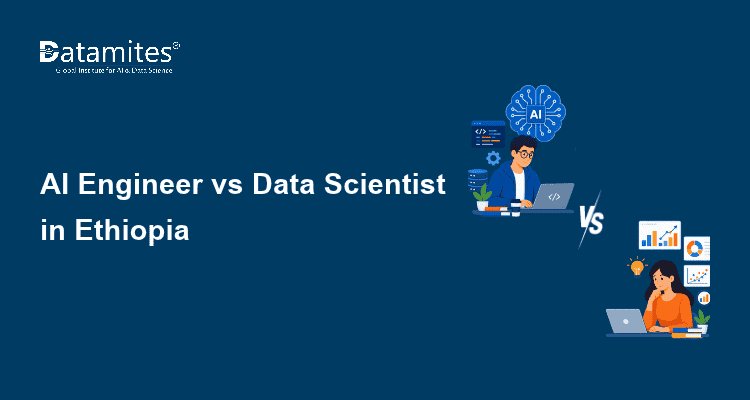
These problems involve data and technology, but the professionals working on them have different responsibilities. A data scientist analyzes information, identifies patterns and develops predictive models. An AI engineer works on integrating artificial intelligence models into applications and building systems that can perform specific tasks.
For Ethiopian graduates, software developers and working professionals, choosing between these careers means understanding what each role involves, which technical skills are required and what the local job market currently offers.
This guide compares AI engineering and data science in Ethiopia, covering their responsibilities, industry applications, skills, salary estimates and career opportunities.
Why Are AI Engineering and Data Science Relevant to Ethiopia?
Ethiopia's digital economy is creating new uses for data analysis, predictive modelling, and artificial intelligence. Telecommunications, banking, agriculture and public services are among the sectors where these technologies can help organizations improve operations and make better decisions.
One example is the growth of digital financial services. According to Ethio telecom's 2025/26 Annual Business Performance Report, its Telebirr platform had 60.6 million customers and processed approximately 2.61 billion transactions worth ETB 4.19 trillion between July 2025 and June 2026.
The volume of activity creates a need to understand transaction patterns, customer behavior, and unusual financial activity. Data scientists can analyze this information and develop predictive models. AI engineers can then help integrate suitable models into financial applications and automated services.
The Ethiopian Artificial Intelligence Institute plays a central role in this development, while the National AI Policy and Digital Ethiopia 2030 provide direction for the country's technology priorities.
A recent assessment offers a clearer picture of the progress and challenges. According to the Africa AI Governance Index 2026, Ethiopia scored 2.12 out of 4 and ranked 11th among 54 African countries. Its strongest area was strategy and vision, with a score of 3.70, while innovation and ecosystem received 1.00. This suggests that policy development is progressing, but building a stronger environment for AI research, innovation and private-sector activity remains a challenge.
There are also developments in research and practical innovation. In February 2026, the Ethiopian Artificial Intelligence Institute, UNDP and Addis Ababa University launched the Artificial Intelligence University Innovation Pod (AI UniPod) in Addis Ababa. The facility includes robotics equipment, high-performance computing systems, laboratories and collaborative workspaces. It is intended to connect researchers, students, government and industry while supporting the development of locally relevant AI solutions.
These initiatives show that Ethiopia is building institutional and research capacity for AI. However, challenges involving infrastructure, funding, specialized skills, and private-sector innovation remain. For aspiring professionals, this makes practical knowledge of programming, data analysis, machine learning and AI application development relevant as the country's technology ecosystem develops.
Digital adoption is not the same across all businesses. A policy brief published by Research ICT Africa on 20 July 2026 examines the barriers facing Ethiopia's microenterprises. Using evidence from the 2022 After Access study, it highlights issues such as the cost of smartphones, limited internet coverage and gaps in digital skills. These challenges can make it harder for smaller businesses to adopt digital tools and benefit from data-driven services.
Taken together, these developments explain why data and AI skills are relevant to Ethiopia's changing economy. They do not, however, confirm widespread recruitment for AI-specific roles. Employment opportunities will depend on how quickly organizations invest in technology and whether they have the resources to build and maintain these systems.
Refer to these articles:
- Agentic AI vs Generative AI: What’s the Difference?
- Small Language Models vs Large Language Models: Which Should You Use?
- CrewAI vs AutoGen vs LangGraph
AI Engineer vs Data Scientist: What Is the Difference?
Consider a financial service provider that wants to detect suspicious transactions and reduce financial losses. Both professionals could contribute to the project, but they would approach the work from different directions.
What Does a Data Scientist Do?
A data scientist examines historical transaction records to understand financial activity and identify unusual behavior.
The work may involve:
- Collecting and cleaning transaction datasets.
- Studying customer spending patterns.
- Applying statistics to identify unusual activity.
- Developing machine learning models.
- Testing and evaluating model performance.
- Explaining findings to business teams.
For example, a data scientist might develop a model that identifies transactions with a higher likelihood of fraudulent activity. The results can help a financial institution decide which transactions need further investigation.
Common tools include Python, SQL, statistics, machine learning libraries and data visualization software.
What Does an AI Engineer Do?
An AI engineer focuses on turning AI capabilities into usable software applications.
In the same financial services project, the engineer might connect a trained model to the organization's transaction-processing system. This could involve developing APIs, integrating databases, deploying the model and monitoring how the application performs.
Typical responsibilities include:
- Developing AI-based applications.
- Integrating machine learning models into software.
- Building APIs and application workflows.
- Working with databases and cloud platforms.
- Deploying and monitoring AI systems.
- Improving application reliability and performance.
AI engineers generally need a combination of programming, machine learning and software development knowledge.
Where Do the Two Careers Overlap?
Both professionals may use Python, work with machine learning models and evaluate data. Their responsibilities can also overlap in smaller organizations where technical teams handle several parts of a project.
The main difference is their usual focus. Data scientists concentrate on understanding data and developing predictive models. AI engineers focus on integrating AI capabilities into applications that people and organizations can use.
Neither role is automatically more advanced than the other. The scope of work depends on the employer, project requirements and the professional's experience.
Where Can AI and Data Science Skills Be Applied in Ethiopia?
The potential uses of these skills become clearer when looking at practical challenges across Ethiopian industries. The examples below describe possible applications; they should not be taken to mean that every organization in these sectors already has dedicated AI teams.
Banking and Digital Financial Services
Banks and digital payment providers handle large volumes of customer information and financial transactions.
Data scientists can analyze transaction histories, identify unusual patterns and develop credit-risk models. AI engineers can integrate these models into financial applications and build automated customer-service systems.
Telecommunications and Customer Services
Telecommunications companies can study customer information to understand service usage, network performance and customer retention.
A data scientist might build a model to identify customers who are likely to discontinue a service. An AI engineer could connect that model to a customer-management platform and automate relevant notifications.
Agriculture and Supply Chains
Agriculture remains an important part of Ethiopia's economy. Information such as historical crop yields, rainfall records, market prices and transportation data can help organizations plan their activities.
Data scientists can use these datasets to forecast crop yields and examine market trends. AI engineers can develop applications that make these predictions accessible to agricultural businesses and supply chain teams.
Healthcare and Public Services
Data analysis can help healthcare organizations study public health trends, plan resources and identify areas that need attention. AI applications may also support document processing and language-based services.
Language technology is particularly relevant in a country with many local languages. For example, Dataset. ET announced an Amharic speech-data release in August 2026 containing 22.7 hours of recordings from 320 speakers. Such datasets can support research and development in speech recognition and other language technologies.
These projects also show the practical work involved in building AI systems: collecting suitable data, checking its quality, training models and evaluating their performance. In healthcare and other sensitive applications, data protection and human oversight remain essential.
Refer to these articles:
- Traditional RAG vs Agentic RAG
- Artificial Intelligence vs Machine Learning
- Deep Learning Vs Machine Learning Vs Data Mining Vs Artificial Intelligence
What Skills Should You Learn for Each Career?
Both professions require programming and analytical foundations. Their technical requirements become more specialized as professionals take on more complex responsibilities.
| Skill area | AI Engineer | Data Scientist |
| Programming | Python and software development | Python and SQL |
| Mathematics | Linear algebra, probability and optimization | Statistics, probability and modelling |
| Machine learning | Model integration and deployment | Model development and evaluation |
| Data handling | Databases, pipelines and application integration | Data cleaning and feature engineering |
| Additional tools | Git, APIs, Docker and cloud platforms | pandas, notebooks and visualization tools |
| Main focus | Developing AI applications | Analyzing data and making predictions |
Skills Both Careers Require
Communication, problem-solving, data quality awareness and responsible data handling are useful in both fields.
A data scientist needs to explain what a model's findings mean for a business. An AI engineer must understand how an application will be used and identify technical issues that could affect its performance.
English is useful for reading technical documentation and working with international teams. Knowledge of Amharic and other Ethiopian languages can also be valuable when developing applications for local users.
AI Engineer vs Data Scientist Salary in Ethiopia (2026)
Salary is an important factor when comparing these careers. However, published estimates for Ethiopia can vary because sources use different calculation methods and occupational benchmarks.
According to Global Salary Guide's 2026 estimates, the mid-career median annual salary for an AI engineer in Ethiopia is approximately ETB 3,460,000. For a data scientist, the estimated mid-career median annual salary is ETB 2,670,000.
| Job role | Estimated annual median salary | Approximate monthly equivalent |
| AI Engineer | ETB 3,460,000 | ETB 288,333 |
| Data Scientist | ETB 2,670,000 | ETB 222,500 |
These figures are modelled estimates, not verified salary averages collected directly from Ethiopian employers. The methodology uses international occupational salary benchmarks, World Bank economic indicators and currency conversion information. Monthly equivalents are calculated by dividing the annual estimates by 12.
They should therefore be treated as indicative comparisons, not guaranteed earnings or typical starting salaries for fresh graduates.
Actual compensation depends on experience, employer, location, technical responsibilities and employment arrangement. Professionals working for international companies or in remote positions may receive different compensation from those employed by local organisations.
Anyone evaluating an offer should compare the role's responsibilities and requirements with current vacancies and employer-provided salary information.
Which Career Should You Choose: AI Engineering or Data Science in Ethiopia?
The right choice depends on your interests, existing knowledge and the kind of work you want to do.
Choose AI Engineering If You Enjoy Building Software
AI Engineering may suit people who enjoy programming, developing applications and connecting different technologies.
Software developers can build on their existing programming experience. However, they will still need to learn machine learning fundamentals, model integration, APIs and deployment practices.
For beginners interested in this field, an online artificial intelligence course in Ethiopia can provide a structured introduction to Python, machine learning, model development and AI application building.
Those based in the capital can also explore an online artificial intelligence course in Addis Ababa to develop technical knowledge while managing other professional commitments.
Choose Data Science If You Enjoy Working With Data
Data science may be a good fit for people who enjoy statistics, analyzing information, testing assumptions and identifying patterns.
Graduates with backgrounds in mathematics, statistics, economics and computer science may find their existing knowledge useful. They will also need practical experience with Python, SQL and data-handling techniques.
An online data science course in Ethiopia can help learners develop foundations in statistics, programming, data analysis and machine learning through structured learning and practical exercises.
For learners in the capital, an online data science course in Addis Ababa can provide a flexible way to build analytical skills and work on data-related projects.
What If You Are a Fresher or Changing Careers?
If you are new to the field, begin with Python, SQL, basic statistics and data handling. These subjects provide a foundation for both career paths.
Try small projects before choosing a specialization. You could analyze customer purchasing patterns using a sample dataset or build a simple application that uses a machine learning model.
If you prefer exploring information and evaluating predictions, Data Science may be a suitable direction. If you enjoy developing applications and connecting models to software, consider AI Engineering.
Refer to these articles:
- Data Science vs Business Intelligence: Which Path to Choose?
- Data Scientist Vs Data Engineer
- Data Science vs Cyber Security: Which Has a Better Future?
How to Find AI and Data Science Opportunities in Ethiopia
Searching only for AI engineer and data scientist positions may give you a limited view of the opportunities available to those pursuing an AI career in Ethiopia. Employers sometimes advertise related responsibilities under different job titles.
Consider searching for roles such as:
- Junior AI Engineer
- Machine Learning Engineer
- AI Developer
- Data Analyst
- Data Scientist
- Applied AI Engineer
- Python Developer
- Research or Data Science Officer
A recent example is a junior AI engineer vacancy advertised by BESYS Technologies PLC in Addis Ababa in October 2026. The listing, published on ICTJobs.et, described three available positions. It requested Python programming knowledge, a basic understanding of machine learning and generative AI, and familiarity with AI APIs or frameworks such as LangChain.
The listing also encouraged applicants to demonstrate practical projects, GitHub repositories and working applications.
This vacancy offers an example of the technical skills one employer is looking for. A single listing, however, cannot establish the overall level of demand for AI professionals across Ethiopia.
Read job descriptions carefully because similar titles can involve very different responsibilities. Some positions focus on reporting and data cleaning, while others require predictive modelling, software development or model deployment.
If dedicated AI positions are limited in your preferred location, data analysis, software development and research-related roles can also help you gain relevant experience.
How to Prepare for an AI Engineer or Data Scientist Career in Ethiopia
Preparing for either career involves more than learning programming languages or completing a course. You need to understand the concepts behind the tools and practise applying them to real problems.
A structured learning approach can help you cover the following areas:
- Programming: Learn Python and become comfortable writing, testing and debugging code.
- Data handling: Practise SQL, database management and data cleaning.
- Mathematics and statistics: Study probability, statistical analysis and relevant mathematical concepts.
- Machine learning: Understand model development, training, testing and evaluation.
- Specialisation: Explore AI application development or advanced data analysis based on your preferred career.
- Practical projects: Work with real-world datasets and build projects that demonstrate your technical knowledge.
Practical work is particularly important when preparing for technical roles. A project that explains the problem, describes the dataset and shows how you evaluated the results can help demonstrate your understanding to a potential employer.
Before selecting a learning program, compare its curriculum, learning format, practical projects and certification details. Choose training that matches your current knowledge and the skills required for your preferred career.
AI Engineering and Data Science offer different ways to work with technology and information. For Ethiopian graduates and working professionals, the better option depends on whether they prefer developing software applications or analysing information to solve problems and make predictions.
Ethiopia's expanding digital services, national AI initiatives and emerging language technology projects demonstrate practical applications for both skill sets. However, the AI employment market is still developing, and national technology investments should not be mistaken for confirmed job availability.
Start with shared technical foundations, explore both fields through practical projects and review current employer requirements before choosing a specialization. Understanding the responsibilities, skills and salary estimates can help you make a more informed career decision.
For individuals interested in building these skills, DataMites Institute offers training programmes in Data Science, Artificial Intelligence and related technical fields. With more than 12 years of experience in the training industry and over 200,000 learners globally, the institute provides learning options for beginners and working professionals. Prospective learners can review the curriculum, training format and practical project components to decide whether a programme suits their learning goals.