Nihad Career Journey from Fresher to Data Analyst
Discover Nihad’s inspiring career journey from fresher to Data Analyst as he shares his transition from a civil engineering background into the analytics industry. Learn how practical training, SQL skills, projects, and persistence helped him build a successful career in data analytics.
 Kriti Maurya
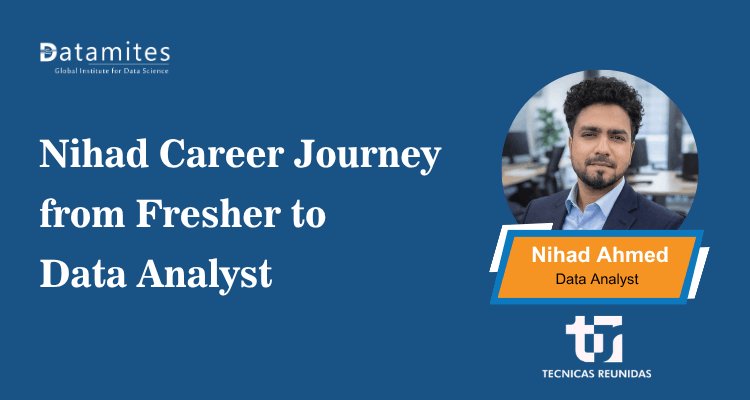
The field of data analytics has become one of the most promising career paths for aspiring professionals from various educational backgrounds. Many learners from non-technical fields are now successfully transitioning into analytics roles through dedication, continuous learning, and practical experience. One such inspiring story is Nihad’s journey from a civil engineering background to becoming a successful Data Analyst working in leading multinational companies.
In this alumni interaction, Nihad shares how he began his career during the challenging COVID period, learned essential analytics skills through DataMites, and gradually built his professional journey through persistence, practical learning, and industry experience. His story highlights the importance of SQL, communication skills, internships, projects, and continuous job applications in building a successful career in data analytics.
Nihad’s Inspiring Transition from Civil Engineering to Data Analytics
The growing demand for data analytics professionals has encouraged learners from various educational backgrounds to explore opportunities in the IT industry. Among the many inspiring success stories from IT courses in Chennai, Nihad’s journey stands out as a remarkable example of determination, continuous learning, and career transformation from civil engineering to data analytics.
Q1. Can you introduce yourself and share your current role?
Hello everyone, my name is Nihad. I am currently working as a Data Analyst, and I am also an alumnus of DataMites Institute. My journey in data analytics started nearly three years ago during the COVID period when I joined DataMites to learn analytics and software-related technologies.
Currently, I am working at Technicas Reunidas, a Spain-based multinational company involved in oil and gas projects. Before this, I worked with companies like Senima Technologies and Maruti Suzuki, where I gained practical experience in analytics, reporting, and dashboard development.
Q2. How did your learning journey begin at DataMites?
I joined DataMites during the COVID period. Initially, everything was completely new to me because I came from a civil engineering background. Many people doubted whether switching from civil engineering to IT was possible, but the trainers and mentors at DataMites gave me confidence by sharing examples of successful career transitions.
At DataMites, I started learning from the basics of Python, including lists, dictionaries, tuples, and other programming concepts. Gradually, I moved toward machine learning, SQL, Tableau, and analytics concepts. The trainers were extremely supportive and clarified every doubt patiently.
This learning experience gave me the confidence that I could build a successful career in data analytics despite coming from a non-technical background.
Refer to these Articles:
- The Future of Data Analytics in Chennai: Trends and Opportunities
- How Internships Shape Data Analyst Career in Chennai
- Data Analyst training in Chennai for Fresher
Q3. How did internships and practical learning help you?
Practical learning played a very important role in my journey. During the training, we worked on multiple concepts and practical sessions that helped me understand how analytics works in real-time business environments.
The internship and project exposure helped me improve my technical skills and understand industry requirements. I learned how analytics tools are applied in practical situations and how business problems are solved using data.
The support from trainers and mentors helped me gain confidence and improve my understanding of analytics tools such as Python, SQL, Tableau, and Power BI.
Q4. How was your job search journey during the COVID period?
Finding a job during COVID was extremely challenging because there were limited opportunities in the market. I started my career with Senima Technologies, which was a startup company. Since I came from a civil engineering background and had no prior IT experience, beginning with a startup helped me gain initial experience.
I continuously applied for jobs through platforms like Naukri.com and LinkedIn. I updated my profile regularly, changed resume formats multiple times, and attended many interviews to understand what companies were looking for.
I also took a Naukri.com subscription and made sure my profile was fully completed. Gradually, I started understanding interview patterns and employer expectations. Eventually, I got opportunities in larger companies like Maruti Suzuki and later Technicas Reunidas.
Q5. What skills are most important for becoming a Data Analyst?
According to my experience, SQL is one of the most important data analyst skills required in the industry. Most interviewers begin by testing SQL knowledge, and if you are strong in SQL, you can clear a major portion of the interview process successfully.
Communication is another essential data analyst skill because professionals need to explain insights clearly and collaborate with different teams regularly. Python knowledge is also valuable, especially basic concepts like loops, data handling, and automation, although many companies focus more heavily on SQL for Data Analyst roles.
Apart from technical expertise, logical thinking, imagination, and business understanding are equally important data analyst skills since analytics professionals are expected to solve real-world business challenges using data-driven approaches.
Q6. Do projects help freshers get Data Analyst jobs?
Yes, projects definitely help freshers, especially recent graduates. Companies hiring freshers often evaluate project experience, technical knowledge, and practical understanding.
However, competition in the Data Analyst field is currently very high. For candidates who graduated several years ago, gaining some practical experience or internships becomes very important.
Projects help learners demonstrate their technical capabilities and show recruiters how they solve business problems using analytics tools.
Q7. What tools have you worked with in your career?
In different companies, I worked with different tools based on project requirements.
At Maruti Suzuki, I worked with:
- Python
- SQL
- Advanced Excel
- Power BI
Currently, at Technicas Reunidas, I mainly work with:
- SQL
- Advanced Excel
- Power BI
Different organizations use different technologies, so flexibility and continuous learning are very important in analytics careers.
Q8. What was your role at Maruti Suzuki?
At Maruti Suzuki, I worked in the Research and Development (R&D) department, where we analyzed vehicle driving patterns and customer behavior using analytics.
We worked with vehicle signal data, battery performance, traffic behavior, and driver patterns. For example, we analyzed driving speed patterns and identified risky driving behaviors.
We also developed dashboards in Power BI to monitor vehicle data and support decision-making processes. Analytics helped improve vehicle safety features and understand customer driving behavior more effectively.
The data was generated in milliseconds and stored in cloud systems, where dashboards automatically refreshed and updated reports in real time.
Q9. What advice would you give to aspiring Data Analysts?
My advice is:
- Build strong SQL skills
- Improve communication skills
- Work on practical projects
- Keep learning continuously
- Apply consistently for jobs
- Update your resume regularly
- Stay patient and confident
The analytics field is highly competitive, but with continuous effort and practical learning, success is definitely possible.
Coming from a non-technical background should never stop anyone from pursuing a career in data analytics.
Key Insights from Nihad’s Career Journey
The inspiring journey of Nihad highlights how determination, practical learning, and continuous skill development can help anyone build a successful career in data analytics. One of the remarkable DataMites Success stories, his transformation from a civil engineering graduate to a Data Analyst working in multinational companies, motivates aspiring professionals to confidently pursue careers in the analytics industry.
- Strong Foundation in Analytics Tools and Technologies: Training at DataMites helped Nihad develop strong knowledge in Python, SQL, Tableau, and Machine Learning. Learning these technologies provided him with the technical skills needed for real-world analytics projects. This foundation helped him confidently start his career in the analytics industry.
- Importance of Practical Learning and Mentorship: Hands-on learning and mentor guidance played a major role in Nihad’s growth. Real-time practice sessions, projects, and doubt-clearing support improved his technical understanding and confidence. The continuous support from trainers helped him stay motivated throughout his learning journey.
- SQL as a Core Skill for Data Analysts: According to Nihad, SQL is one of the most important skills for Data Analyst interviews. Most companies evaluate SQL knowledge during the hiring process because it is essential for handling and analyzing data. Strong SQL skills can significantly improve interview performance and job opportunities.
- Communication and Logical Thinking Matter: Apart from technical knowledge, communication skills and logical thinking are highly important in analytics careers. Data Analysts need to explain insights clearly and collaborate with teams effectively. Strong analytical thinking also helps professionals solve real business problems using data.
- Consistent Job Applications Improved Career Opportunities: Nihad continuously updated his profiles on platforms like Naukri.com and LinkedIn while applying for multiple jobs. Regular applications, profile optimization, and resume improvements increased his visibility to recruiters. Persistence in job searching eventually helped him secure better opportunities.
- Projects and Internships Enhanced Practical Knowledge: Working on projects and internships helped Nihad understand how analytics is applied in real business environments. Practical exposure improved his confidence in handling analytics tools and solving business problems. These experiences also strengthened his resume during interviews.
Nihad’s journey proves that with the right guidance, practical learning, and continuous effort, anyone can build a successful career in data analytics. His experience highlights the importance of developing strong technical knowledge, improving data analysis skills, and staying consistent while pursuing opportunities in the growing analytics industry.
Refer to these Articles:
- How is Data Analytics Influencing the Educational Sector
- Applying Data Analytics to Finance
- Data Analytics in Business – How does it benefit Business Operations
DataMites Institute delivers career-focused training and industry-relevant certifications designed to help learners build successful data-driven careers. Its programs are aligned with globally recognized bodies such as IABAC and NASSCOM FutureSkills, offering comprehensive learning pathways in Data Analytics Chennai, along with specialized programs in Data Science, Machine Learning, Artificial Intelligence, Python, Tableau, and MLOps. Learners can also explore advanced certifications, including Certified Data Scientist, AI for Managers, and Computer Vision Expert.
In addition, the institute offers a data analyst course in Coimbatore through offline training centers located in major cities such as Bangalore, Pune, Hyderabad, Chennai, Delhi, Kolkata, Mumbai, Ahmedabad, Chandigarh, and others. The training programs focus on classroom-based learning, hands-on projects, internship opportunities, and placement assistance to help students and professionals develop practical, industry-ready skills.