Essential AI Skills for Marketing Professionals in 2026
Discover the essential AI skills for marketing professionals, including predictive analytics, customer segmentation, marketing automation, generative AI, and campaign optimization. Learn how AI-driven insights improve customer engagement, personalize marketing strategies, measure ROI, and support data-driven decisions in today's competitive digital marketing landscape.
 Kriti Maurya
Artificial intelligence is changing how marketing teams create content, understand customers, optimize campaigns, and measure business performance. From generative AI and predictive analytics to intelligent automation and personalized customer journeys, AI is becoming an important part of modern marketing.
For marketing professionals, learning to use AI effectively means more than knowing how to write prompts or generate content. It involves interpreting data, evaluating AI-generated outputs, understanding customer needs, and connecting technology to measurable business objectives.
The most valuable AI skills for marketing professionals in 2026 combine technical knowledge with creativity, strategic thinking, analytical ability, and responsible decision-making. Marketers who develop these capabilities can improve their workflows, make better-informed decisions, and create more relevant customer experiences.
Why AI Skills Matter for Marketing Professionals in 2026
Marketing teams increasingly work across multiple channels, manage large amounts of customer data, and need to deliver relevant messages at the right time. AI can help identify patterns, automate repetitive activities, support content development, and provide insights that would otherwise take considerable manual effort.
The Salesforce State of Marketing Report explores how marketers are adopting generative and predictive AI, investing in data strategies, and working toward more personalized customer experiences. Its findings also highlight challenges associated with implementing AI and activating real-time data.
However, adopting AI does not automatically improve marketing performance. Results depend on data quality, workflow design, appropriate tool selection, human oversight, and clear performance objectives.
For example, a marketing team might use AI to generate email subject lines, analyze previous campaign performance, and suggest audience segments. The team must still evaluate whether the suggestions reflect its brand voice, comply with privacy requirements, and improve actual business outcomes.
This makes AI literacy a practical marketing capability rather than simply a technology trend.
7 Essential AI Skills for Marketing Professionals
To succeed in 2026, marketing professionals need to develop these seven essential AI skills to improve campaign performance, streamline workflows, personalize customer experiences, and make data-driven marketing decisions.
1. Generative AI and Prompt Engineering in Marketing
Generative AI tools can help marketers brainstorm campaign concepts, prepare content briefs, develop audience personas, summarize research, and generate initial drafts of marketing materials.
Prompt engineering is the skill of providing clear instructions, relevant context, constraints, and output requirements so that an AI system produces useful results.
A strong prompt typically specifies:
- Role: The perspective the AI should adopt.
- Context: The product, audience, campaign, and business objective.
- Task: The specific work required.
- Constraints: Brand guidelines, word limits, factual requirements, and prohibited claims.
- Output format: A table, outline, email draft, campaign plan, or another defined format.
Practical example of leveraging Generative AI in Marketing :
Suppose a company is launching a project management platform for small businesses. Instead of asking an AI tool to write an advertisement, a marketer could provide the target audience, the product's verified features, the campaign objective, the preferred tone, and the desired call to action.
The marketer could then request three message variations, each addressing a different customer pain point, and compare them against the campaign brief.
The resulting drafts are starting points, not automatically approved advertising copy. Product claims, audience assumptions, and brand consistency still require review.
Skills to develop:
- Writing structured prompts.
- Providing relevant context and source material.
- Iteratively refining outputs.
- Evaluating accuracy and relevance.
- Creating reusable prompt templates.
2. AI-Powered Content Creation and Optimization
AI can support the development of blog outlines, email campaigns, social media posts, landing-page copy, advertising concepts, and content repurposing workflows.
Its greatest practical value often comes from assisting with research organization, drafting, and repetitive editing rather than replacing editorial judgment.
Marketing professionals should know how to use AI to improve content while maintaining originality, accuracy, audience relevance, and a consistent brand voice.
Practical example: Turning one webinar into multiple content assets
A B2B marketing team could use an approved webinar transcript to prepare:
- A blog outline based on the webinar's key insights.
- A series of social media posts.
- A follow-up email for attendees.
- A short newsletter summary.
- A list of questions for a future webinar.
The marketer should verify every asset against the original transcript, remove unsupported claims, check quotations, and adapt the messaging to each channel.
This workflow can reduce repetitive drafting, but the actual time saved should be measured rather than assumed.
Useful performance indicators:
- Time required to produce and approve content.
- Editorial revision rate.
- Content engagement and qualified traffic.
- Email click-through rate.
- Conversion rate from relevant landing pages.
Refer to the articles below:
- Key Challenges and Opportunities in AI Product Management
- The Role of AI in Financial Reporting and Financial Analysis
- How AI Helps HR Teams Predict Workforce Needs
3. Marketing Automation and AI Workflows
Marketing automation combines rules, triggers, customer data, and communication channels to deliver relevant messages with less manual intervention. AI can enhance these workflows by helping classify inquiries, summarize customer interactions, prioritize leads, and recommend follow-up actions.
Marketers should understand how automated workflows operate before adding AI to them.
Key concepts include:
- Trigger-based communication.
- Lead scoring and qualification.
- Email nurturing sequences.
- Customer relationship management (CRM) integration.
- Workflow testing and error handling.
- Human approval for sensitive or high-impact actions.
Practical example: Automating lead follow-ups
Consider a B2B company that receives inquiries through a website form.
A workflow might operate as follows:
- A prospect submits a form requesting a product demonstration.
- The CRM records the inquiry and its consent status.
- An approved automation rule assigns the lead to the appropriate sales team.
- AI summarizes the prospect's stated business needs using the submitted information.
- The system drafts a relevant follow-up email.
- A sales representative reviews the draft before it is sent.
The team tracks response rates and qualified meetings.
This approach combines automation with human oversight. It also makes it easier to identify where errors occur and whether the workflow is delivering useful results.
Skills to develop:
- Workflow mapping.
- CRM and marketing platform integration.
- Trigger and condition configuration.
- Testing, monitoring, and troubleshooting.
- Automation performance measurement.
4. Data Analytics and Predictive Modeling
AI marketing analytics helps teams analyze campaign results, identify patterns, and generate forecasts. Predictive models can support lead prioritization, customer churn analysis, demand forecasting, and conversion probability estimation.
Marketing professionals do not necessarily need to become machine-learning engineers. They do, however, need enough analytical knowledge to understand what a model measures, how reliable its predictions are, and where its limitations lie.
Important skills include:
- Working with marketing dashboards.
- Understanding AI in Marketing Funnel Analysis for conversion.
- Interpreting statistical trends.
- Identifying data-quality problems.
- Understanding prediction confidence and model limitations.
- Comparing results against meaningful baselines.
Practical example: Identifying underperforming campaigns
Imagine a marketing team is running paid campaigns across search, social media, and display advertising.
Rather than judging success solely by clicks, the team combines campaign costs with qualified leads, conversions, and revenue where available. AI-assisted analysis can help identify patterns such as high click volume but low lead quality. The team can then investigate landing-page relevance, targeting, offer quality, and conversion tracking before reallocating its budget.
The important distinction is that an AI-generated explanation is a hypothesis to investigate, not proof of causation.
Useful performance indicators:
| KPI | What it measures |
| Cost per lead | Cost of acquiring a lead |
| Customer acquisition cost | Cost of acquiring a customer |
| Conversion rate | Percentage of eligible users who complete a desired action |
| Return on ad spend | Revenue attributed to advertising relative to advertising cost |
| Customer lifetime value | Estimated economic value of a customer over the relationship |
| Forecast error | Difference between predicted and actual results |
Marketers should also understand attribution limitations. A campaign that receives credit for a conversion did not necessarily cause the entire conversion. Where appropriate, controlled experiments can provide stronger evidence of incremental impact.
5. AI-Driven Customer Segmentation and Personalization
Customer segmentation groups audiences according to relevant characteristics, behaviors, needs, or purchasing patterns. AI can help marketers identify useful patterns across customer interactions and support more tailored messaging.
Potential Applications of AI in Marketing include product recommendations, customer lifecycle campaigns, personalized landing pages, churn prevention, and account-based marketing.
Practical example: Segmenting an online retail audience
An online retailer might identify several behavior-based groups:
- New visitors who have not purchased.
- Customers who recently completed a first purchase.
- Repeat customers with frequent purchases.
- Customers whose purchasing activity has declined.
The marketing team could develop different communication strategies for each group. New visitors might receive educational content, while repeat customers might receive relevant product recommendations.
These segments should be validated against actual AI for Customer Behavior Analysis. A model-generated segment is not automatically meaningful simply because it appears statistically distinct.
Personalization also requires responsible data handling. Marketers should use appropriate consent and lawful data-processing practices, limit unnecessary collection, and avoid sensitive or discriminatory inferences.
Skills to develop:
- Audience analysis.
- Customer lifecycle mapping.
- Behavioral segmentation.
- Personalization testing.
- Consent and preference management.
- Evaluation of segment quality and campaign outcomes.
6. AI-Powered SEO and Search Optimization
AI tools can assist with keyword research, search-intent analysis, topic clustering, content gap identification, content briefs, and on-page optimization.
However, effective SEO requires more than generating keyword-rich text. Marketing professionals must understand search intent, technical website health, internal linking, content usefulness, and the information users need to complete their tasks.
They should also understand how search experiences evolve as search engines introduce AI-powered features.
Practical example: Building a search-focused content brief
Suppose a company wants to publish a guide about email marketing automation.
A marketer could use AI to:
- Organize relevant search queries into topic clusters.
- Identify the different questions readers are trying to answer.
- Compare the proposed article with existing content on the company's website.
- Develop an outline covering setup, workflows, measurement, and common mistakes.
- Identify claims that need authoritative sources.
- Review the finished article for accuracy, originality, and completeness.
Before publishing, the marketer should confirm important claims, add meaningful examples, remove redundant sections, and ensure the article offers value beyond a generic summary.
Refer to the articles below:
- Ethical Challenges of AI in Healthcare
- The Role of AI in Investment and Portfolio Analysis
- Top AI Product Manager Trends Shaping 2030
7. Responsible AI, Data Privacy, and Ethics
Responsible AI is an essential marketing skill because AI systems can produce incorrect information, reproduce biases, expose confidential data, and make recommendations that are unsuitable for a particular audience.
Marketers should know how to identify these risks and establish appropriate review procedures.
The NIST Generative AI Risk Management Profile specify report on identifying, assessing, and managing risks associated with generative AI systems. Although it is not a marketing-specific standard, its risk-management principles can help organizations establish more responsible AI practices.
A practical marketing review process should include:
- Accuracy: Verify statistics, product claims, quotations, and factual statements.
- Privacy: Avoid entering personal or confidential information into tools without appropriate authorization and safeguards.
- Fairness: Review targeting, segmentation, and generated content for potentially discriminatory outcomes.
- Transparency: Provide appropriate disclosures when AI involvement is material to the audience or required by applicable rules.
- Human oversight: Require approval for sensitive claims, important customer communications, and high-impact decisions.
- Accountability: Document who approves outputs, which tools are used, and how problems are escalated.
Practical example: Reviewing an AI-generated advertising campaign
Before launching a campaign, a marketer could check whether the copy makes substantiated product claims, whether the images accurately represent the product, whether targeting rules create unfair exclusions, and whether the campaign complies with applicable advertising and privacy requirements.
The marketer should also confirm that the organization has permission to use the supplied assets and that any customer data shared with external tools is handled appropriately.
Responsible AI is not simply about avoiding mistakes. It helps protect customer trust, brand reputation, and the quality of marketing decisions.
How to Develop AI Marketing Skills in 2026
The most effective way to learn from AI marketing guide is to combine structured learning with practical projects. Instead of experimenting with many tools without a clear objective, choose a recurring marketing problem and test whether AI can improve the process.
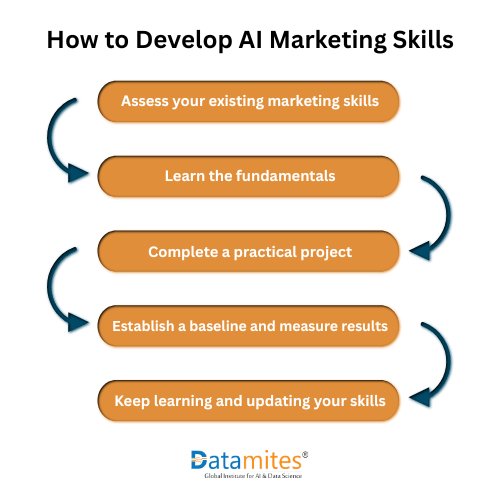
Step 1: Assess your existing marketing skills
Identify the areas in which you already have experience, such as SEO, content marketing, paid advertising, email marketing, analytics, or CRM management.
Choose one area where AI could reduce repetitive work or improve decision-making.
Step 2: Learn the fundamentals
Start with prompt design, data literacy, content verification, workflow logic, and responsible AI practices.
Use official documentation and reputable educational resources to understand the AI tools for marketing you intend to use.
Step 3: Complete a practical project
Choose a project that can be completed and evaluated within a few weeks.
Examples include:
- Developing an AI-assisted content briefing workflow.
- Building a lead-nurturing automation.
- Analyzing a historical campaign dataset.
- Creating and validating customer segments.
- Preparing an SEO content audit.
Use approved data and avoid sharing confidential customer information with tools that have not been cleared for that purpose.
Step 4: Establish a baseline and measure results
Record the existing process before introducing AI. Depending on the project, measure the time required, error rate, revision workload, conversion performance, or another relevant KPI.
For example, if an email campaign normally requires four hours of drafting and review, record the time for several comparable campaigns. Then measure the time spent using the AI-assisted workflow while maintaining the same quality and approval standards.
This is a measurement example, not a claim that AI will necessarily reduce production time by a particular percentage.
Step 5: Document the project
Create a short portfolio case study that includes:
- The original marketing problem.
- The workflow and tools used.
- The role of AI and human review.
- The baseline and evaluation method.
- The results actually observed.
- Limitations, errors, and lessons learned.
A transparent account of what worked and what did not provides stronger evidence of practical capability than a list of AI tools alone.
Step 6: Keep learning and updating your skills
AI products, search systems, privacy requirements, and marketing workflows continue to evolve. Review official product documentation, test new capabilities in controlled settings, and periodically reassess whether your workflows remain effective.
The goal is not to adopt every new AI tool. It is to develop the judgment to select suitable tools, evaluate their outputs, and use them responsibly.
A 30-Day AI Marketing Skills Development Plan
The following plan provides a practical starting point for marketers who want to build confidence through a small, measurable project.
| Period | Learning focus | Practical deliverable |
| Days 1–7 | Generative AI and prompt engineering | A reusable prompt library and content brief |
| Days 8–14 | Content optimization and SEO | An edited, fact-checked content asset |
| Days 15–21 | Analytics and automation | A simple workflow or campaign analysiS |
| Days 22–30 | Evaluation and responsible AI | A documented case study with KPIs and limitations |
At the end of the month, review what you learned, how much work the process required, whether quality improved, and which tasks still needed substantial human intervention.
The outcome should be a practical demonstration of skill, not simply a collection of AI-generated assets.
How to Measure the Business Value of AI Marketing
AI adoption should be evaluated using outcomes that matter to the business rather than the number of prompts written or assets generated.
The appropriate measures depend on the use case.
| AI application | Suggested measures |
| Content creation | Production time, editorial revisions, qualified organic traffic |
| Email marketing | Click-through rate, conversion rate, unsubscribe rate |
| Marketing automation | Time saved, workflow error rate, lead response time |
| Predictive analytics | Forecast accuracy, lead quality, model performance |
| Personalization | Conversion lift, engagement, customer retention |
| SEO optimization | Relevant organic traffic, qualified leads, conversions |
| Responsible AI | Factual error rate, policy violations, privacy incidents |
Where possible, compare similar campaigns or use controlled tests to determine whether an AI-assisted change produced an improvement. Account for differences in audience, budget, seasonality, and other factors that could affect results.
A workflow that produces more content but lowers accuracy or attracts unqualified traffic should not automatically be considered successful.
Refer to the articles below:
- CrewAI vs AutoGen vs LangGraph: Top Multi-Agent Frameworks for 2026
- Green AI Guide: Quantization and FinOps to Reduce LLM Costs
- How Knowledge-Augmented Generation (KAG) Is Solving AI Hallucinations
Essential AI skills for marketing professionals in 2026 include generative AI, content optimization, automation, data analytics, personalization, SEO, and responsible AI use. Marketers should develop these skills through practical projects, measurable outcomes, and continuous learning. Combining AI expertise with creativity, strategic thinking, customer understanding, and human judgment supports effective, ethical marketing decisions.
DataMites Institute offers an industry-oriented AI marketing courses for professionals seeking to develop expertise in AI-driven marketing strategies and business applications. The institute also provides specialized programs in AI for Finance, AI Product Management, and Generative AI for Business Leaders. Through online and classroom training, internships, and practical case studies, learners develop essential marketing technology skills and data-driven marketing capabilities.
The Certified AI Professional in Marketing Analytics course, accredited by IABAC, helps learners strengthen their professional credentials. With training centers across India, including Pune, Bangalore, Hyderabad, Mumbai, Coimbatore, Chennai, Delhi, and Ahmedabad, DataMites Institute makes AI-focused education accessible to aspiring and experienced marketing professionals.