PyTorch vs TensorFlow: Which is Better in 2026
Compare PyTorch vs TensorFlow in 2026. Explore performance, usability, real-world adoption, and expert insights to choose the best AI framework.
 Swagatam Sinha
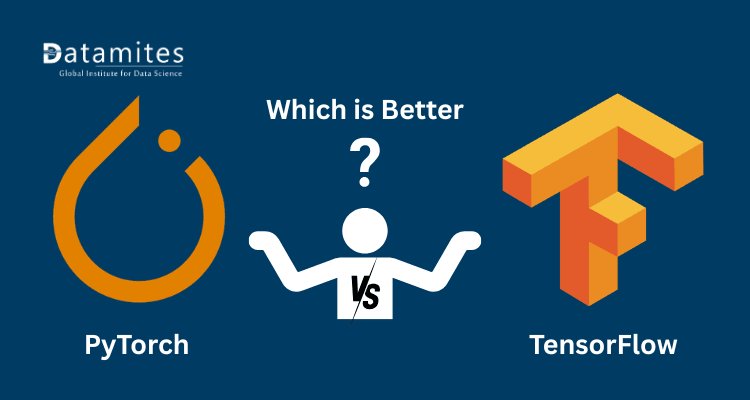
Artificial Intelligence is no longer a future concept it’s already shaping industries like healthcare, finance, e-commerce, and autonomous systems. Behind every intelligent system, there is a powerful deep learning framework. Two names dominate this space: PyTorch and TensorFlow.
Both frameworks have evolved significantly over the years, and in 2026, the competition is tighter than ever. Developers, startups, and enterprises are constantly debating: Which one is better for real-world applications?
This blog breaks down the comparison with real data, market trends, and practical insights—so you can make an informed decision.
What is PyTorch?
PyTorch is an open‑source deep learning framework developed by Meta AI (formerly Facebook AI Research). It’s widely adopted because of its intuitive design, Python‑friendly API, and support for dynamic computation graphs (define‑by‑run), which make experimentation and research very efficient.
Key Features
- Dynamic computation graph (define-by-run)
- Python-friendly and intuitive syntax
- Strong debugging capabilities
- Excellent support for experimentation
Who Uses PyTorch?
- Meta (Facebook) – for AI research and recommendation systems
- OpenAI – for advanced model training workflows
- Tesla – for computer vision models in autonomous driving
Why Developers Prefer It
PyTorch feels natural for Python developers. You can modify models on the go, which makes it ideal for experimentation and innovation.
According to Second Talent and Programming Helper Tech’s 2026 analysis, PyTorch dominates the research landscape with roughly 70–85% of AI researchers preferring it, and a majority of deep learning research papers continue to use it. However, TensorFlow still has higher enterprise penetration.
Refer these articles:
- Top AI Trends That Will Shape 2026
- LLM Fine-Tuning vs Prompt Engineering: Which Is Better?
- Why Agentic AI Is the Most In-Demand Skill for Data Scientists in 2026
What is TensorFlow?
TensorFlow is an open‑source machine learning framework developed by Google. It excels in scalable production deployment, broad ecosystem tools, and enterprise‑grade performance.
Key Features
- Static and dynamic graph support
- TensorFlow Extended (TFX) for production pipelines
- TensorFlow Lite for mobile and edge devices
- Strong deployment capabilities
Who Uses TensorFlow?
- Google – search, translation, and AI services
- Netflix – recommendation systems
- Airbnb – dynamic pricing models
Why Enterprises Prefer It
TensorFlow excels in large-scale deployment and production environments where stability and performance matter most.
Market research reports indicate TensorFlow holds approximately 37–38% global market share in enterprise AI deployments, with tens of thousands of companies using it. Its ecosystem dominates large‑scale production use cases and edge deployments through TensorFlow Lite (LiteRT).
A recent global forecast shows the AI framework market growing at ~25.7 % CAGR through 2030, driven by expanding adoption across industrial, healthcare, finance, and transportation sectors — indicating strong long‑term demand for AI platforms like PyTorch and TensorFlow. (Source: Lucintel)
Core Differences Between PyTorch and TensorFlow
In 2026, PyTorch and TensorFlow remain the two dominant frameworks in the field of deep learning and AI development. Choosing the right framework can impact your learning curve, deployment efficiency, and career opportunities. This guide provides a detailed comparison of PyTorch vs TensorFlow for beginners, highlighting features, adoption trends, and market insights.
Ease of Use
PyTorch: Known for its Pythonic design, PyTorch offers a very easy and intuitive interface. Developers can write deep learning models as naturally as writing Python code, making it ideal for researchers and beginners.
TensorFlow: While TensorFlow has improved its usability with Keras integration, it remains moderately complex for newcomers. Its syntax is more structured and requires understanding of the computational graph concept.
Learning Curve
PyTorch: Beginner-friendly and easy to debug, PyTorch is widely recommended for those starting in machine learning or AI research.
TensorFlow: Slightly steeper learning curve due to more structured workflows, TensorFlow is favored for enterprise-level applications.
Debugging and Development
PyTorch: Offers simple and intuitive debugging, with dynamic computation graphs allowing step-by-step inspection.
TensorFlow: Debugging is more structured, relying on static graphs, which can be efficient but less flexible for rapid experimentation.
Deployment and Production
PyTorch: Deployment is improving with TorchServe and ONNX for cross-platform model serving.
TensorFlow: TensorFlow leads in deployment options, offering TFX, TensorFlow Serving, and TensorFlow Lite, making it ideal for enterprise and mobile deployment.
Community and Adoption
Community Strength: PyTorch has a strong research community, while TensorFlow has a strong enterprise community.
Research Adoption: Approximately 85% of AI research papers in 2026 use PyTorch, while 15% use TensorFlow.
Market Adoption: TensorFlow holds around 37.5% market share, and PyTorch has about 25.7%.
Job Postings: PyTorch leads slightly with 37.7% of AI job postings, compared to TensorFlow’s 32.9%, indicating growing industry demand.
Refer to these articles:
- How AI is Transforming Customer Analytics in 2026
- Explainable AI: Why Black-Box Models Are Losing Trust
- Will AI Agents Replace Your Next Coworker? Exploring the Future of Work
Real World Use Cases: Where PyTorch and TensorFlow Each Win
In the rapidly evolving world of deep learning frameworks, PyTorch and TensorFlow remain the top choices for developers, researchers, and enterprises. Understanding where each framework wins in real‑world applications helps tech teams choose the right tool for innovation, scalability, and production deployment.
PyTorch in Action - Flexibility and Cutting‑Edge Innovation
PyTorch has emerged as the framework of choice for research, prototyping, and rapid AI innovation in 2026. Industry adoption data shows that PyTorch dominates deep learning research, appearing in approximately 85% of published papers, with a strong preference among researchers and small teams for its intuitive, dynamic API.
Why teams choose PyTorch:
- Dynamic computation graphs for flexible model experimentation and debugging.
- Pythonic design that feels natural to Python developers and educators.
- Excellent support from the Hugging Face ecosystem and cutting‑edge pre‑trained models.
- Strong adoption in NLP, computer vision, and generative AI research.
Real‑world PyTorch examples:
- Healthcare AI startup: A medical tech company developed a disease detection model in PyTorch, enabling rapid experimentation with architectures and faster iteration of proof‑of‑concept models.
- Generative AI team: A small AI research team used PyTorch with Hugging Face Transformers to prototype a custom chatbot fine tuned on domain‑specific data.
- Academic research labs: Universities and research institutes publish new network architectures and training methods in PyTorch first, reflecting its research dominance.
Key markets where PyTorch excels:
- Cutting‑edge AI labs and research institutions.
- Startups and agile teams focused on innovation.
- Projects where flexibility, rapid iteration, and prototyping speed are strategic priorities.
TensorFlow in Action - Production‑Grade Performance and Enterprise Scalability
TensorFlow remains a pillar in enterprise AI production environments, backed by a mature ecosystem that supports the full lifecycle of machine learning applications from development to deployment. Market data shows TensorFlow holds the largest share of enterprise deployment (around 37–38%) with extensive use across large companies.
Strengths that enterprise teams rely on:
- TensorFlow Extended (TFX) for robust ML pipelines and data workflows.
- TensorFlow Serving and Lite for scalable model serving and deployment to edge/mobile.
- Multi‑language support beyond Python (C++, Java).
- Tight integration with Google Cloud AI/ML services and production monitoring tools.
Real‑world TensorFlow examples:
- E‑commerce personalization engine: A large online retailer deployed a TensorFlow‑based recommendation system to serve real‑time suggestions at scale using TFX.
- Mobile image recognition app: A hardware company used TensorFlow Lite to deploy optimized computer vision models on millions of mobile devices.
- Financial fraud detection: Major banks integrated TensorFlow models into production fraud detection pipelines, benefiting from stable scalability and enterprise support.
Key markets where TensorFlow excels:
- Large enterprises with mature ML/AI infrastructure.
- Services requiring reliable production deployment and monitoring.
- Use cases involving mobile, edge, or distributed systems.
Refer to these articles:
- How Knowledge-Augmented Generation (KAG) Is Solving AI Hallucinations
- AI Sovereignty: The New Mandate for Data Governance in the Cloud Era
- LLMs vs. SLMs: Key Differences and How to Choose the Right Model
PyTorch vs TensorFlow: Which One Should You Choose in 2026?
When it comes to deep learning frameworks, PyTorch and TensorFlow are the two most popular choices. Choosing the right framework depends on your goals, experience level, and project requirements. Here’s a detailed guide to help you decide.
Why Choose PyTorch? Best for Beginners and Research
PyTorch has gained massive popularity among researchers and developers due to its simplicity and dynamic computation graph. You should choose PyTorch if:
- You are new to deep learning – PyTorch is intuitive and beginner-friendly, making it easier to understand neural networks.
- Focus on research or experimentation – Its flexible design allows you to experiment freely with new models and algorithms.
- Faster prototyping – Dynamic computation graphs make debugging easier and speed up the development cycle.
- Pythonic coding style – PyTorch feels like writing standard Python code, which reduces learning overhead.
- Strong community support – A vast community contributes to tutorials, pre-trained models, and libraries.
For those just starting, comparing PyTorch and TensorFlow can be confusing, but the pytorch vs tensorflow for beginners debate often leans toward PyTorch for its simplicity and ease of learning.
Why Choose TensorFlow? Ideal for Production and Enterprise AI
TensorFlow is a robust framework designed for large-scale machine learning and enterprise solutions. It’s the preferred choice when deploying models in production environments. You should choose TensorFlow if:
- Working on production systems – TensorFlow offers advanced tools like TensorFlow Serving for seamless deployment.
- Need scalability – TensorFlow supports distributed training and cloud-based deployment efficiently.
- Enterprise-level AI solutions – Ideal for organizations building AI-powered products or apps.
- Cross-platform support – TensorFlow works across mobile, web, and embedded systems through TensorFlow Lite and TensorFlow.js.
- High-performance optimization – TensorFlow leverages GPU/TPU acceleration for faster training on large datasets.
In 2026, both PyTorch and TensorFlow continue to lead the deep learning ecosystem, each excelling in its domain. PyTorch dominates research, prototyping, and innovation, making it ideal for beginners and academic exploration. TensorFlow, on the other hand, offers enterprise-grade stability, production deployment, and scalability, making it the top choice for large-scale AI applications. Choosing the right framework depends on your goals, whether it’s learning, experimentation, or production-ready AI solutions.
For anyone aspiring to build a career in AI, understanding both frameworks can be a game-changer. Developing practical skills in PyTorch vs TensorFlow for beginners opens doors to exciting opportunities in data science, machine learning, and artificial intelligence industries.
DataMites is a leading institute dedicated to training professionals in Artificial Intelligence, Machine Learning, and Data Science. Our Artificial Intelligence Course in Pune equips learners with hands-on experience in PyTorch, TensorFlow, and other modern AI tools. Students gain practical exposure through real-world projects, making them industry-ready.