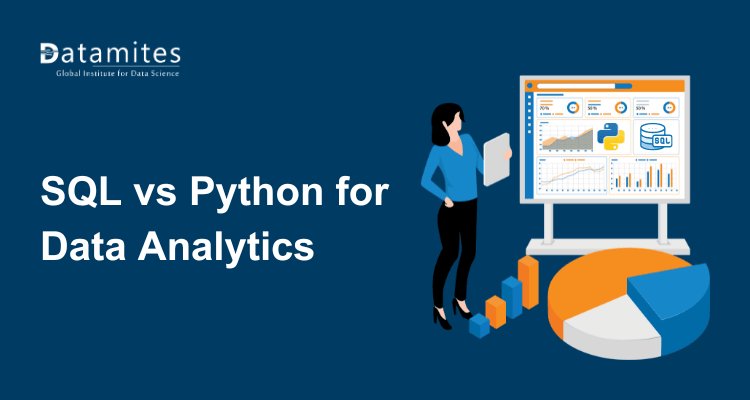
SQL vs Python for Data Analytics in 2026: Which Skill Should You Learn First?
Learn SQL vs Python for data analytics in 2026 and discover which skill to learn first. Explore real-world examples, industry trends, and career insights for aspiring data analysts.
 Swagatam Sinha
Data analytics is no longer just a technical field; it has become a core business function. In 2026, companies depend on data to understand customers, reduce costs, and plan future strategies. From banks and hospitals to e-commerce and government agencies, almost every industry uses data to make decisions.
If you want to enter this field, one of the first questions you will face is: SQL vs Python — which skill should you learn first for data analytics?
Both tools are powerful and widely used. However, they serve different purposes. This blog explains sql vs python, how each is used in data analytics, and which one you should start with based on industry demand and real-world use. It also includes market research and statistics to help you make an informed choice.
What Is Data Analytics?
Data analytics is the process of collecting, cleaning, and analyzing data to find useful patterns and insights. A data analyst may answer questions like:
- Why did sales increase last quarter?
- Which product is most profitable?
- Which customers are likely to leave?
To answer these questions, analysts need tools that can:
- Access data from databases
- Clean and organize the data
- Analyze and visualize the results
This is where SQL for data analytics and Python for data analytics come into play.
According to Grand View Research, the global data analytics market is projected to grow from around USD 69.54 billion in 2024 to over USD 85.47 billion in 2025, and is expected to continue expanding rapidly toward USD 302 billion by 2030.
Overview of SQL for Data Analytics
SQL (Structured Query Language) is the primary language used to interact with and manage databases. Most business data is stored in relational databases such as MySQL, PostgreSQL, Oracle, and SQL Server.
What SQL Is Used For
- Retrieving data from large databases
- Filtering and sorting records
- Joining multiple tables
- Creating reports
For example, if a company wants to know how many products were sold last month, SQL can fetch that information in seconds.
Strengths of SQL
- Simple and easy to learn
- Very fast for querying large datasets
- Used in almost every company
- Essential for business reporting
SQL is usually the first tool used in data analytics because data is stored in databases. Without SQL, you cannot easily access that data.
Why SQL Is Essential
Direct Access to Data: SQL lets analysts pull exactly the data they need from large databases without needing complex code. Reports show that SQL appears in over 50% of data analyst job postings.
High Job Requirement: A 2026 job market report indicates that 45% of data analysts use SQL daily, highlighting its place as a core skill.
Used Across Sectors: From banking to e-commerce, SQL remains the language used to fetch structured data for dashboards, reports, and exploratory analysis.
SQL in Job Ads and Market Demand
Data collected from job boards shows that SQL is still one of the most frequently required skills in data analytics roles. In one 2024 study of job listings, SQL was mentioned in more than half of all data analyst positions (52.9%), making it often the first technical requirement recruiters list.
This reflects a broader market pattern: even as new tools emerge, the ability to pull, join, and aggregate data from databases remains vital. Mastering SQL allows you to handle the foundational step in analytics getting data ready for analysis.
Research shows job postings emphasizing analytics roles frequently list SQL as a core requirement with multiple industry analyses indicating SQL proficiency remains a foundational requirement for data professionals, reflecting its central role in querying and preparing data from structured databases.
Refer to these articles:
- Edge Analytics Explained: Processing Data Where It Matters Most
- Augmented Analytics Explained: How AI is Reshaping the Data Analyst Role
- Why Data Analysts Are Choosing DuckDB for Modern Analytics
Overview of Python for Data Analytics
Python is a general-purpose programming language. In data analytics, Python is used for data cleaning, statistical analysis, automation, and visualization.
Python consistently ranks among the most popular programming languages globally and is widely used for data projects, continuing its strong growth in the TIOBE index of programming languages.
What Python Is Used For
- Cleaning messy datasets
- Performing calculations and statistics
- Creating charts and dashboards
- Working with machine learning models
Python uses popular libraries such as:
- Pandas for data handling
- NumPy for numerical operations
- Matplotlib and Seaborn for charts
Strengths of Python
- Very flexible
- Works well with large and small datasets
- Used for advanced analytics and AI
- Strong community support
Python for data analytics becomes important when analysis goes beyond simple queries and needs deeper insights.
Python’s Role in Data Analytics
Python’s rise in analytics comes from the powerful libraries it offers:
- Pandas and NumPy for data transformation and numerical operations.
- Matplotlib and Seaborn for visualization.
- Tools like Scikit-learn for predictive modeling and machine learning.
According to recent research, Python is preferred by 69% of data professionals over R, and its usage continues to grow in data roles.
Job Market Demand for Python
As of 2026, surveys indicate that Python is required or preferred in a significant share of analytics and data science jobs. One profile of job trends shows 55% of data analysts use Python for daily tasks.
In addition, a career insights report shows that Python appears in 65% of data scientist and analytics job postings and skilled professionals can earn higher salaries benchmark U.S. data suggests Python-skilled analysts earn an average of $103,694 annually, compared with $70,811 for non-Python analysts.
SQL vs Python: Key Differences
Understanding the difference between SQL vs Python helps you decide which skill to tackle first.
| Feature | SQL | Python |
| Purpose | Data retrieval | Data analysis and modeling |
| Learning curve | Easy | Moderate |
| Best for | Databases and reporting | Advanced analysis and automation |
| Speed | Very fast for queries | Depends on dataset and code |
| Flexibility | Limited to databases | Highly flexible |
In simple terms:
- SQL helps you get the data
- Python helps you analyze the data
This is the core difference in the sql vs python debate.
Refer to these articles:
- How GenAI Is Influencing Data Analyst Productivity and Accuracy
- Is the Data Analyst Market Overcrowded?
- How Looker, Tableau, and Power BI Are Revolutionizing Data Analytics
Use Cases: When to Use SQL and When to Use Python
Understanding the typical use cases helps frame which skill is more relevant at different stages of a career or project:
SQL Use Cases
- Filtering records and summarizing data for reports.
- Joining customer or transactional tables.
- Preparing datasets for dashboards.
Example: A marketing analyst using SQL might join user data with purchase history to calculate conversion rates.
Python Use Cases
- Cleaning datasets with irregular structure.
- Creating automated data pipelines.
- Building predictive models to forecast future sales.
Example: A business analyst might use Python to automate weekly trend reports and visualize them with libraries like Seaborn.
According to the U.S. Bureau of Labor Statistics, employment for data scientists is projected to grow over 33 % by 2034 — far above average job growth across other fields. This strong demand shows that analytics expertise, including both SQL and Python, will remain crucial in the coming decade.
Real-World Examples: SQL vs Python in Action
Understanding sql vs python becomes much easier when you see how companies use these tools in real situations. Below are concrete examples from different industries showing how sql for data analytics and python for data analytics are applied.
1. E-commerce Industry
SQL Example:
Amazon gathers extensive data on its customers, such as their browsing behavior, purchase history, and wishlist activities. An analyst at Amazon might use SQL to:
- Extract all users who added a product to their cart but did not complete the purchase.
- Aggregate purchase trends by product category and region.
- Join tables from marketing campaigns and transaction logs to analyze promotion effectiveness.
By writing optimized SQL queries, analysts can quickly generate insights that inform pricing strategies or personalized recommendations.
Python Example:
After extracting the raw data with SQL, Amazon might use Python to:
- Build a predictive model to recommend products to users based on purchase history.
- Use Python’s pandas and NumPy to clean irregular datasets from multiple sources (e.g., website logs + mobile app data).
- Automate weekly reports that track conversion rates or campaign performance using Python scripts.
This combination ensures efficiency: SQL handles data retrieval, while Python handles analysis and automation.
2. Banking and Finance
SQL Example:
JPMorgan Chase and other financial institutions rely heavily on SQL for querying transaction databases:
- Detecting suspicious activity or potential fraud by aggregating large transactional datasets.
- Creating reports that summarize customer account balances, deposits, and withdrawals.
Python Example:
Python is used to build fraud detection models using machine learning algorithms. For instance:
- Python’s scikit-learn or TensorFlow can detect unusual patterns in transaction data.
- Automated alert systems flag accounts with suspicious activity, reducing manual oversight.
A combination of SQL and Python enables banks to comply with regulations while improving operational efficiency.
3. Healthcare Analytics
SQL Example:
Hospitals like Mayo Clinic use SQL to manage patient records stored in relational databases:
- Extracting patient records for clinical studies.
- Aggregating data to analyze treatment outcomes by demographic.
Python Example:
Python helps healthcare analysts with predictive analytics:
- Predict patient readmission rates using historical treatment and demographic data.
- Automate the generation of visual dashboards for hospital management using Python’s Matplotlib or Plotly.
By combining SQL and Python, healthcare providers can make faster, evidence-based decisions that improve patient care.
4. Marketing and Social Media Analytics
SQL Example:
Netflix relies on SQL to query its massive datasets to understand user engagement:
- Identify users who watched a certain genre but stopped midway.
- Aggregate viewing habits by region and time of day.
Python Example:
Python helps Netflix personalize recommendations and optimize campaigns:
- Build recommendation engines using collaborative filtering and neural networks.
- Analyze sentiment from social media data to adjust content strategy.
This real-world usage demonstrates how sql for data analytics and python for data analytics work hand-in-hand to drive business decisions.
5. Retail Analytics
SQL Example:
Walmart uses SQL to analyze supply chain data:
- Query inventory levels across hundreds of stores.
- Aggregate sales trends by SKU, region, and season.
Python Example:
Python allows Walmart analysts to forecast demand and optimize stock levels:
- Predict product demand during peak seasons.
- Automate restocking recommendations based on historical sales trends and machine learning models.
SQL handles structured queries on large datasets efficiently, while Python adds predictive power and automation capabilities.
These examples show that in the real world, SQL is essential for retrieving and preparing data, while Python unlocks the ability to perform complex analysis, build predictive models, and automate workflows. Professionals who can combine both skills are more valuable in industries ranging from e-commerce to finance, healthcare, and retail.
Refer to these articles:
- Correlation vs Covariance for Analysis
- Data Lakehouse: Transforming Analytics with Unified Data
- Data Science Vs Data Analytics
Learning Path: Which Skill Should You Learn First?
Choosing which skill to learn first depends on your career goals and context.
If You Are a Beginner
Start with SQL. You will quickly be able to:
- Write queries to extract meaningful data
- Work with real datasets in business environments
- Get early success in reporting and dashboarding tasks
- Improve confidence before moving into programming
SQL is less intimidating for beginners and immediately useful for entry-level jobs.
If You Aim for Advanced Analytics
After SQL, learn Python. Python empowers you to:
- Clean and transform large datasets
- Visualize insights with charts and dashboards
- Apply statistics and predictive modeling
Python becomes essential if you aim for titles like data scientist, machine learning specialist, or analytics manager.
If You Want Both
Ideally, learn SQL first, then Python. This order helps you build a strong foundation in data retrieval before mastering the larger analytical toolset.
Employers increasingly value professionals who can both retrieve data with SQL and analyze it with Python and this combination often leads to better roles and salaries.
In the sql vs python debate, SQL often makes sense as the first skill to learn for those entering data analytics. Its core role in data querying and high job demand make it a foundational skill that helps you start analyzing data right away. After that, moving on to Python for data analytics will deepen your analytical capabilities, broaden your career options, and position you for more advanced analytics and data science work.
By mastering SQL first and then Python, you build a strong technical foundation that aligns with what employers are looking for in 2026 and beyond. Combine these skills with data visualization and critical thinking, and you will be well-equipped for a successful career in analytics.
DataMites offers a comprehensive Data Analyst Course in Hyderabad designed to equip learners with industry-ready skills in SQL, Python, Excel, and data visualization. With over 11 years of trust in the analytics training domain, DataMites has successfully trained more than 150,000 learners, helping them secure roles in top companies across India and globally.
Our course is delivered through hands-on sessions, real-time projects, and expert mentorship. DataMites has more than 20 physical locations, including Bangalore, Pune, Hyderabad, Mumbai, Chennai, Coimbatore, Delhi, and more, ensuring learners have access to quality training and support wherever they are.