What Are Graph Neural Networks? A Simple Guide for Beginners
Beginner-friendly guide to Graph Neural Networks (GNNs). Learn how GNNs work, types, real-world applications, benefits, and latest 2026 market trends in AI and data science.
 Swagatam Sinha
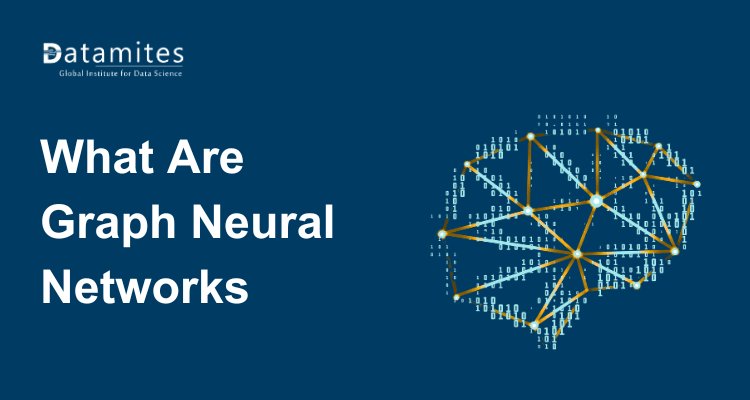
Data today is no longer simple or isolated. Everything is connected people, transactions, devices, and even molecules. Traditional machine learning models struggle to understand these relationships properly. This is where Graph Neural Networks (GNNs) come into the picture.
Instead of treating data as rows and columns, GNNs look at how things are connected. They learn patterns from relationships, not just individual data points. This makes them powerful for solving real-world problems where connections matter more than isolated values.
In this guide, you will understand Graph Neural Networks in the simplest way possible, with real-life examples, practical use cases, and the latest industry insights.
What Are Graph Neural Networks?
Graph Neural Networks are a type of deep learning model designed to work with graph-based data structures. In simple terms, they help machines understand relationships between connected data points.
A graph consists of:
- Nodes (Vertices): Individual entities (like people, products, or cities)
- Edges: Connections between those entities
For example:
- In a social network → users are nodes, friendships are edges
- In a road map → locations are nodes, roads are edges
GNNs analyze these connections and learn patterns from them, making predictions based on both data and relationships.
The global GNN market was valued at $1.45 billion in 2024 and is expected to reach $13.2 billion by 2033, growing at a CAGR of 28.4% (Market Intelo)
Read to these articles:
- PyTorch vs TensorFlow: Which is Better?
- Top AI Trends That Will Shape 2026
- LLM Fine-Tuning vs Prompt Engineering: Which Is Better?
How Graph Neural Networks Work (Step-by-Step)
Graph Neural Networks (GNNs) are designed to process and learn from graph-structured data, making them highly effective for tasks like social network analysis, recommendation systems, fraud detection, and molecular modeling. Unlike traditional machine learning models, GNNs focus on relationships between data points, not just the data itself.
Step 1: Initialize Node Features
Every graph consists of nodes (also called vertices) and edges (connections between nodes). In the first step, each node is assigned an initial feature vector.
These features can include:
- User profile data in social networks
- Attributes of molecules in chemistry
- Product information in recommendation systems
This step provides the foundational data that the Graph Neural Network will use for learning.
Step 2: Gather Information from Neighboring Nodes
In this stage, each node collects information from its directly connected neighbors. This process is known as message passing or neighborhood aggregation.
Key idea:
A node does not learn in isolation it learns from its surrounding nodes.
For example:
- In a social network, a person’s preferences may be influenced by their friends
- In fraud detection, suspicious behavior may be linked to connected accounts
This step allows the model to capture local relationships within the graph.
Step 3: Update Node Representation
After gathering information, each node updates its feature representation by combining:
- Its own features
- Aggregated features from neighboring nodes
This is typically done using neural network layers and activation functions.
As a result:
- Each node becomes more context-aware
- The representation now reflects both individual and neighbor information
This step is crucial for learning meaningful patterns in graph data.
Step 4: Repeat the Message Passing Process
The message passing and update steps are repeated multiple times (layers). With each iteration:
- Nodes gather information from farther parts of the graph
- The model captures deeper and more complex relationships
For example:
- After 1 iteration → node learns from immediate neighbors
- After 2 iterations → node learns from neighbors of neighbors
This iterative process helps GNNs understand both local and global graph structures.
Step 5: Final Prediction
Once the model has learned rich node representations, it uses them to make predictions. The output depends on the task, such as:
- Node classification (e.g., predicting user interests)
- Link prediction (e.g., recommending new connections)
- Graph classification (e.g., identifying molecule properties)
The final prediction layer transforms learned embeddings into actionable insights.
Types of Graph Neural Networks (GNNs)
Different types of GNNs are designed to handle specific data patterns and computational needs. Below are the most widely used types of Graph Neural Networks:
1. Graph Convolutional Networks (GCN)
Graph Convolutional Networks (GCNs) are one of the most popular and foundational types of GNNs. They extend the concept of convolution from traditional neural networks to graph data, allowing models to aggregate information from neighboring nodes.
GCNs are widely used for tasks such as node classification, link prediction, and recommendation systems. By combining features from nearby nodes, GCNs can effectively capture local graph structures and relationships. This makes them highly suitable for applications like social network analysis, citation networks, and user-item recommendation platforms.
Key Benefits:
- Efficient for semi-supervised learning
- Captures local neighborhood information
- Scalable for large graph datasets
2. Graph Attention Networks (GAT)
Graph Attention Networks (GATs) introduce an attention mechanism to graph processing. Instead of treating all neighboring nodes equally, GAT assigns different importance (weights) to each connection. This allows the model to focus on the most relevant nodes when learning.
GATs are particularly useful when dealing with complex graphs where not all relationships are equally important. By dynamically learning attention weights, they improve model performance in tasks such as node classification, fraud detection, and recommendation systems.
Key Benefits:
- Learns the importance of each neighbor
- Improves interpretability of graph models
- Handles heterogeneous graph structures effectively
3. Graph Recurrent Networks (GRN)
Graph Recurrent Networks (GRNs) are designed to process sequential or time-dependent graph data. They combine graph structures with recurrent neural networks (RNNs) to capture temporal dependencies across nodes and edges.
GRNs are commonly used in scenarios where graph data evolves over time, such as traffic prediction, dynamic social networks, and time-series forecasting on graphs. These networks enable the model to learn both spatial (graph) and temporal (sequence) patterns simultaneously.
Key Benefits:
- Handles dynamic and time-evolving graphs
- Captures sequential dependencies
- Useful for real-time prediction systems
Refer these articles:
- Why Agentic AI Is the Most In-Demand Skill for Data Scientists in 2026
- How AI is Transforming Customer Analytics in 2026
- Explainable AI: Why Black-Box Models Are Losing Trust
Real-World Applications of Graph Neural Networks (GNNs)
Graph Neural Networks (GNNs) are transforming how complex, interconnected data is analyzed across industries. By leveraging relationships between entities, GNNs enable more accurate predictions and smarter decision-making. Below are some of the most impactful real-world applications:
1. Social Media Recommendations
Social media platforms use GNNs to enhance user engagement by analyzing connection patterns. By studying mutual friends, shared interests, and interaction networks, GNNs help suggest relevant connections, groups, and content, creating a more personalized user experience.
2. Fraud Detection in Banking and Finance
Financial institutions rely on GNNs to identify fraudulent activities. These models detect unusual transaction patterns by mapping relationships between accounts, devices, and transactions. This network-based approach improves the accuracy of fraud detection compared to traditional methods.
3. Healthcare and Drug Discovery
In healthcare, GNNs play a crucial role in analyzing molecular structures and biological networks. They help researchers understand how different compounds interact, accelerating the discovery of new drugs and improving treatment strategies.
4. E-commerce Recommendation Systems
E-commerce platforms use GNNs to recommend products based on user behavior, purchase history, and product relationships. By capturing complex interactions between users and items, GNNs provide highly relevant and personalized product suggestions, boosting customer satisfaction and sales.
5. Traffic Prediction and Navigation Systems
Navigation systems utilize GNNs to model road networks and predict traffic conditions. By analyzing connections between roads, intersections, and real-time data, GNNs help optimize routes, reduce travel time, and improve overall transportation efficiency.
These applications highlight how Graph Neural Networks are driving innovation by effectively modeling relationships in complex data, making them a powerful tool across multiple domains.
The global neural network market is expected to reach USD 31.23 billion in 2026, growing rapidly toward USD 142 billion by 2034. (Source: Precedence Research)
Benefits of Graph Neural Networks (GNNs)
Unlike traditional machine learning models, GNNs are specifically designed to work with graph-structured data, making them highly effective for real-world applications where relationships matter. Below are the key benefits of Graph Neural Networks explained:
1. Captures Complex Relationships in Data
One of the biggest advantages of Graph Neural Networks is their ability to understand and model relationships between data points. Instead of treating data as isolated entries, GNNs consider how each node is connected to others within a network. This makes them ideal for applications like social networks, recommendation systems, and fraud detection, where connections play a crucial role.
2. Improves Prediction Accuracy
GNNs enhance predictive performance by incorporating contextual information from neighboring nodes. This means predictions are not based on a single data point alone but also on its surrounding structure. As a result, Graph Neural Networks often deliver higher accuracy compared to traditional models, especially in tasks like node classification, link prediction, and graph classification.
3. Scalable for Large and Complex Datasets
Graph Neural Networks are highly scalable and can efficiently process large, interconnected datasets. Whether it's millions of users in a social network or complex biological networks, GNNs are designed to handle high-dimensional and structured data. Techniques like sampling and distributed training further improve their scalability, making them suitable for enterprise-level applications.
4. Supports Versatile Real-World Applications
GNNs are widely used across various industries due to their flexibility. Some common applications include:
- Recommendation systems (e.g., e-commerce platforms)
- Fraud detection in banking and finance
- Drug discovery in healthcare
- Traffic prediction in smart cities
- Knowledge graph analysis in search engines
This versatility makes Graph Neural Networks a powerful tool for solving diverse and complex problems across domains.
Refer to these articles:
- Will AI Agents Replace Your Next Coworker? Exploring the Future of Work
- CrewAI vs. AutoGen vs. LangGraph
- How Knowledge-Augmented Generation (KAG) Is Solving AI Hallucinations
Graph Neural Networks are changing the way machines understand data. Instead of analyzing data in isolation, they focus on relationships, which makes them more powerful and realistic.
From social media to healthcare, GNNs are solving complex problems that traditional models cannot handle. With rapid growth and real-world adoption, learning GNNs today can open strong career opportunities in data science and AI.
If you are entering the world of machine learning, Graph Neural Networks are worth your attention.
DataMites Institute is a leading training provider delivering industry relevant skills in data science, analytics, and emerging technologies through expert mentors, practical learning, and recognized certifications for career growth success.
With a strong focus on career outcomes, DataMites also offers the Artificial Intelligence Couse in Mumbai, helping professionals gain practical experience and advance in competitive technology driven job markets today.