What Is Agentic AI Architecture? Components, Workflow, and Real-World Applications
Explore Agentic AI Architecture, its key components, workflow, different types, and real-world applications across industries, along with future scope and essential skills.
 Prerana B A
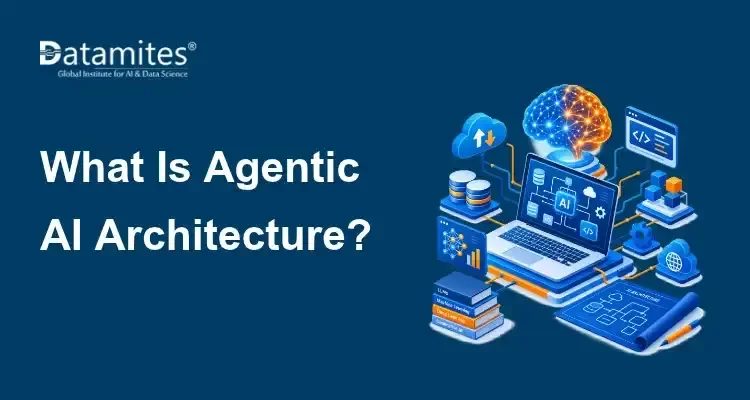
Artificial Intelligence (AI) is transforming how businesses operate, make decisions, and manage complex tasks. Unlike traditional systems that follow predefined instructions, Agentic AI can understand goals, analyse information, plan actions, and complete multi-step tasks with limited human intervention, helping businesses improve efficiency through intelligent automation.
At the center of this development is agentic AI architecture, which combines reasoning, memory, planning, and tool integration to manage complex workflows. According to MarketsandMarkets, the global Agentic AI market is projected to grow from USD 19.33 billion in 2026 to USD 205.88 billion by 2033, at a CAGR of 40.2%. This growth highlights the increasing interest in autonomous AI systems and the importance of understanding their architecture, components, and real-world applications.
What Is Agentic AI Architecture?
Agentic AI architecture is the structural framework that enables AI agents to understand goals, make decisions, plan tasks, interact with external tools, and perform actions autonomously. Unlike traditional AI applications that mainly respond to individual instructions, agent-based systems can handle broader objectives by breaking them into smaller tasks, selecting suitable tools, evaluating results, and adjusting their approach when necessary.
For example, an AI-powered travel assistant can go beyond suggesting destinations. It can compare travel options, check accommodation availability, create personalised itineraries, and assist with booking-related activities based on its permissions and integrations.
The architecture generally combines several technologies, including:
- Large Language Models (LLMs): Help agents understand natural language, interpret instructions, and generate responses.
- Memory Systems: Store relevant information from previous interactions and maintain context.
- Planning Mechanisms: Break complex objectives into manageable steps.
- Tool Integration: Connect agents with APIs, databases, search engines, and other software applications.
- Decision-Making Mechanisms: Evaluate available information and select suitable actions.
- Feedback Systems: Review outcomes and support adjustments when tasks do not produce the expected results.
Together, these elements allow intelligent agents to perform multi-step activities rather than simply generate text-based responses.
Refer to these articles:
- Learn about the Types of Machine Learning Algorithms
- What is a Confusion Matrix in Machine Learning?
- Supervised vs. Unsupervised Learning: What’s the Difference?
Key Components of Agentic AI Architecture
An effective agent-based system depends on multiple interconnected components. Each component performs a specific function, while their coordination enables the system to complete complex tasks.
1. AI Agent and Reasoning Engine
The AI agent serves as the central decision-making unit, receiving instructions, understanding objectives, and determining the next steps. Its reasoning engine analyses information, evaluates possible solutions, and selects suitable actions, often using Large Language Models (LLMs) for language understanding and reasoning support.
For instance, an AI customer support agent can understand a customer's complaint, identify the issue, retrieve relevant information, and recommend an appropriate solution.
2. Planning and Task Management
Planning allows an AI agent to break complex objectives into smaller, manageable tasks. It creates an organised sequence of actions, identifies priorities, and determines the steps needed to achieve the desired outcome efficiently.
Important planning activities include:
- Understanding the primary objective.
- Breaking the objective into smaller tasks.
- Identifying dependencies between tasks.
- Selecting suitable execution methods.
- Monitoring progress and adjusting the plan.
This component is particularly useful for business processes involving multiple steps and decision points.
3. Memory and Knowledge Management
Memory allows an AI agent to retain useful information and maintain context throughout an interaction.
There are two commonly discussed memory types:
- Short-term memory: Maintains information required during the current task or conversation.
- Long-term memory: Stores relevant information that may be useful across future interactions.
Knowledge management systems can also connect agents to external information sources, such as company documents, databases, and knowledge repositories.
Retrieval-Augmented Generation (RAG) is one approach that helps agents retrieve relevant information from external sources before generating responses.
4. Tools and External Integrations
AI agents often need access to external applications to complete tasks beyond text generation.
Tool integration allows agents to interact with different digital systems, including:
- APIs and web services.
- Enterprise databases.
- Search engines.
- Customer Relationship Management (CRM) platforms.
- Business intelligence applications.
- Workflow automation tools.
For example, an AI-powered business assistant may retrieve customer details from a CRM platform, analyse sales information, and prepare a performance report.
5. Action Execution and Feedback
The execution component performs selected actions using connected tools or applications, while the feedback mechanism evaluates the results to check whether the intended objective has been achieved.
If an operation fails, the agent may retry, choose another approach, or request human assistance. Appropriate permissions, validation, and monitoring are important to prevent incorrect or unintended actions.
Refer to these articles:
- What are the Best Artificial Intelligence and Deep Learning Courses in India?
- Artificial Intelligence Career Scope in India
- How to Become an Artificial Intelligence Engineer in India?
How Does Agentic AI Architecture Work? Understanding the Workflow
The workflow explains how different components work together to achieve a specific objective. Although implementation varies across applications, most agentic systems follow a similar sequence.
Step 1: Goal Identification
The process begins when a user or an external system provides an objective. The agent analyses the instruction and identifies the expected outcome.
For example, a business manager may ask an AI agent to prepare a monthly sales performance report.
Step 2: Understanding and Planning
The agent interprets the request and divides it into smaller activities. It may identify the need to collect sales records, organise information, calculate performance metrics, and prepare a summary.
Step 3: Information Collection
The system retrieves relevant information from connected databases, documents, APIs, or other knowledge sources.
The accuracy of future decisions depends heavily on the quality and relevance of the information gathered.
Step 4: Reasoning and Decision-Making
The agent analyses the available information and determines the most appropriate next action. It may compare different approaches and select one based on the task requirements.
Step 5: Action Execution
The selected actions are performed using connected tools. For example, the agent may retrieve sales records, calculate monthly revenue, and generate a structured report.
Step 6: Evaluation and Feedback
The system checks whether the completed action meets the original objective. If the result is incomplete or incorrect, it can revise its approach and attempt another solution.
Step 7: Final Output
After completing the required activities, the agent presents the results to the user. Depending on the application, the final output could be a report, recommendation, completed workflow, or notification.
This continuous process of planning, acting, and evaluating makes agent-based systems suitable for complex and multi-stage tasks.
Different Types of Agentic AI Architecture
Different applications require different architectural approaches. The selection depends on task complexity, system requirements, available resources, and the level of autonomy required.
1. Single-Agent Architecture
A single-agent architecture uses one intelligent agent to manage and execute a task.
The agent receives instructions, plans the required activities, accesses available tools, and delivers the output.
This approach is suitable for applications such as personal assistants, automated research tools, and basic customer support systems.
2. Multi-Agent Architecture
A multi-agent architecture uses multiple specialized agents to achieve a shared goal, with each handling a specific task. For example, in market research:
- One agent collects market information.
- Another analyses competitors.
- A third evaluates customer trends.
- A reporting agent combines the findings.
This approach can improve task distribution and support complex workflows. However, communication, coordination, and conflict resolution between agents must be carefully managed.
3. Hierarchical Agent Architecture
Hierarchical architecture organizes agents into different levels of responsibility. A supervisory agent assigns tasks to subordinate agents, monitors their progress, and reviews their results. This structure is useful for managing complex enterprise workflows and multiple business processes.
4. Collaborative Agent Architecture
Collaborative architecture enables multiple agents to communicate, share information, and work together without following a fixed hierarchy. It is useful for research, complex problem-solving, and tasks requiring expertise from different domains.
Refer to these articles:
- PyTorch vs TensorFlow: Which is Better?
- What Are Graph Neural Networks? Simple Guide for Beginners
- What is Artificial Narrow Intelligence?
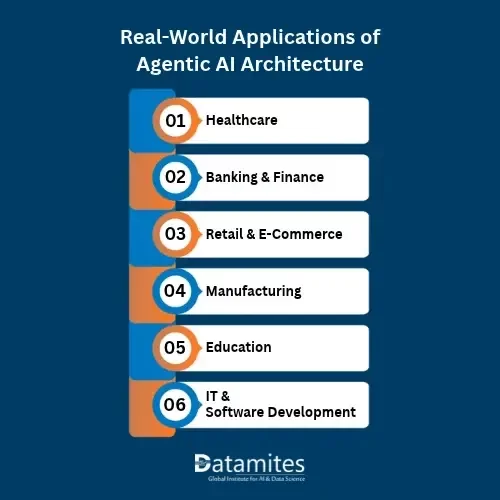
Real-World Applications of Agentic AI Architecture
The adoption of intelligent agents is helping businesses streamline operations, improve decision-making, and automate repetitive tasks across industries.
According to Grand View Research, the global Agentic AI market was valued at USD 16.2 billion in 2025 and is projected to reach USD 224.5 billion by 2033, growing at a 38.6% CAGR from 2026 to 2033. This growth highlights the expanding role of agentic systems in healthcare, banking, retail, manufacturing, and IT.
1. Healthcare
Healthcare organizations can explore agentic systems to support administrative and information-management activities.
PotenOrganizingtions include:
- Organizing patient information.
- Supporting appointment scheduling.
- Retrieving relevant medical documents.
- Assisting healthcare professionals with information gathering.
Coordinating administrative workflows.
Clinical decisions must remain under appropriate professional supervision. AI-generated information should not replace qualified medical judgment.
2. Banking and Finance
Financial institutions handle large volumes of transactions, customer information, and operational activities.
Agentic systems can support processes such as transaction monitoring, financial document analysis, customer service, and risk assessment.
For example, an AI agent may identify unusual transaction patterns, gather relevant information, and flag potentially suspicious activities for review by authorized professionals.
3. Retail and E-Commerce
Retail businesses can use intelligent agents to improve customer experiences and streamline operational processes.
Common applications include:
- Personalized product recommendations.
- Inventory monitoring.
- Customer query management.
- Order tracking.
- Demand forecasting support.
An agent can analyze customer preferences and purchase history to recommend suitable products while helping businesses manage customer interactions more efficiently.
4. Manufacturing
Manufacturing organizations can use agentic systems to coordinate different operational activities.
Potential applications include predictive maintenance support, production scheduling, inventory management, and quality monitoring.
For instance, an intelligent agent can analyze machine performance information, identify unusual patterns, and notify maintenance teams when equipment requires inspection.
5. Education
Educational institutions can explore AI agents to support personalized learning and administrative tasks.
Applications include:
- Providing personalized learning recommendations.
- Answering common student queries.
- Organizing educational resources.
- Supporting assignment feedback.
- Assisting with course-related administrative activities.
Human educators continue to play an important role in evaluating student progress and providing meaningful guidance.
6. Information Technology and Software Development
The IT industry is another area where agentic systems have significant potential.
AI agents can assist with code generation, software testing, debugging support, documentation, and issue tracking.
For example, a development-focused agent can analyze a reported software issue, identify relevant code sections, suggest possible corrections, and run tests within an authorized development environment.
Future Scope of Agentic AI Architecture and Skills Required
The future of agentic systems will involve deeper enterprise integration, improved collaboration between specialized agents, and advanced automation. As businesses adopt autonomous workflows, professionals with AI development, software engineering, and intelligent automation skills may find growing career opportunities.
Some important skills include:
- Programming Knowledge: Python for AI development, API integration, and agent-based applications.
- Machine Learning and Deep Learning: Understanding neural networks, model training, and AI fundamentals.
- Large Language Models: Knowledge of LLMs, prompt engineering, embeddings, and retrieval techniques.
- Agent Development Frameworks: Familiarity with LangGraph, LangChain, CrewAI, and AutoGen.
- API and Database Integration: Understanding REST APIs, JSON, SQL, and database operations.
- Cloud Computing and Deployment: Knowledge of cloud platforms, containers, and application deployment.
- AI Safety and Governance: Understanding data privacy, security, human oversight, and responsible AI practices.
Along with technical expertise, professionals should develop analytical thinking, problem-solving, communication, and system-design skills to build reliable and effective AI solutions.
As the technology matures, organizations will also need professionals who can evaluate whether an agent-based solution is suitable for a particular business problem rather than introducing automation without a clear purpose.
Agentic AI is transforming artificial intelligence by enabling systems to plan, reason, make decisions, and execute complex tasks autonomously. With applications across healthcare, banking, manufacturing, retail, and IT, it helps businesses improve productivity and streamline operations. As organizations increasingly adopt intelligent automation, understanding agentic AI architecture, its components, and applications is becoming valuable for technology professionals. Developing skills in Python, machine learning, LLMs, APIs, and agent development frameworks can help professionals prepare for emerging opportunities in the evolving AI industry.
For learners interested in agentic AI and its practical applications, DataMites Institute offers industry-oriented programs that help build knowledge of autonomous AI systems, agent development, and intelligent automation. Learners exploring the top artificial intelligence course in Hyderabad can benefit from hands-on projects, IABAC® and NASSCOM® certifications, internship opportunities, and job assistance. Recognized as the best skill development EdTech, DataMites focuses on practical, career-oriented learning that helps learners understand agentic AI architecture, develop relevant technical skills, and explore emerging opportunities in the AI industry.
DataMites offers flexible online and classroom learning options to help learners develop practical skills in artificial intelligence. With 50+ offline centers across India, the institute provides the best artificial intelligence training in Pune and other major cities, including Hyderabad, Chennai, Coimbatore, Mumbai, Kolkata, Ahmedabad, and Chandigarh. These options help students, freshers, and working professionals learn AI concepts, explore real-world applications, and build relevant technical skills based on their learning preferences and career goals.