What Is Data Anonymization and Why Is It Important for Data Privacy?
Learn what data anonymization is, how it works, and why it is essential for data privacy. Explore key techniques, benefits, real-world applications, and the role of anonymized data in protecting sensitive information, reducing privacy risks, and supporting secure data analysis and regulatory compliance.
 Kriti Maurya
As businesses collect increasing amounts of personal information, protecting sensitive data has become essential. Organizations need to analyze information to improve services, identify trends, develop artificial intelligence (AI) applications, and make informed business decisions. However, using personal data without adequate safeguards can expose individuals to privacy risks.
Data anonymization helps organizations reduce these risks by transforming datasets so individuals cannot reasonably be identified from the remaining information. It supports data analysis, research, and controlled data sharing while minimizing unnecessary exposure of personal details.
However, removing names and email addresses is not always enough. Information such as age, location, occupation, and transaction history can sometimes be combined with other datasets to identify individuals. Effective anonymization therefore requires selecting appropriate techniques and assessing the possibility of re-identification.
In this article, we explore what data anonymization means, why it matters for data privacy, the most common anonymization techniques, real-world applications, and practical steps businesses can follow to protect sensitive information.
What Is Data Anonymization?
Data anonymization is the process of modifying, removing, or transforming information so that individuals cannot reasonably be identified from a dataset, taking into account the information available and the methods reasonably likely to be used.
It is commonly used to protect personally identifiable information (PII), including names, email addresses, phone numbers, and other details that can reveal someone's identity.
Anonymization may also involve modifying indirect identifiers that could identify someone when combined with other information.
Direct Identifiers, Quasi-Identifiers, and Sensitive Attributes
Understanding the different types of information in a dataset is essential for determining what needs protection.
1. Direct identifiers
Direct identifiers can identify a person directly or provide a straightforward link to their identity.
Examples include:
- Full name
- Email address
- Telephone number
- Government identification number
- Account number that can be linked to a specific individual
2. Quasi-identifiers
Quasi-identifiers do not necessarily identify someone on their own, but combinations of these attributes may distinguish an individual from others.
Examples include:
- Age and geographic area
- Occupation and employer
- Admission date and hospital location
- Purchase timestamps and transaction patterns
- Rare combinations of demographic characteristics
3. Sensitive attributes
Sensitive attributes are details that could cause harm, discrimination, or unwanted disclosure if exposed.
Examples include:
- Medical diagnoses
- Financial circumstances
- Biometric information
- Employment records
- Personal preferences and behavioral information
Sensitive attributes are not necessarily identifiers, but they still require appropriate protection.
Example: Why Removing Names Is Not Enough
Imagine a hospital shares a research dataset after removing patient names and telephone numbers. The remaining records include age, residential area, admission date, and a rare diagnosis.
A person with access to publicly available information might combine these details to identify a patient.
A more effective approach could involve grouping ages into broader ranges, replacing precise locations with larger geographic areas, reducing date precision, and evaluating whether rare combinations remain distinctive.
The appropriate transformations depend on the dataset, data analyst tools and the research purpose. Removing identifiers is a useful starting point, but it does not by itself establish that a dataset is anonymous.
Refer to the articles below:
- What Is Categorical Analysis and How Do Data Analysts Use It
- Top 5 Emerging Trends in Data Analytics
- Why Storytelling in Data Analytics Has Become a Critical Skill
Why Is Data Anonymization Important for Data Privacy?
Data anonymization helps organizations reduce privacy risks while retaining information that can support research, analytics, and business decisions.
1. Protects Individual Privacy
Anonymization reduces the exposure of personal information by removing or transforming details that could reveal an individual's identity. This is particularly important when datasets contain sensitive medical, financial, or behavioral information.
2. Supports Safer Data Sharing
Businesses, research institutions, and public organizations often need to share data with partners or researchers. Properly anonymized datasets can make this collaboration safer by reducing the amount of identifiable information being disclosed.
However, anonymization should be combined with appropriate security measures and data-sharing controls.
3. Enables Responsible Data Analytics
Organizations can analyze trends, customer behaviour analysis, operational performance, and population-level patterns without always needing access to directly identifiable records.
For instance, a retailer may study monthly sales by product category rather than giving analysts access to individual customers' names and contact information.
4. Helps Inform Privacy Compliance
Data anonymization can support privacy and data protection programs. However, its legal implications depend on the applicable jurisdiction and whether the data genuinely falls outside the relevant definition of personal data.
Under the UK GDPR, genuinely anonymous information is treated differently from pseudonymized personal data. Organizations should evaluate the applicable legal requirements rather than assume that anonymization automatically ensures compliance.
5. Reduces Certain Data Exposure Risks
If a properly anonymized analytical dataset is disclosed, the absence of reasonably identifying information can reduce the likelihood of harm to individuals. Nevertheless, anonymization does not replace encryption, access controls, secure storage, or other cybersecurity safeguards.
Source: The National Institute of Standards and Technology (NIST) provides guidance on de-identification and the challenges of balancing data utility with privacy protection.
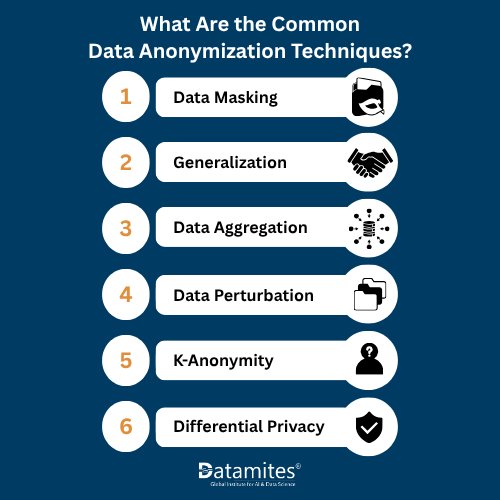
What Are the Common Data Anonymization Techniques?
Different techniques address different privacy risks. The appropriate method depends on the sensitivity of the data, the intended analytical purpose, the acceptable level of information loss, and the possibility of re-identification.
1. Data Masking
Data masking hides or obscures selected values so that users cannot immediately see the original information.
For example:
- Original account number: 123456789012
- Masked account number: 9012
Masking is useful in customer service interfaces, software testing, and demonstrations where users need to recognize a record without seeing its full identifier.
However, masking does not necessarily anonymize a dataset. If other fields identify an individual, or if the original values remain accessible, privacy risks may persist.
Best suited for: Limiting the display of sensitive fields in applications and test environments.
2. Generalization
Generalization replaces precise information with broader categories.
For example:
- Exact age: 27 years
- Generalized age: 25–30 years
- Exact location: A specific street address
Generalized location: A district or broader geographic area
Generalization reduces the precision of potentially identifying attributes while preserving useful information for statistical analysis.
Its effectiveness depends on the distribution of records. A broad age range may still identify someone if it is combined with a rare occupation and a distinctive medical condition.
Best suited for: Demographic analysis, healthcare research, and reporting where approximate values are sufficient.
3. Data Aggregation
Data aggregation combines individual records into summaries, reducing the need to distribute detailed records.
For example, instead of sharing individual purchase histories, a retailer might publish monthly sales totals by product category.
Aggregation can make it easier to study patterns without exposing each underlying transaction. However, small groups, unusually high values, and repeated detailed queries can sometimes reveal information about particular individuals.
Organizations should consider minimum group sizes, suppression of sensitive results, and the risk of combining multiple reports.
Best suited for: Business dashboards, market research, population statistics, and performance reporting.
4. Data Perturbation
Data perturbation modifies selected values to reduce the exposure of exact information while preserving useful statistical characteristics.
For example, a research team may add carefully calibrated noise to numerical measurements before sharing a dataset.
The transformations must be designed and evaluated carefully. Excessive modification can distort important relationships, while insufficient modification may leave identification risks.
Perturbation is a broad term; adding random noise does not automatically provide a formal privacy guarantee.
Best suited for: Certain statistical analyses and research applications where approximate values are acceptable.
5. K-Anonymity
K-anonymity is a privacy model designed to ensure that each record is indistinguishable from at least a specified number of records based on selected quasi-identifiers.
For example, a dataset satisfying 5-anonymity has each record sharing its quasi-identifier pattern with at least four other records.
Suppose age range and region are the quasi-identifiers. The dataset is transformed so that each combination of these attributes appears in at least five records.
This reduces some forms of identification risk, but it does not guarantee complete privacy. If all five records share the same sensitive diagnosis, an observer may still infer that diagnosis about a person whose record belongs to that group.
K-anonymity also depends on which attributes are selected and what external information an attacker may possess.
Best suited for: Certain structured datasets where record-level analysis is required and quasi-identifier risks can be evaluated.
6. Differential Privacy
Differential privacy is a mathematical framework that limits how much the output of an analysis can reveal about the participation of a particular individual.
It commonly involves adding carefully calibrated randomness to statistical results or controlling how queries access a dataset. Its formal guarantees depend on the mechanism, privacy parameters, and implementation.
For example, a service may publish approximate usage statistics using a differentially private mechanism so that an individual's contribution has a bounded influence on the released result.
A key consideration is the privacy budget, often represented by epsilon (ε). In general, a smaller epsilon provides a stronger privacy guarantee under the framework's assumptions, although it may also reduce the accuracy of results. Repeated queries must be managed because their privacy costs can accumulate.
Differential privacy does not automatically protect against every form of data misuse, nor does it make all outputs equally accurate.
Best suited for: Aggregate statistics, large-scale analytics, and selected machine learning applications requiring formal privacy guarantees.
Choosing the Right Technique
| Technique | Primary purpose | Important limitation |
| Data masking | Hide selected values | Other fields may still identify individuals |
| Generalization | Reduce attribute precision | Rare attribute combinations may remain |
| Aggregation | Summarize records | Small groups or repeated queries may reveal details |
| Perturbation | Modify values or statistical results | Poorly calibrated noise may harm utility or provide inadequate protection |
| K-anonymity | Reduce distinguishability based on quasi-identifiers | Does not prevent all attribute disclosure |
| Differential privacy | Bound individual influence on analytical outputs | Requires careful parameter selection and privacy-budget management |
These methods are not interchangeable. Some are primarily data-transformation techniques, while others are formal privacy models. A robust strategy may combine several approaches and should include a documented assessment of the risks that remain.
What Are the Benefits of Data Anonymization?
The main benefits of data anonymization include:
- Reduced identification risk: Helps limit the exposure of individuals' identities in analytical datasets.
- Improved data sharing: Can make information more suitable for research and collaboration when appropriate safeguards are in place.
- Better analytical opportunities: Allows organizations to study patterns and trends without routinely using identifiable information.
- Support for AI development: Can help prepare datasets for machine learning while addressing certain privacy risks.
- Improved data governance: Encourages organizations to identify sensitive information and establish consistent data-handling practices.
- Potential compliance support: Can contribute to privacy protection strategies when implemented in accordance with applicable legal requirements.
These benefits depend on implementation quality. Poorly anonymized data may remain identifiable, and excessive transformations may reduce its usefulness for analysis.
Organizations should therefore balance privacy protection with the legitimate purpose for which the data is being used.
Data Anonymization Examples in Real-World Applications
The following scenarios illustrate how organizations could apply anonymization principles in different industries. They are illustrative examples rather than documented case studies of specific organizations.
1. Healthcare and Medical Research
Healthcare providers and research institutions leverages data analytics in healthcare to analyze medical information to understand disease patterns, evaluate treatments, and study public health outcomes.
A research team preparing a dataset could:
- Remove patient names and contact details.
- Replace exact ages with age ranges.
- Generalize precise residential locations.
- Reduce the precision of dates where appropriate.
- Review rare diagnoses and unusual treatment histories for identification risks.
- Researchers may then analyze population-level patterns with less exposure to identifiable information.
However, medical data can remain identifiable even after direct identifiers are removed. Rare diseases, detailed timelines, and distinctive treatment combinations may require additional transformations or restrictions on data access.
The appropriate approach should be determined by the sensitivity of the information, the research objective, and applicable legal and ethical requirements.
2. Retail and E-Commerce
Retailers use data analytics in retail for customer and transaction data to forecast demand, evaluate promotions, and understand purchasing behavior.
Instead of sharing detailed customer histories with every analytics team, a retailer could create summaries of monthly purchases by product category and broad region.
For example, an analyst might discover that demand for a product increases during a particular season without receiving individual customers' names, email addresses, or full transaction histories.
If transaction-level data is necessary, the organization should assess whether combinations of purchase items, timestamps, locations, and spending patterns could distinguish particular customers.
3. Banking and Financial Services
Financial institutions uses data analytics in finance to analyze transaction data to identify unusual activity, understand spending patterns, and improve services.
For general spending research, a bank might aggregate transactions by broad spending category and month while removing unnecessary direct identifiers.
However, financial transactions often contain distinctive patterns. A combination of purchase locations, amounts, and timestamps may reveal an individual's activities even when names are replaced with codes.
Financial institutions should therefore evaluate re-identification risks, restrict access to sensitive source records, and select privacy techniques that fit the specific analytical purpose.
Anonymization should also be distinguished from controls needed for regulated activities such as fraud investigation, transaction monitoring, and customer verification.
4. Artificial Intelligence and Machine Learning
AI projects often use large datasets to train, test, and evaluate models. These datasets may contain personal information that is not necessary for every stage of development.
An organization could reduce exposure by removing unnecessary identifiers, generalizing selected attributes, restricting access to source data, or using privacy-preserving statistical methods.
For example, a team developing a customer support classifier may not need actual customer names or email addresses to learn how to categorize support requests.
However, anonymizing the training data does not automatically make the resulting model privacy-safe. Depending on the model and training process, information about training examples may sometimes be inferred or extracted from model outputs.
Organizations should assess model-specific risks and consider appropriate safeguards, testing, and access restrictions.
These examples demonstrate an important principle: privacy protection should be designed around the intended use of the information rather than applied as a single, universal transformation.
Refer to the articles below:
- What would be the Data Analyst Course Fee in India
- Data Analyst Career Scope in India
- Why DataMites for Data Analytics Course in India
What is the difference between data anonymization and pseudonymization?
Data anonymization and data pseudonymization both help reduce privacy risks, but they provide different levels of protection.
| Feature | Data anonymization | Data pseudonymization |
| Identification | Designed to prevent reasonable re-identification | Direct identifiers are replaced with codes or aliases |
| Additional information | Should not reasonably enable identification | May enable identification using separately held information |
| Data protection | Effectiveness depends on residual identification risks | Requires appropriate safeguards and access controls |
| Reversibility | Should not be reasonably reversible into identifiable information | May be reversible when additional information is available |
| Legal treatmen | Genuinely anonymous data may fall outside personal data rules | Generally remains personal data when an individual can be identified using additional information |
Example of Anonymization
A research team removes patient identifiers, generalizes indirect identifiers, and assesses whether the remaining records could reasonably be linked to specific individuals.
If the resulting data meets the relevant standard for anonymity, it may be treated as anonymous information under the applicable legal framework.
Example of Pseudonymization
A hospital replaces patient names with unique codes and stores the code-to-identity mapping separately.
Researchers may work with the coded records, but authorized personnel can still reconnect the records to individual patients using the mapping.
This is pseudonymization rather than full anonymization.
For more info, see the UK Information Commissioner's Office (ICO)
How Can Businesses Implement Data Anonymization?
Organizations should treat anonymization as an ongoing data governance process rather than a one-time technical task.
The following seven steps provide a practical starting point.
Step 1: Identify and Classify Sensitive Data
Create an inventory of the data the organization collects, stores, processes, analyzes, and shares.
Identify direct identifiers, quasi-identifiers, sensitive attributes, and combinations of fields that may reveal identity.
Include datasets used in analytics, software testing, AI development, reporting, and third-party collaboration.
Practical example: A company reviewing customer data may discover that its analytics team needs purchase categories and monthly totals but does not need customer phone numbers or full postal addresses.
Step 2: Define the Purpose of Data Use
Determine why the dataset is needed and which attributes are essential for the intended analysis.
This prevents organizations from retaining or distributing more detailed information than necessary.
Practical example: A sales forecasting model may require product categories, historical sales, and appropriately generalized dates. It may not require customers' names or contact details.
Document the intended use, expected outputs, users, and any restrictions on sharing.
Step 3: Choose an Appropriate Anonymization Technique
Select techniques according to the sensitivity of the data, the analytical requirements, and the likely risks of identification.
Use masking when selected fields need to be hidden from particular users.
Consider generalization when precise values are unnecessary.
Use aggregation when summary-level analysis is sufficient.
Evaluate k-anonymity when structured record-level data must be released.
Consider differential privacy when publishing statistical outputs with formal privacy guarantees is appropriate.
Do not choose a technique solely because it is convenient or available in a particular software product.
Step 4: Apply Transformations and Protect Source Data
Implement the selected transformations and maintain appropriate separation between identifiable source records and the resulting analytical dataset.
Restrict access to original data and any keys, mappings, or auxiliary information that could reconnect records to individuals.
Document the transformation process so that it can be reviewed and reproduced where appropriate.
Encryption, access controls, and secure storage should remain in place for identifiable source data.
Step 5: Assess Re-Identification Risks
Evaluate whether an individual could be identified by combining the transformed dataset with publicly available information or other datasets reasonably accessible to potential recipients.
Consider:
- Rare combinations of demographic attributes.
- Detailed timestamps and location information.
- Small groups or unusual values.
- Distinctive transaction histories.
- Sensitive attributes that can be inferred from group membership.
- Repeated queries or releases that could reveal additional information.
Where appropriate, use statistical testing, specialist review, and controlled re-identification assessments.
Step 6: Document Decisions and Reassess Regularly
Record the purpose of the anonymization, the techniques used, the assumptions made, the identified risks, and the reasons the dataset is considered appropriate for its intended use.
Reassess the data when:
- The dataset changes substantially.
- New external information becomes available.
- The intended use or recipient changes.
- Additional analytical outputs are released.
- New identification techniques or privacy risks emerge.
Anonymization is context-dependent. Information that is difficult to identify today may become easier to identify as available data and analytical methods change.
Step 7: Maintain Complementary Security Controls
Continue using appropriate security and governance measures after anonymization.
These may include access controls, encryption, monitoring, secure storage, retention limits, incident response procedures, and restrictions on unauthorized data sharing.
It is important to distinguish these controls from anonymization itself.
Encryption protects information by making it unreadable without the appropriate key. The original data can generally be recovered by someone with the key, so encryption alone does not anonymize it.
Pseudonymization replaces identifying information with codes or aliases, but re-identification may remain possible.
Anonymization aims to ensure that individuals cannot reasonably be identified from the resulting information in the relevant context.
A robust privacy program considers all three where appropriate.
Common Challenges and Limitations of Data Anonymization
Anonymization can reduce privacy risks, but it does not eliminate every challenge.
1. Risk of Re-Identification
Individuals may be identified through combinations of seemingly harmless attributes or by linking information from multiple sources.
Organizations must consider the broader information environment rather than evaluating each field in isolation.
2. Loss of Data Utility
Generalizing, suppressing, or modifying information can reduce its usefulness for certain analyses.
For example, replacing exact dates with monthly periods may protect privacy but make detailed seasonal or event-based analysis more difficult.
Organizations should test whether transformed data remains suitable for its intended purpose.
3. Changing Privacy Risks
External datasets, technical capabilities, Ethics of Data Analytics and analytical methods evolve over time. This can change the likelihood of identifying individuals from previously transformed information.
Periodic reassessment is therefore an important part of effective data governance.
4. Implementation Complexity
Large datasets can contain subtle identifying patterns that are difficult to detect manually.
Selecting appropriate methods and evaluating residual risks may require specialist knowledge, suitable software, and independent review.
5. Misunderstanding the Meaning of Anonymity
A dataset may be described as anonymized even though it retains identifiers, distinctive patterns, or easily linkable information.
Organizations should base this assessment on documented evidence rather than the name of a technique or a software vendor's claims.
Recognizing these limitations helps organizations choose proportionate safeguards and make more informed decisions about how data can be used or shared.
Refer to the articles below:
- How Data Analytics Skills Open Opportunities Across Multiple Industries
- Why Data Analytics Matters in Every Career
- How AI and Data Analytics Integration Leads to Better Decision-Making
However, effective anonymization involves more than removing names and contact details. Businesses must consider quasi-identifiers, assess the possibility of re-identification, select appropriate techniques, and review their safeguards as circumstances change.
DataMites Institute is a professional training institute offering career-focused programs in Data Science, Artificial Intelligence, Machine Learning, and Data Analytics. Learners can also explore the Data Analyst Course in Mumbai to develop analytical skills and gain practical knowledge. The institute emphasizes hands-on learning through practical projects, internships, and placement assistance to help learners build industry-relevant skills. With certifications associated with IABAC and NASSCOM FutureSkills, DataMites offers flexible online and classroom learning options to suit different learning needs.
In addition to DataMites Delhi, has a presence in major Indian cities, including Bangalore, Pune, Chennai, Mumbai, Kolkata, Coimbatore, and Chandigarh, providing learners with access to its training programs across multiple locations.