AI Engineer vs Data Scientist in Kenya: Which Career Should You Choose
Compare AI engineering and data science careers in Kenya, including salary estimates, required skills, job opportunities, and learning paths to help you choose the right career.
 Swagatam Sinha
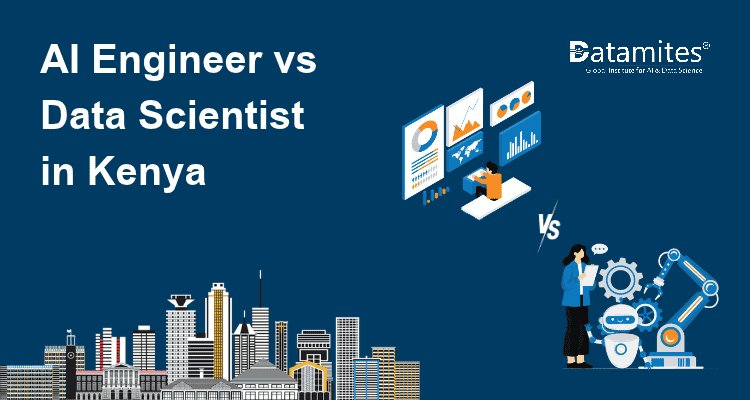
Kenya's use of digital services in banking, telecommunications, retail, and agriculture creates practical problems that AI engineers and data scientists can help solve. AI engineers build applications that automate tasks, while data scientists examine business data to identify trends and support decisions.
However, choosing between AI engineering and data science can be challenging. AI engineers focus on developing and deploying AI applications, while data scientists use statistics, programming, and machine learning to identify patterns and support business decisions.
For students, fresh graduates, IT professionals, and career changers in Kenya, the right choice depends on their interests, existing skills, salary expectations, and preferred type of work. This guide compares both careers using Kenya-specific market research, salary estimates, job roles, and practical learning advice.
How Are AI Engineering and Data Science Different?
AI engineering and data science share some technical foundations, including Python and machine learning. However, their primary responsibilities differ.
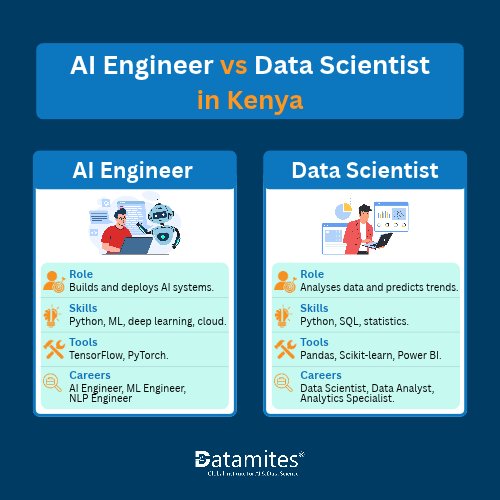
An AI engineer develops software applications that use AI models, APIs, and machine learning technologies. A data scientist analyzes datasets, builds statistical or predictive models, and explains findings that can help organizations make decisions.
For example, a Kenyan financial services company could use data science to analyze transaction records and identify suspicious patterns. An AI engineer could then develop an application that uses those patterns to flag potentially fraudulent transactions for review.
| Comparison factor | AI Engineer | Data Scientist |
| Main responsibility | Building and deploying AI applications | Analyzing data and developing predictive models |
| Core skills | Programming, software engineering, machine learning | Statistics, data analysis, programming |
| Common tools | Python, PyTorch, TensorFlow, APIs | Python, SQL, Pandas, scikit-learn |
| Example project | An AI customer support assistant | A customer churn prediction model |
| Suitable interests | Building and maintaining technical applications | Investigating data and finding patterns |
Neither career is restricted to these tasks. Some data scientists deploy models, and AI engineers may analyze data while developing applications. The main difference is the problem each professional is expected to solve.
Refer to these articles:
- What’s the Difference Between Gen AI, Agentic AI and AI Agents
- How AI is Transforming Cybersecurity in 2026
- A Complete Guide to AI in Finance
What Is Driving AI and Data Careers in Kenya?
Kenya's technology market provides useful context for people considering these careers. However, market growth should not be confused with a guaranteed increase in AI engineer or data scientist vacancies.
According to 6Wresearch's Kenya Artificial Intelligence Platform Market report, the AI platform market was estimated at USD 242 million in 2025 and is projected to reach USD 326 million by 2032. The report forecasts a compound annual growth rate (CAGR) of 5.4% from 2026 to 2032. Its coverage includes AI tools and applications such as machine learning, natural language processing, chatbots, and text recognition.
Data analytics also has a separate market outlook. 6Wresearch's Kenya Business Intelligence and Analytics Software Market report estimates the market at USD 180 million in 2025 and projects it to reach USD 197 million by 2032, with a forecast CAGR of 1.6% from 2026 to 2032. This market covers analytics and business intelligence software, not data science salaries or vacancies.
Kenya's broader economic performance provides further context. The Kenya National Bureau of Statistics 2026 Economic Survey reports that the Information and Communication sector grew by 4.8% in 2025, while Financial and Insurance activities grew by 6.5%. These sector figures do not directly measure AI or data science hiring, but they identify industries where digital systems, analytics, and automation can be relevant.
Data quality is another important factor. A GSMA report published in June 2026 examines Kenya's data ecosystem and highlights challenges such as fragmented datasets, inconsistent data quality, limited interoperability, and skills gaps. These challenges affect AI engineers building applications as well as data scientists preparing datasets and developing reliable models.
The figures point to activity in AI platforms, analytics software, and Kenya's wider digital economy. However, they do not show how many AI engineering or data science jobs are currently available, so job seekers should also review live vacancies.
What Does an AI Engineer Do?
An AI engineer builds software that uses machine learning models or language models to perform specific tasks. The work might involve connecting a chatbot to a company's knowledge base, testing its responses, and deploying it so customers or employees can use it. For learners who want to develop these skills, an online artificial intelligence course in Kenya can provide a structured way to study AI concepts and practice building applications.
In Kenya, possible applications include automating customer inquiries, processing business documents, improving fraud detection systems, and integrating language models into existing software.
Typical responsibilities include:
- Developing applications using Python and machine learning frameworks.
- Integrating AI models and APIs into business software.
- Building chatbots and recommendation systems.
- Testing applications for accuracy, reliability, and security.
- Deploying and maintaining AI solutions.
- Monitoring performance and resolving technical issues.
Skills Needed for AI Engineering
Start with Python programming, basic mathematics, and machine learning. Then progress to deep learning, generative AI, APIs, Git, software testing, and cloud deployment.
Practical projects can help demonstrate these skills. For example, a beginner could build a chatbot that answers questions using approved business documents or develop a tool that categorizes customer inquiries.
Software engineering is particularly important because an AI application must function reliably beyond a simple demonstration. Knowledge of version control, testing, APIs, and deployment can help learners understand the full development process.
Refer to these articles:
- How AI Is Changing the Future of Product Development Strategy
- What is artificial narrow intelligence?
- A Complete Guide to AI in Healthcare
What Does a Data Scientist Do?
A data scientist starts with a business question and uses data to investigate it. For example, a retailer might ask why sales fall during certain months. The data scientist could compare sales records, customer activity, and seasonal trends before building a forecast and explaining the findings to the business team. Those who want to build these skills can consider an online data science course in Kenya that covers data analysis, statistical methods, and practical projects.
A Kenyan retailer, for example, might analyze purchasing records to understand seasonal demand and forecast future sales. A financial services provider could examine repayment histories to identify patterns associated with credit risk.
Typical responsibilities include:
- Collecting, cleaning, and preparing datasets.
- Exploring data to identify trends and relationships.
- Applying statistical methods and machine learning.
- Developing forecasting and classification models.
- Creating dashboards and visual reports.
- Communicating results and limitations to business stakeholders.
Skills Needed for Data Science
Important foundations include Python, SQL, statistics, probability, and data visualization. Tools such as Pandas, NumPy, scikit-learn, and Power BI can support analysis and model development.
Beginners can practice by analyzing sales data, studying customer retention, or investigating publicly available agricultural datasets. A good project should explain the question being investigated, the methods used, the findings, and any limitations.
Data science generally places more emphasis on statistical reasoning and interpreting evidence, while AI engineering often places greater emphasis on developing and deploying software applications. There is some overlap, particularly in machine learning.
Refer to these articles:
- Data Science and Automation: Will AI Replace Data Scientists?
- How Generative AI is Changing the Role of Data Scientists
- The Rise of Data Science in the Agriculture Industry
AI Engineer vs Data Scientist Salary in Kenya in 2026
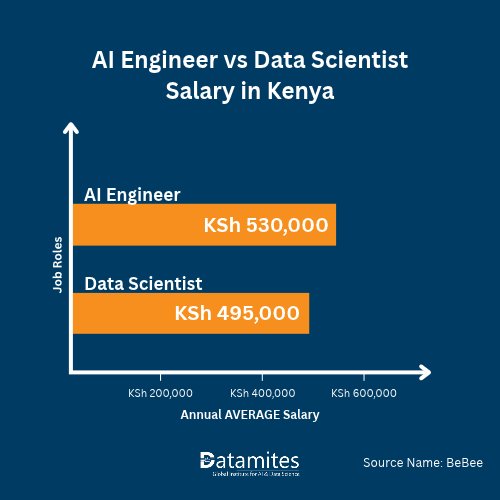
In Kenya, the median salary of an AI engineer is estimated at KES 530,000 per year, while the median salary of a data scientist is around KES 495,000 per year, according to BeBee. This difference suggests that AI engineers earn slightly more in the reported salary data, although actual earnings vary across roles.
The AI engineer vs data scientist salary in Kenya depends on several factors, including work experience, technical skills, company size, industry, and job responsibilities. These figures are estimates based on BeBee's reported job listings, not official national salary averages. Comparing current job vacancies can help aspiring AI engineers and data scientists understand salary expectations and identify the skills employers are looking for.
Career Opportunities for AI Engineers and Data Scientists in Kenya
In Kenya, AI engineers may work on automated services, model deployment, and AI software, while data scientists may focus on forecasting, customer analysis, and financial risk. The roles below show how these skills can translate into different job options.
AI Engineering Jobs in Kenya
Potential AI engineering roles include:
- AI Engineer
- Machine Learning Engineer
- Generative AI Engineer
- Natural Language Processing Engineer
- Computer Vision Engineer
- AI Software Developer
- MLOps Engineer
These roles may involve integrating AI into existing software, developing automated systems, deploying machine learning models, or maintaining AI applications. Employers may look for programming, software development, cloud computing, machine learning, and deployment skills.
Data Science Jobs in Kenya
Data science and related analytical career options include:
- Data Scientist
- Junior Data Scientist
- Machine Learning Scientist
- Business Intelligence Analyst
- Predictive Analytics Specialist
- Quantitative Analyst
- Data Science Consultant
These professionals may work on sales forecasting, customer behavior, financial risk, business performance, or agricultural analysis. Depending on the position, employers may require Python, SQL, statistics, data visualization, and experience with predictive modeling.
Where Can You Find Jobs in Kenya?
Nairobi is a useful starting point because it hosts financial institutions, technology companies, startups, and regional business offices. However, job seekers should also check opportunities in other parts of Kenya and remote positions where available.
Search for roles through LinkedIn Jobs, BrighterMonday Kenya, MyJobMag Kenya, and company career pages. The Kenya Labour Market Information System is another resource for labour market and vacancy information.
Try specific searches such as “Junior Data Scientist Kenya,” “Machine Learning Engineer Kenya,” and “AI Engineer remote Kenya.” Compare job descriptions to identify recurring qualifications, technical skills, experience requirements, and tools. Job titles vary between employers, so review the actual responsibilities rather than relying on the title alone.
Which Career Should Fresh Graduates Choose?
If you enjoy building software and troubleshooting technical problems, start by exploring AI engineering. If you prefer statistics, investigating datasets, and explaining patterns, data science may be a better fit.
AI engineering may suit you if you enjoy:
- Developing software and applications.
- Connecting APIs and integrating technologies.
- Building chatbots and AI-powered tools.
- Testing, deploying, and maintaining technical systems.
- Data science may suit you if you enjoy:
- Working with numbers and datasets.
- Applying statistics to practical problems.
- Investigating trends and making predictions.
- Explaining findings through reports and visualizations.
Your degree can give you a starting advantage, but you will still need to build the technical skills required for your chosen role. Computer science graduates may already have programming experience, while graduates in mathematics, statistics, economics, and related fields may have useful analytical foundations. Both careers require continued learning and practical work.
Refer to these articles:
- Mastering Data Wrangling in Data Science: Techniques and Best Practices
- Does Data Science Require Coding? What Skills You Really Need
- What Is Regression Analysis in Data Science? A Beginner’s Guide
How to Prepare for Your Chosen Career
The learning path depends on the role you want to pursue.
For AI engineering, begin with Python and machine learning before progressing to deep learning, generative AI, APIs, software testing, and deployment. Learners based in the capital can explore an online artificial intelligence course in Nairobi to develop these skills while studying remotely. Build projects that demonstrate how you can turn a technical idea into a working application.
For data science, start with Python, SQL, statistics, and data visualization. Then practise exploratory data analysis, predictive modeling, and presenting findings through clear reports. An online data science course in Nairobi may be worth considering for learners who prefer a structured learning schedule alongside practical exercises.
When comparing training programs, check the curriculum, practical projects, learning format, and time commitment. Choose a program that matches your current knowledge and the skills requested in the roles you want to pursue.
A portfolio can strengthen your application by showing how you approach practical problems. For each project, explain the objective, dataset, methods, results, and limitations. Use publicly available or appropriately anonymized data rather than sharing confidential business information.
Choosing between AI engineering and data science comes down to the work you want to do. If you prefer building and deploying applications, explore AI engineering. AI engineering focuses on building and deploying intelligent applications, while data science focuses on analyzing information, developing predictive models, and communicating insights.
If you prefer investigating data and explaining what it reveals, consider data science. Check current Kenyan job listings to see which skills employers expect, then use practical projects or structured training to address the gaps in your knowledge. Review current vacancies, compare employer requirements, and choose the path that best matches your interests and technical strengths.
DataMites offers AI and data science training programs for learners who want to build their technical knowledge through structured study and practical projects. With more than 12 years of experience and over 200,000 learners globally, the institute provides learning options for people exploring either career path.