Ethical Challenges of AI in Healthcare
Explore ethical challenges of AI in healthcare, including patient privacy, algorithmic bias, safety, and transparency. Learn how healthcare providers can use AI responsibly and protecting patients and building trust.
 Prerana B A
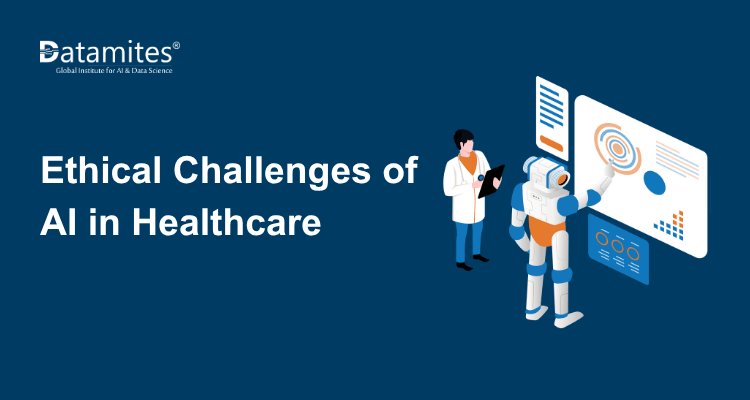
Artificial intelligence (AI) is increasingly used in medical diagnosis, patient monitoring, clinical decision support, medical research, and hospital operations. These technologies can help healthcare professionals analyze information and identify patterns, but they also raise concerns about privacy, fairness, transparency, and patient safety.
Understanding the ethical challenges of AI in healthcare is essential for protecting patients and maintaining trust in medical services. From biased algorithms to unclear accountability, healthcare organizations must address these concerns before adopting AI tools. Responsible implementation requires balancing technological benefits with patient rights, clinical expertise, and ethical standards.
Understanding the Role of AI in Healthcare
Artificial intelligence is increasingly supporting medical diagnosis, patient monitoring, clinical research, and healthcare management. However, its growing role also raises concerns about patient safety, data privacy, algorithmic bias, and accountability. Understanding these risks is essential for healthcare organizations seeking to adopt AI responsibly.
A study published in AI and Ethics in February 2026 analyzed 295 unique documented health-related AI incidents from public databases and repositories. The findings highlight the importance of monitoring AI-related risks and improving incident reporting. However, these documented cases do not represent the total number of AI-related harms in healthcare.
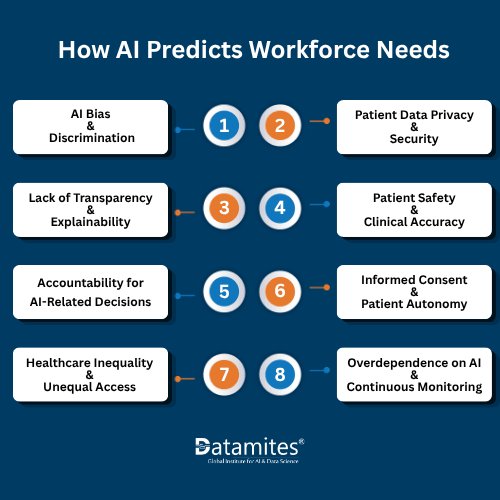
Major Ethical Challenges of AI in Healthcare
AI ethics in healthcare involves ensuring that technology supports safe, fair, and patient-centred care. The World Health Organization (WHO), in its 2021 report, Ethics and Governance of Artificial Intelligence for Health, established six core ethical principles covering human autonomy, safety, transparency, accountability, equity, and sustainability. These principles provide a foundation for addressing the following challenges.
AI Bias and Discrimination
AI systems learn from historical data, which may contain existing inequalities or insufficient representation of certain patient groups. As a result, an algorithm may produce less reliable predictions for some populations, potentially affecting diagnosis and treatment decisions.
Healthcare providers should test AI systems across diverse patient groups and investigate differences in outcomes. Evaluating overall accuracy alone is not enough; fairness must also be assessed.
Patient Data Privacy and Security
Healthcare AI may process sensitive information, including medical records, diagnostic images, and laboratory results. Inadequate data protection can expose patients to unauthorized access or misuse of personal information.
Organizations should apply data minimization, secure storage, access controls, and appropriate consent procedures. They should also understand how third-party AI providers handle patient information.
Lack of Transparency and Explainability
Some AI systems produce recommendations without clearly explaining how they reached a conclusion. This can make it difficult for clinicians to evaluate a prediction or explain its implications to patients.
Healthcare professionals should understand a system's intended use, limitations, and supporting evidence. Clear communication about AI-assisted decisions helps patients make informed choices and strengthens trust.
Patient Safety and Clinical Accuracy
AI tools can generate incorrect predictions because of incomplete data, unsuitable training, or differences between testing environments and real clinical settings. If recommendations are accepted without review, errors may influence diagnosis or treatment.
Organizations should validate AI systems for their intended clinical purposes before deployment. They must also establish procedures for reviewing questionable outputs, reporting incidents, and monitoring performance.
Accountability for AI-Related Decisions
When an AI-assisted decision contributes to patient harm, responsibility may be unclear. Healthcare professionals, administrators, developers, and technology providers may have different roles in the decision-making process.
Organizations should define who approves AI tools, supervises their use, investigates incidents, and implements corrective measures. Accountability must remain clear rather than being shifted to the algorithm itself.
Informed Consent and Patient Autonomy
Patients may not always know when AI influences their diagnosis, monitoring, or treatment planning. Without appropriate information, they may struggle to understand how technology affects decisions about their health.
Healthcare providers should explain AI use when relevant, follow applicable consent requirements, and allow patients to ask questions. AI should support patient participation rather than undermine individual choice.
Healthcare Inequality and Unequal Access
Advanced AI for healthcare tools may be more accessible to well-funded hospitals than to smaller facilities or underserved communities. Systems developed using data from particular populations may also perform poorly in different clinical environments.
Healthcare organizations should evaluate whether AI tools suit local populations, languages, resources, and workflows. Responsible adoption should consider equitable access alongside efficiency and cost.
Overdependence on AI and Continuous Monitoring
Excessive trust in automated recommendations may cause professionals to overlook errors or reduce independent assessment. AI performance can also change as patient populations, clinical practices, and data inputs evolve.
Regular staff training, human oversight, and post-deployment monitoring are essential. Organizations should be prepared to correct, replace, or withdraw systems when their performance becomes unreliable.
Refer to these articles:
- The Role of AI in Investment and Portfolio Analysis
- Ethical Challenges of Using AI in Human Resources
- Top AI Skills for Finance Professionals
Real-World Case Studies of AI Ethics in Healthcare
Real-world case studies highlight how AI ethics in healthcare can affect patient outcomes, fairness, privacy, and clinical decision-making. Examining these examples helps healthcare organizations understand potential risks and adopt responsible AI practices.
Case Study 1: Racial Bias in Healthcare Algorithms
A 2019 study published in Science by Obermeyer and colleagues found that a widely used US healthcare algorithm underestimated the needs of Black patients because it used healthcare spending as a proxy for health needs. Correcting the bias was estimated to increase the proportion of Black patients selected for additional care from 17.7% to 46.5%.
Key lesson: Healthcare AI must use appropriate clinical measures and be tested for bias across patient populations.
Case Study 2: WHO Guidance on AI Safety and Regulation
The WHO's report, Regulatory Considerations on Artificial Intelligence for Health, highlights data quality, transparency, privacy, cybersecurity, risk assessment, and ongoing performance evaluation.
Key lesson: Healthcare organizations should validate AI tools before implementation and monitor their performance in real-world settings. The report provides regulatory considerations rather than a universally binding legal framework.
How Healthcare Organizations Can Address AI Ethics
Responsible AI in healthcare requires cooperation between clinical teams, technology developers, administrators, and regulators. Organizations can take the following steps:
- Test for bias: Evaluate performance across relevant demographic groups and investigate unequal outcomes.
- Validate clinical performance: Confirm that tools are suitable for their intended uses before deployment.
- Protect patient information: Apply appropriate security controls, data minimization, and consent procedures.
- Maintain human oversight: Ensure qualified professionals can review AI recommendations and intervene when necessary.
- Define accountability: Establish clear responsibilities for approval, incident reporting, and corrective action.
- Monitor performance: Reassess safety, accuracy, and fairness after implementation.
- Train healthcare professionals: Teach staff to understand AI limitations, privacy obligations, and the importance of independent clinical judgment.
These measures help translate ethical principles into everyday clinical practice.
Refer to these articles:
- Reinforcement Learning: Basics and Applications
- What is the Difference Between AI Engineer and AI Expert Course?
- What is an AI Agent? Guide to Intelligent Agents in AI
The Future of Responsible AI in Healthcare
The future of AI in healthcare depends on developing technologies that are transparent, equitable, privacy-conscious, and clinically validated. When implemented responsibly, AI can help healthcare professionals improve disease detection, support clinical decision-making, enhance patient monitoring, and streamline hospital operations. Healthcare organizations must ensure that AI systems are tested across diverse patient populations, protect sensitive medical information, and undergo continuous monitoring to maintain accuracy, fairness, and patient safety.
Achieving these goals requires collaboration among healthcare providers, AI developers, regulators, and patients. By prioritizing human oversight, transparency, and accountability, healthcare organizations can build trust in AI and support safer, fairer, and patient-centred care.
The ethical challenges of AI in healthcare include algorithmic bias, patient privacy, limited transparency, accountability, and patient safety. Addressing these risks is essential to ensuring fair and reliable healthcare.
Healthcare organizations should validate AI systems, protect patient data, monitor performance, and maintain human oversight. Responsible AI adoption can build trust, support clinical decisions, and improve patient outcomes.
DataMites Institute offers AI for Healthcare training to help healthcare professionals understand AI fundamentals and explore their applications in patient care, hospital operations, and medical research. The institute also provides specialized AI programs in HR and people analytics, finance, marketing, and business management.
Learners can choose from online classes, classroom training, and project-based internships to develop practical skills. The program offers IABAC-aligned certification leading to the Certified AI Professional in Healthcare & Clinical Operations credential. With 50+ offline centres across India, including Bangalore, Chennai, Hyderabad, Pune, Mumbai, Ahmedabad, Coimbatore, and Delhi, DataMites provides flexible learning options for healthcare professionals and individuals looking to build their AI knowledge.