How Jayaram Transitioned from Mechanical Engineering to an AI Engineer
Learn how Jayaram transitioned from mechanical engineering to an AI Engineer. Explore his AI career journey, essential Artificial Intelligence skills, upskilling path, and practical steps to build a successful career in Artificial Intelligence.
 Priyanka BR
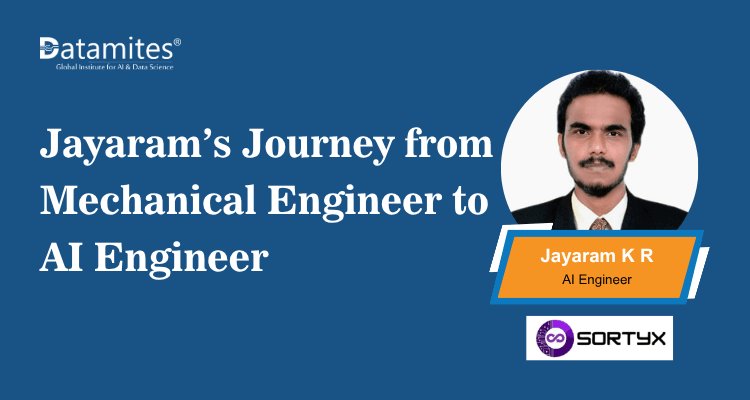
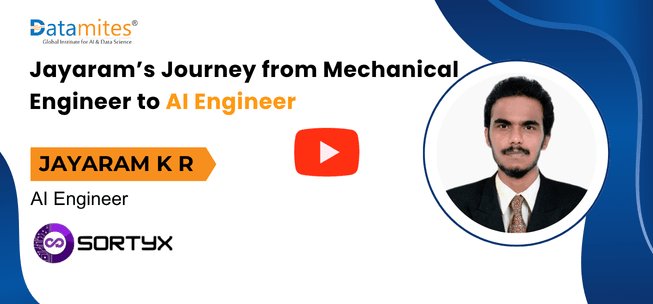
Meet Jayaram, whose journey from mechanical engineering to Artificial Intelligence reflects the importance of strong fundamentals, practical learning, and consistent effort. After gaining professional experience in the mechanical engineering domain, he decided to transition into Artificial Intelligence and Machine Learning. His training at DataMites helped him build technical skills through hands-on projects and practical learning.
Today, Jayaram works as an AI Engineer, applying his knowledge to computer vision, object detection, model training, and deployment. His journey highlights how professionals from different backgrounds can develop relevant AI skills through focused learning, regular practice, and real-world project experience.
How Jayaram Started His Journey in Artificial Intelligence with DataMites
Jayaram’s journey offers a glimpse into his transition into Artificial Intelligence and the learning experiences that shaped his career path. In the following Q&A, he shares his personal insights and experiences from his AI journey.
Q1. Could you briefly introduce yourself and tell us about your career journey?
My name is Jayaram, and I have around eight years of professional experience. I originally come from a mechanical engineering background and later decided to transition into Artificial Intelligence and Machine Learning. I completed specialized training at DataMites and worked on several practical projects before moving into an AI Engineer role at Sortyx Ventures.
Q2. What motivated you to transition from mechanical engineering to Artificial Intelligence?
I wanted to move into a technology-focused career with new learning opportunities. Since my previous experience was in a completely different domain, the transition was challenging, but I was ready to learn from the fundamentals and build the technical skills required for Artificial Intelligence and Machine Learning.
Q3. Was learning Python difficult when you started your AI journey?
Yes, initially it was difficult because I did not have strong coding experience. I had some exposure to programming during college, but I had not practiced it regularly. With mentor guidance and consistent practice, I gradually understood Python and learned how to apply it to real projects.
Q4. How did you overcome the challenges you faced while learning Artificial Intelligence?
Daily practice helped me the most. I spent around eight to nine hours practicing and working through concepts. Instead of only studying theory, I tried to understand how each concept could be implemented in a project. That practical approach made learning easier.
Q5. What projects did you complete during your training?
I completed six projects in total, including four Data Science projects and two Data Engineering projects. These projects helped me understand important steps such as data preprocessing, model selection, model tuning, training, and improving model performance.
Q6. How has your DataMites training helped you in your current AI career?
The training gave me a strong foundation for my career transition. The practical projects and technical concepts I learned continue to help me in my current work. It gave me the confidence to move from a mechanical engineering background into Artificial Intelligence.
Q7. How many interviews did you attend before getting your AI Engineer role?
I attended around ten interviews before getting the job. The first nine interviews did not work out, but each one taught me something new. Instead of becoming discouraged, I used those experiences to improve my preparation for the next opportunity.
Q8. What kind of technical questions were asked during the interviews?
The questions focused on fundamentals and practical understanding. I was asked why I would choose a particular model, how I could improve model accuracy, and how different technologies work. Interviewers were interested in whether I understood the reasoning behind the implementation.
Q9. What did you learn from attending multiple AI interviews?
Every interview gave me a different learning experience. I understood that knowing code alone is not enough. You should also understand why you are using a particular model, database, framework, or technology and how it fits the project requirements.
Q10. What are you currently working on as an AI Engineer?
I currently work on computer vision projects. My responsibilities include collecting datasets, training models, working on object detection and classification, handling real-world challenges, and deploying models for practical applications.
Q11. What challenges do you face when working on real-world computer vision projects?
Real-world projects can have challenges such as poor-quality images, changing lighting conditions, and differences between training data and actual environments. Data augmentation and proper dataset preparation can help address some of these challenges and improve model performance.
Q12. Which technologies do you use in your current AI projects?
I work with several technologies depending on the project requirements. These include computer vision models, AWS, Docker, SQL, and deployment technologies. I have also worked with Jetson Nano for deploying AI models in real-world environments.
Q13. What advice would you give to freshers who want to start a career in Artificial Intelligence?
I would suggest building strong fundamentals first. Focus on Python, SQL, Machine Learning concepts, and other core areas before trying to learn everything at once. Once the basics are clear, work on different projects and understand how to apply what you learn.
Q14. What should candidates understand about AI tools and technologies before an interview?
You should understand why a particular tool or technology is being used. For example, if you use a specific Machine Learning model, database, or framework, you should know why it was selected and what problem it solves. Practical understanding is more valuable than simply knowing the name or code.
Refer to these articles:
- AI in Cybersecurity: How Companies Are Fighting AI-Powered Threats
- AI Answer Engines vs Traditional Search: How Google Rankings Are Changing
- AI Browsers Explained: How Agentic Browsing is Changing the Internet
Jayaram’s Key Takeaways for Aspiring AI Professionals
Jayaram shares practical lessons from his transition from mechanical engineering to Artificial Intelligence, emphasizing strong fundamentals, hands-on projects, continuous practice, and persistence. His experience offers useful guidance for professionals and freshers looking to build practical skills and pursue opportunities in the AI field.
- Transition from Mechanical Engineering: Jayaram began his professional career in the mechanical engineering domain before deciding to transition into Artificial Intelligence and Machine Learning.
- DataMites as a Learning Milestone: His training at DataMites helped him develop foundational knowledge and gain practical exposure to AI and related technologies, making it a valuable step among the top IT courses for professionals looking to build skills in emerging technologies.
- Building Python Skills: Coming from a non-coding background, Jayaram initially found Python challenging but improved through regular practice and mentor guidance.
- Strong Focus on Practical Learning: Working on multiple projects helped him understand data preprocessing, model selection, model training, tuning, and performance improvement.
- Experience Across Different Projects: During his training, Jayaram completed projects covering Data Science and Data Engineering, giving him exposure to different technical workflows.
- Transition into an AI Engineer Role: His consistent preparation and practical experience eventually helped him move into an AI Engineer position.
- Current Focus on Computer Vision: Jayaram currently works on computer vision projects involving object detection, object classification, dataset preparation, and model training.
- Real-World AI Deployment: His current experience extends beyond model development to deploying AI solutions in practical environments, including work with Jetson Nano devices.
- Understanding Technology Choices: Jayaram emphasizes that candidates should understand why a particular model, database, or technology is selected instead of simply knowing how to use it.
- Learning from Interview Experiences: He attended multiple interviews before securing his role and used each experience to identify gaps, improve his knowledge, and prepare better.
- Importance of Strong Fundamentals: Jayaram recommends building a solid foundation in Python, SQL, Machine Learning, and other core concepts before moving into advanced areas.
- Continuous Learning in AI: His experience highlights the importance of continuously learning and updating technical skills as Artificial Intelligence continues to evolve.
Jayaram’s journey shows how strong fundamentals, hands-on projects, and consistent practice can support a successful transition into Artificial Intelligence. Moving from mechanical engineering into AI, he built his skills through practical learning and persistence, eventually progressing into an AI Engineer role working on computer vision and real-world AI applications.
Refer to these articles:
- How Tamil Selvan Landed His First Job as an AI/ML Engineer
- How Angel Started Her AI/ML Engineer Career as a Fresher
- How Pooja Transitioned into an AI Developer Career
If you’re inspired by Jayaram’s journey and looking to build your career in AI, DataMites offers structured, industry-focused learning with practical projects and expert mentorship. Its training approach helps learners develop skills in Python, Machine Learning, Data Science, and Artificial Intelligence while gaining practical exposure to real-world applications.
DataMites Training Institute provides a structured 9-month Artificial Intelligence course that combines foundational concepts with practical industry exposure. Learners can develop skills in Python, machine learning, neural networks, TensorFlow, Keras, cloud technologies, and other essential AI areas through hands-on projects, internship opportunities, and expert-led training. The program is accredited by IABAC and NASSCOM FutureSkills and offers flexible learning options with career guidance. With 50+ offline training centers across India, DataMites also provides Artificial Intelligence courses in Coimbatore, Chennai, Ahmedabad, Delhi, Mumbai, Hyderabad, and Pune, helping learners gain practical AI skills through accessible, industry-focused training.
Students and professionals across Delhi NCR can explore DataMites’ Artificial Intelligence course in Delhi, featuring practical training, industry-oriented projects, expert mentorship, and career guidance. DataMites also offers Artificial Intelligence and Machine Learning training in Noida and Gurgaon, helping learners build practical, job-ready technical skills.