How to Become an AI Engineer in Kenya
Discover how to become an AI engineer in Kenya, including the essential skills, qualifications, career opportunities, salary expectations, and learning pathways to build a successful career in artificial intelligence.
 Swagatam Sinha

Artificial intelligence is becoming part of how businesses operate, from automating customer support to analyzing financial transactions and improving agricultural decisions. As organizations explore these applications, professionals who can build, test and deploy AI solutions are becoming increasingly important.
For aspiring technology professionals in Kenya, AI engineering offers a career path that combines programming, data analysis, machine learning and software development. However, entering the field requires more than learning how to use AI tools. Employers need people who understand how AI systems work and can turn them into reliable solutions for real business problems.
This guide explains what AI engineers do, how the global and Kenyan AI industries are developing, which career opportunities are available, what salaries to expect, and how to prepare for an AI engineering career in Kenya.
What Does an AI Engineer Do?
An AI engineer develops software applications that use artificial intelligence to perform tasks, analyze information, or support decisions. An AI engineer combines software development, machine learning, data analysis, and model deployment to build practical AI solutions.
For example, a Kenyan financial services company might want to identify suspicious transactions more quickly. An AI engineer could help develop a model that recognizes unusual transaction patterns, integrate it into the company's software and monitor its performance after deployment.
Typical responsibilities include:
- Developing AI applications: Building systems that use machine learning models, large language models and other AI technologies.
- Preparing data: Preparing data by cleaning it, organizing it, and checking its accuracy before using it to train or test AI models.
- Training and testing models: Selecting suitable algorithms, evaluating results and improving model performance.
- Integrating AI into software: Connecting models to websites, mobile applications, business systems or APIs.
- Deploying and monitoring solutions: Making applications available to users and checking their accuracy, reliability, security and cost.
- Managing responsible AI use: Considering data privacy, bias, transparency and the risks associated with automated decisions.
AI engineers may work alongside data scientists, software developers, data engineers and business teams. While a data scientist often focuses on analyzing data and developing insights, an AI engineer typically concentrates on building and maintaining usable AI applications. The exact duties may vary by company, and some roles may share similar responsibilities.
Refer to the articles:
- AI in Cybersecurity: How Companies Are Fighting AI-Powered Threats
- A Complete Guide to AI in Finance
- Essential AI Skills for Healthcare Professionals
AI Engineering Worldwide: How the Career Is Evolving
AI engineering is developing alongside growing investment in computing infrastructure, AI software and business applications. Organizations are moving beyond experimentation and exploring how to incorporate AI into their existing products and operations.
According to Gartner's forecast, worldwide spending on AI is expected to reach approximately US$2.7 trillion in 2026, representing 49.5% growth from the previous year. The forecast includes spending across AI infrastructure, software and services, rather than employment spending alone.
This investment is creating more opportunities for professionals who can build real-world AI solutions. Businesses need people who can connect models to company data, build secure applications, test their outputs and keep systems working after launch.
The work is also expanding beyond traditional machine learning. AI engineers may now develop applications using generative AI, retrieval-augmented generation (RAG), document-processing systems and AI agents. Working with these technologies involves more than understanding AI models. You also need skills in software development, data management, testing, and monitoring.
For job seekers, the important takeaway is that AI engineering is not limited to research laboratories or large technology companies. Opportunities can also emerge in established businesses, technology consultancies, startups and organizations adopting AI to improve their services. Nevertheless, demand differs by location and employer, and global spending growth should not be treated as a guarantee of local job availability.
How Is Kenya's AI Industry Developing?
Kenya has an established digital services and technology ecosystem, with opportunities to apply AI to local business and public-sector challenges. Nairobi is an important center for technology companies and startups, while mobile financial services and digital platforms provide practical areas where data-driven systems can be developed.
A significant policy development was the launch of the Kenya National Artificial Intelligence Strategy 2025–2030 on 27 March 2025. According to the Ministry of Information, Communications and the Digital Economy, the strategy focuses on three main pillars: AI digital infrastructure, data and AI governance, and AI research, innovation and commercialization. It also identifies the development of AI skills as important to the country's progress.
The strategy establishes a national direction for AI development, but implementation will take time. Infrastructure, access to suitable data, funding, specialist skills and responsible governance will influence how quickly AI applications expand.
Several sectors offer potential areas of work:
- Financial services: Fraud detection, transaction monitoring, risk assessment, and customer-support automation.
- Agriculture: Crop disease identification, yield forecasting, weather-related analysis, and decision-support tools for farmers.
- Healthcare: Medical image analysis, administrative automation and systems that help organize health information.
- Retail and e-commerce: Product recommendations, demand forecasting, inventory planning and customer-service applications.
- Telecommunications: Network optimization, customer analytics, and automated support.
- Education: AI-powered learning tools, student support systems, and automated administrative tasks.
- Logistics and transport: Planning delivery routes, predicting delivery times, and improving day-to-day operations.
These are areas where AI can be applied, not a list of guaranteed vacancies. Actual hiring depends on company investment, project needs and the availability of suitable candidates. For aspiring engineers, building projects around these local challenges can demonstrate an understanding of both technical methods and practical business requirements.
Refer to these articles:
- How AI Is Changing the Future of Product Development Strategy
- What is artificial narrow intelligence?
- What Are Graph Neural Networks? A Simple Guide for Beginners
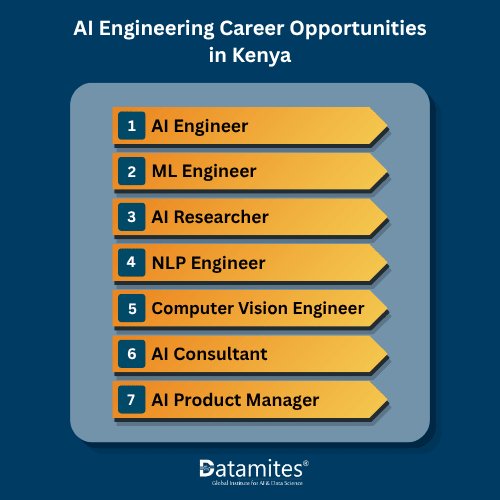
AI Engineering Career Opportunities in Kenya
AI engineering includes several related job titles. The exact responsibilities vary by organization, so candidates should review the skills and experience listed in each job description rather than relying on the title alone.
1. AI Engineer
AI engineers develop applications that use machine learning and other AI technologies. They may integrate language models into business software, create automated workflows or build tools that process documents and customer requests.
2. Machine Learning Engineer
Machine learning engineers build, evaluate and deploy models that learn patterns from data. Their work often involves model pipelines, feature engineering, performance evaluation and production monitoring.
3. AI Researcher
AI researchers investigate methods for improving AI models and algorithms. These roles often require strong mathematics, programming and research skills, and some positions prefer a postgraduate qualification.
4. Natural Language Processing (NLP) Engineer
NLP engineers develop systems that process human language. Projects may include chatbots, text classification, document extraction, search tools and language applications. Knowledge of local language requirements can be useful when developing solutions for Kenyan users.
5. Computer Vision Engineer
Computer vision engineers build systems that interpret images and video. Potential applications include visual quality checks, image classification, object detection and agricultural image analysis.
6. AI Consultant
AI consultants help organizations identify suitable use cases, assess data readiness and plan AI implementations. Depending on the role, they may also develop prototypes, evaluate vendors or support deployment.
7. AI Product Manager
AI product managers connect customer needs, business priorities and technical teams. They help define product requirements, evaluate performance and consider issues such as reliability, cost and responsible AI use. This role generally requires product or business experience alongside an understanding of AI.
Where can you look for opportunities? Explore technology companies, banks and fintech firms, telecommunications providers, consulting businesses, startups, research institutions and organisations with data or automation teams. Search for related titles such as machine learning engineer, AI developer, data scientist, MLOps engineer and generative AI developer, as employers do not always use the title “AI engineer."
Remote positions with international employers may also be an option for experienced candidates who can demonstrate strong technical skills and communicate effectively with distributed teams.
AI Engineer Salary in Kenya: What Can You Expect?
AI engineer salaries in Kenya vary according to experience, employer, technical specialization, and the complexity of the work. Candidates working for local organizations may receive different compensation than those employed by international companies or working on overseas contracts.
Salary websites also report different figures because they may use job advertisements, employee submissions, or estimated salary models. As a result, a single national average should not be treated as a definitive benchmark.
For example, BeBee's Kenya AI engineer salary page has reported an estimated median annual salary of around KES 537,500. Glassdoor's Nairobi salary page has shown a different monthly estimate, around KES 58,000. These figures should be checked directly before publication because estimates, sample sizes and reporting periods can change.
Rather than relying on one figure, use the following factors to assess likely compensation:
- Entry-level candidates: People starting out may need to build experience through internships, junior software roles, data-related positions or practical projects before securing a dedicated AI engineering role.
- Mid-level professionals: Engineers who can develop and deploy applications independently may qualify for more specialised roles.
- Senior engineers and specialists: Professionals with production experience, strong software engineering skills and expertise in areas such as MLOps, cloud deployment or generative AI may access higher-paying opportunities.
When comparing offers, check whether the stated amount is gross or net, whether benefits are included, and whether the role is permanent, contract-based or freelance. International remote salaries are not directly comparable with local salaries because contract terms, taxes, benefits and payment arrangements differ.
For a more reliable estimate, compare several recent Kenyan job advertisements with salary information from more than one source.
Refer to these articles:
- Top AI Trends That Will Shape 2026
- LLM Fine-Tuning vs Prompt Engineering: Which Is Better?
- Will AI Agents Replace Your Next Coworker? Exploring the Future of Work
Qualifications and Skills Required to Become an AI Engineer
There is no single route into AI engineering. A degree in computer science, software engineering, data science, mathematics or a related discipline can provide a useful foundation, and some employers require one. Others place significant weight on practical experience, technical assessments and a strong portfolio.
The most important skills generally fall into the following areas.
Programming and Software Development
Python is widely used for machine learning and AI application development. Learn how to write functions, work with data structures, handle errors, use libraries and organize code into maintainable projects. Familiarity with Git, APIs, testing and basic software engineering practices is also valuable.
Mathematics, Statistics and Data Analysis
Linear algebra, probability, statistics and basic calculus help explain how machine learning models work. You should also learn data cleaning, exploratory analysis and SQL so that you can retrieve and prepare information from databases.
Machine Learning and Deep Learning
Understand supervised and unsupervised learning, model evaluation, overfitting, feature engineering and the limitations of different algorithms. Later, explore neural networks and deep learning frameworks such as PyTorch or TensorFlow.
Generative AI and Model Integration
Learn how to use model APIs, create structured prompts, work with embeddings and build retrieval-augmented generation applications. Understand how to evaluate outputs and manage hallucinations, data privacy and model costs instead of relying on a model's responses without checking them.
Deployment and Cloud Tools
Building a model is just the first step; it also needs to work reliably in real-world situations. Learn how to expose a model through an API, package applications, use containers and deploy services to a cloud environment. Familiarity with monitoring and version control can help you move from a demonstration project to a maintainable application.
You do not need to master every tool before beginning a project. Start with Python, data analysis, and basic machine learning, then add advanced technologies as your projects require them.
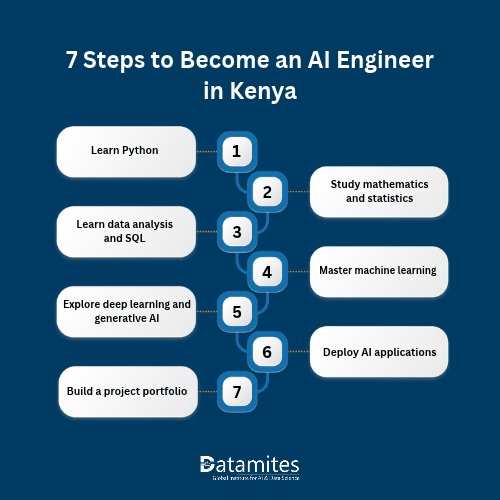
How to Become an AI Engineer in Kenya: A Step-by-Step Roadmap
A structured learning plan helps you build skills in the right order. The timeline will depend on your starting point, available study time and previous programming experience.
Step 1: Learn Python and Software Development
Start with Python fundamentals, including variables, loops, functions, data structures and file handling. Practise writing small programs and learn Git so you can manage and share your code.
Practical task: Build a program that reads a dataset, checks for missing values and produces a basic summary.
Step 2: Study Mathematics, Statistics and Data Analysis
Learn the basics of statistics, probability, linear algebra, and data visualization. Practise using libraries such as NumPy, pandas and Matplotlib, along with SQL for querying structured data.
Practical task: Analyze a dataset and explain the patterns, limitations and conclusions in a short report.
Step 3: Master the Fundamentals of Machine Learning
Study regression, classification, clustering and model evaluation. Learn how to split datasets into training and testing sets and why accuracy alone may not be enough to evaluate a model.
Practical task: Build a classification model and compare its performance using appropriate evaluation metrics.
Step 4: Explore Deep Learning and Generative AI
Once the fundamentals are clear, explore neural networks, computer vision, NLP or generative AI. Choose a specialization based on the type of work you want to pursue rather than trying to learn every area at once.
Practical task: Build a document question-answering tool or a text-classification application, and test how well it handles unfamiliar inputs.
Step 5: Build Projects Relevant to Kenya
Choose a problem that has a clear purpose and can be tested with suitable data. Examples include a crop-information assistant, a customer-support prototype, a demand-forecasting model or a tool that categorizes public information.
Use public or properly authorised data. Avoid exposing private information, and explain the limitations of your results.
Step 6: Deploy an Application and Build a Portfolio
Package your project into a usable application using an API, a simple interface or a cloud deployment. Add a README explaining the problem, dataset, method, evaluation results, limitations and instructions for running the project.
Two or three well-documented projects can communicate your skills more effectively than a long list of unfinished tutorials.
Step 7: Prepare for Interviews and Apply for Jobs
Practise Python coding, SQL, basic machine learning concepts and explaining technical decisions. Be prepared to discuss how you selected your data, measured model performance, handled errors and maintained your application in production.
Apply for internships, graduate programs, and junior software or data roles as well as dedicated AI positions. Related experience can provide a route into specialized AI engineering work.
Refer to these articles:
- CrewAI vs AutoGen vs LangGraph: Top Multi-Agent Frameworks for 2026
- How Knowledge-Augmented Generation (KAG) Is Solving AI Hallucinations
- The Future of Coding: Can AI Replace Software Engineers?
Where Can You Learn AI Engineering in Kenya?
Learners can develop AI engineering skills through university programs, online courses, independent projects and professional training.
- University education: Degrees in computer science, software engineering, data science, statistics and related fields can provide foundations in programming, mathematics and algorithms. Compare course content, practical work, admission requirements and fees before choosing a program.
- Online learning: Structured online courses can help you learn Python, machine learning, deep learning and generative AI at your own pace. Enrolling in an online artificial intelligence course in Kenya can provide a structured learning path, especially for beginners who want to build technical knowledge alongside their existing studies or work. Combine coursework with practical projects so you can demonstrate what you have learned.
- Professional training: Training providers such as DataMites offer courses related to data science, machine learning and AI. Learners exploring an online artificial intelligence course in Nairobi can compare available programs based on their syllabus, practical assignments, trainer support, project work, fees and career assistance. Choose a program that matches your current skills and the AI engineering role you want to pursue.
- Self-directed projects and communities: Build applications, read technical documentation, and take part in relevant technology communities or project collaborations. Feedback from other developers can help you identify weaknesses and improve your code.
The best learning route is one that combines sound fundamentals with consistent practical work. A certificate can support your application, but it does not replace the ability to explain and demonstrate your skills.
Becoming an AI engineer in Kenya involves building a foundation in programming and data analysis, learning machine learning, and gaining experience developing and deploying AI applications. Kenya's National AI Strategy 2025–2030 provides a policy framework for AI infrastructure, governance and innovation, while practical opportunities may emerge across finance, agriculture, healthcare, telecommunications and other sectors.
Start with the fundamentals, develop projects that address real problems, and research job requirements and salary information before making career decisions. Structured learning through university, online courses or providers such as DataMites can support this process, but practical skills and a demonstrable portfolio remain essential.
For learners looking to develop practical skills in artificial intelligence, DataMites offers training in AI, machine learning and data science. With more than 12 years of trust and over 200,000 learners globally, DataMites provides learning opportunities for individuals who want to build their technical knowledge through structured training and practical projects.