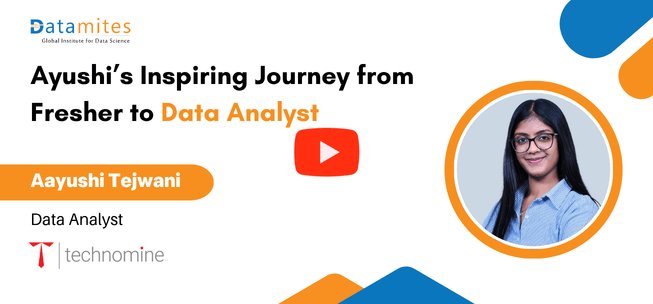
Ayushi’s Inspiring Journey from Fresher to Data Analyst
Ayushi’s inspiring journey from fresher to Data Analyst highlights her dedication, continuous learning, and career transformation through practical analytics training. Discover how she developed industry-relevant skills, gained confidence, and successfully built a rewarding career in data analytics.
 Kriti Maurya
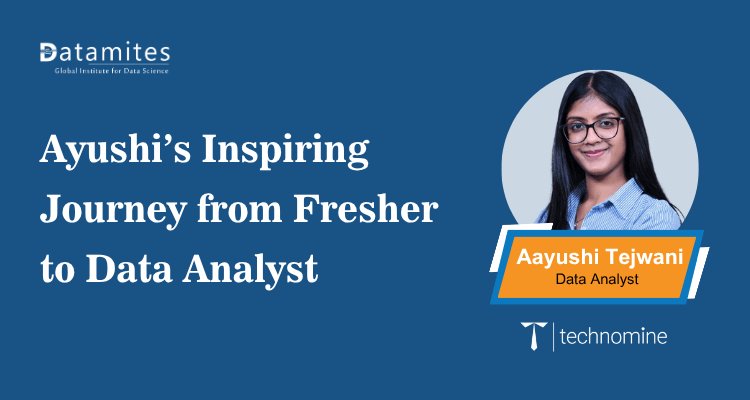
Transitioning into the analytics industry without a technical background can feel challenging for many students. However, with the right guidance, consistent learning, and practical exposure, building a successful career in data analytics is possible. Ayushi Tejwani’s journey from a commerce student to a Data Analyst at Technominds Group highlights how dedication and structured training can help freshers confidently enter the fast-growing analytics industry. In this alumni interaction, Ayushi shares her learning experience, internship journey, interview preparation strategies, and valuable insights for aspiring data analysts.
Ayushi’s Successful Transition from Fresher to Data Analyst
Ayushi Tejwani’s journey highlights how determination, consistent learning, and practical exposure can help freshers successfully enter the analytics industry. Coming from a commerce background, she confidently transitioned into the technical field of Data Analytics through structured training, internships, and hands-on project experience. Her journey from being unsure about analytics to becoming a Data Analyst at Technomine serves as an inspiring example for aspiring professionals looking to build a successful career in data analytics and to explore promising IT courses in Ahmedabad.
Q1. Please introduce yourself and share your career journey.
My name is Ayushi Tejwani, and I am from Ahmedabad. Coming from a commerce background, I was initially unsure about entering a technical field like Data Analytics. However, with the guidance and support of mentors at DataMites Institute, I began my learning journey in October 2025. Within four to five months, I completed my course and internship, and today I am working as a Data Analyst at Technominds Group, where I also assist the CFO with reporting and operational support.
Q2. How was your learning experience during the Data Analytics course?
The learning experience was highly structured and practical, with four weekly sessions from Monday to Thursday focused on theory and core concepts, while Friday to Sunday were dedicated to practical exercises and assignments. The mentors, including Prashant Sir, Abhishek Sir, and Sachin Sir, were extremely supportive, friendly, and always available for doubt-clearing sessions, which helped me learn Data Analytics comfortably despite coming from a non-technical background.
Refer to these Articles:
- Tips for Selecting the Top Data Analytics Institute in Ahmedabad
- The Rise of Data Analytics Careers in Ahmedabad: What You Need to Know
- How to Become a Data Analyst in Ahmedabad
Q3. Which tools and technologies did you learn during the course?
We started with Python basics and then moved into statistics because statistics is the foundation of Data Analytics, Data Science, and AI. After that, we learned:
- Excel
- SQL
- Power BI
- Tableau
- NumPy
- Pandas
As a Data Analyst, the workflow usually begins with data cleaning in Excel, then using SQL to fetch insights, and finally creating dashboards in Power BI.
Q4. How much time did you spend daily preparing and revising?
I usually spend around two to three hours daily on revision and practice. What matters most is consistency rather than long study hours. Revising concepts daily, especially statistics and technical tools, is very important. Weekly revision alone is not enough to retain concepts effectively.
Q5. How did internships and projects help you?
After completing the course, I received internship opportunities along with a capstone and client projects. These projects gave me practical exposure to real-world analytics tasks.
- The process included:
- Data cleaning using Excel
- Extracting insights through SQL
- Dashboard creation in Power BI
The internship experience helped me understand how analytics projects are handled in companies and improved my confidence significantly.
Q6. How did you prepare for interviews?
I practiced extensively by working on datasets downloaded from Google and solving multiple analytics problems, as technical preparation was very important for handling both practical and theoretical interview questions. I also uploaded my projects to GitHub to strengthen my profile and regularly prepared for interviews through revision, YouTube tutorials, and online learning resources.
Q7. Which learning resources and YouTube channels helped you?
YouTube was very useful during my preparation journey. Some helpful channels included:
- Shraddha Khapra for Python
- Satish Gavale for Excel
Apart from these, I explored many interview preparation videos focused on Data Analytics, Power BI, SQL, and Excel.
Q8. Which job portals are most useful for Data Analyst jobs?
Many people believe LinkedIn alone is enough, but candidates should apply through multiple job portals, such as:
- Naukri
- Indeed
- Jobs Aura
- Jobill
Although I finally got my job through LinkedIn, regularly updating profiles and applying consistently across platforms is extremely important.
Q9. Can you share your interview experience?
I attended three interview rounds:
- HR Round: The HR round focused on communication skills and background discussion.
- CFO Round: This round included scenario-based and theoretical questions. They evaluated my thinking ability and how I could contribute to the company’s growth.
- Technical Round: The technical round mainly covered Excel, SQL, Power BI, and Statistics. Most questions focused on advanced Excel functions, project work, and theoretical concepts related to data analytics.
Q10. Did you learn any additional tools after attending interviews?
After attending multiple interviews, I realized that companies increasingly use Google Sheets and Looker Studio alongside Excel and Power BI. Since Google Sheets supports live collaboration and Looker Studio helps create real-time interactive dashboards, I started learning both tools to strengthen my data analyst skills and improve my industry readiness.
Q11. What type of technical questions were asked?
Most questions were theory-based. Statistics-related concepts were asked frequently because statistics form the core of analytics.
Interviewers also asked:
- Advanced Excel functions
- Project explanations
- SQL concepts
- Dashboard-related questions
Explaining projects properly was very important because interviewers wanted to understand my practical knowledge and problem-solving approach.
Q12. How did you prepare your resume?
I prepared my resume using Claude AI because it helped generate an ATS-friendly resume efficiently. However, candidates must ensure they fully understand everything written on their resumes because interviewers ask detailed questions from it. For freshers, especially, resume-based questions play a major role during interviews.
Q13. What advice would you give to aspiring Data Analysts?
My biggest suggestion is to stay consistent with revision and practice. Do not focus on only one tool at a time. Instead, revise all important subjects regularly, including:
- Excel
- SQL
- Power BI
- Statistics
- Python
After internships, continue practicing interview questions and work on real datasets. Consistent learning and practical exposure are the keys to succeeding in Data Analytics.
Key Insights from Ayushi’s Data Analytics Journey
Datamites Success stories continue to inspire aspiring professionals who want to build successful careers in analytics and technology. Ayushi’s journey from a commerce background to becoming a Data Analyst highlights the importance of consistency, practical learning, internships, and continuous skill development in achieving career success in the data analytics industry.
- Consistency Matters More Than Long Study Hours: Ayushi emphasized that regular revision and daily practice are more effective than studying for long hours occasionally. Consistency helped her strengthen concepts and improve technical confidence.
- Statistics Builds the Foundation of Analytics: Statistics played a major role throughout her learning journey. Regular practice of statistical concepts helped her understand data analysis techniques and perform better during interviews.
- Internships and Projects Improve Practical Knowledge: Hands-on experience through internships and capstone projects helped Ayushi gain practical exposure to real-world analytics tasks. Working on projects improved her problem-solving and analytical skills.
- Excel, SQL, and Power BI Are Essential Skills: Ayushi highlighted that Excel, SQL, and Power BI were among the most important tools asked during interviews. Strong knowledge of these tools helped her prepare for technical rounds confidently.
- GitHub Projects Strengthen a Fresher’s Profile: Uploading projects on GitHub helped showcase her practical work and technical abilities. A strong project portfolio can improve visibility and credibility for freshers applying for analytics roles.
- Applying Through Multiple Job Portals Is Important: Ayushi suggested using multiple platforms like LinkedIn, Naukri, and Indeed instead of relying on a single portal. Regular applications and profile updates can increase interview opportunities.
Ayushi’s journey demonstrates how dedication, consistent practice, and practical learning can help freshers successfully transition into the field of Data Analytics. Her experience highlights that with the right guidance, internships, and continuous skill development, aspiring professionals can build rewarding careers in the rapidly growing analytics industry.
Refer to these Articles:
- Future of Data Analytics: What Skills Will Matter by 2030
- Is AI Changing the Role of Data Analysts
- Data Analytics in the Age of Big Data & Machine Learning
DataMites Institute emphasizes practical, career-focused learning and industry-recognized certifications to help learners build successful careers in data-driven technologies. Its training programs are aligned with globally recognized organizations such as IABAC and NASSCOM FutureSkills, offering structured learning paths in Data Analytics Ahmedabad, along with specialized programs in Data Science, Machine Learning, Artificial Intelligence, Python, Tableau, and MLOps. Learners can also explore advanced certifications, including Certified Data Scientist, AI for Managers, and Computer Vision Expert.
The institute further offers a comprehensive data analyst course in Mumbai through offline training centers established across major cities such as Bangalore, Pune, Hyderabad, Chennai, Delhi, Kolkata, Coimbatore, Ahmedabad, and Chandigarh. These programs focus on hands-on practical training, classroom interaction, internships, live projects, and career guidance to help learners develop industry-ready analytical skills.