How to Start a Career in AI for HR and People Analytics
Learn how to start a career in AI for HR and People Analytics by building skills in HR, data analytics, and AI. Explore career paths, essential skills, learning steps, and opportunities in this growing field.
 Prerana B A
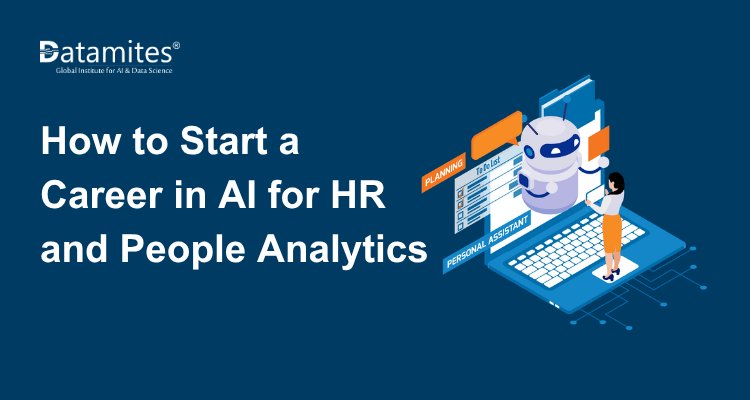
Artificial intelligence is changing how HR teams recruit, analyse workforce data, support employees, and plan talent strategies. At the same time, People Analytics is helping organisations use workforce data to understand trends and make better decisions.
This creates opportunities for HR professionals, recruiters, students, and career switchers interested in combining HR knowledge, data analytics, and AI. A career in AI for HR does not necessarily require becoming a machine learning engineer. For many roles, the practical path is to understand HR processes, develop analytical skills, and learn how AI can be applied to real HR challenges.
SHRM's State of AI in HR 2026 research, based on responses from 1,908 HR professionals, examines how AI is affecting HR functions and the challenges organisations face when adopting the technology.
What Is AI for HR and People Analytics?
AI for HR refers to using artificial intelligence to support HR activities such as recruitment, employee engagement, workforce planning, talent management, and employee support.
People Analytics focuses on analysing workforce data to answer business and HR questions. It can involve HR metrics, dashboards, statistical analysis, and predictive analytics.
The two areas overlap but are not the same. For example, People Analytics may identify a pattern of higher employee turnover in a particular department, while AI can help process large datasets, identify patterns, or support predictive analysis.
Some common use cases for AI in HR include:
- Recruitment and candidate analysis
- Employee engagement analysis
- Workforce planning
- Employee retention
- Performance analysis
- Skills analysis
- Learning and development
AI should support HR decision-making rather than replace professional judgment, particularly when decisions affect employees.
Why Consider a Career in AI for HR?
HR professionals increasingly need to understand how workforce data, AI, and technology can support better business decisions. A strong career profile can combine HR domain knowledge, data analytics, and AI skills. For example, HR professionals can use Excel, SQL, and Power BI to analyse recruitment and workforce data, while Generative AI can help with tasks such as summarising information, creating drafts, and improving repetitive workflows.
The growing use of AI also makes AI literacy increasingly relevant for HR professionals. SHRM 2026 research found that 41% of surveyed workers reported using AI in their work, while 45% of entry-level and early-career professionals reported pressure to use AI. The World Economic Forum's Future of Jobs Report also identifies AI and big data as the fastest-growing skills, highlighting the increasing importance of AI knowledge across careers.
A career in AI for HR can lead to different paths, including People Analytics, HR technology, workforce strategy, and AI-driven HR processes. The level of technical knowledge required depends on the specific role and career goal.
AI Trends Every HR Professional Should Understand
HR professionals do not need to follow every new AI development, but understanding major AI Trends for HR professionals should know can help them identify practical applications.
Important trends include:
- Generative AI for HR content and employee support
- AI-assisted recruitment
- Skills-based workforce planning
- AI-powered HR analytics
- Automated HR workflows
- Predictive workforce analysis
- AI-enabled learning and development
Recruitment provides a clear example of this shift. LinkedIn's Future of Recruiting report found that 37% of organisations were actively integrating or experimenting with generative AI in recruiting, compared with 27% a year earlier. LinkedIn's research drew on billions of platform data points and a survey of more than 1,000 talent professionals.
The important question is not simply which AI tool is popular. HR professionals should ask whether a technology solves a genuine business problem, uses appropriate data, and can be implemented responsibly.
Refer to these aritcles:
- Popular AI Tools in Healthcare
- AI in Marketing Funnel Analysis for Effective Decision-Making
- Top AI Skills for Finance Professionals
Skills Required for AI in HR Professionals
The skills for AI in HR professionals depend on the career path and job role. Beginners do not need advanced programming knowledge to start. A combination of HR knowledge, data skills, AI fundamentals, and analytical thinking can help professionals build a career in AI for HR.
Beginner-Level Skills
Professionals starting with AI in HR can focus on:
- HR fundamentals and processes
- People Analytics and HR metrics
- Excel or Google Sheets
- Basic statistics
- Data interpretation
- Power BI or Tableau
- Basic SQL
- Generative AI fundamentals
- Prompt engineering
- AI tools for HR
These skills can help HR professionals use data and AI for practical tasks such as identifying employee turnover patterns, tracking recruitment performance, analyzing workforce data, and improving employee engagement.
Advanced Skills
Professionals moving toward more technical AI for HR roles can develop skills such as:
- Predictive analytics
- Python for data analysis
- Advanced SQL
- Machine learning fundamentals
- Workforce forecasting
- Natural language processing
- AI model evaluation
Not every AI in HR professional needs to become an AI engineer. The level of technical knowledge required depends on the specific role. HR professionals working in people analytics may need stronger data and analytical skills, while those involved in AI implementation may need deeper knowledge of AI tools and model evaluation.
Responsible AI Skills
HR professionals should also understand data privacy, algorithmic bias, transparency, responsible AI, and ethical use of employee information. These skills are important because AI-based HR systems can influence recruitment, performance evaluation, workforce planning, and other employee-related decisions.
Overall, the right combination of HR expertise, data analytics, AI knowledge, and responsible AI practices can help professionals effectively use AI in HR and prepare for emerging career opportunities.
AI Tools Transforming HR
The AI tools transforming HR landscape include technologies used for recruitment, employee support, analytics, content creation, learning, and workflow automation.
Depending on the organisation, HR teams may use:
- Generative AI assistants for drafting and summarising
- AI-powered recruitment platforms
- People Analytics platforms
- HR chatbots
- Workforce analytics software
- AI-enabled learning platforms
- Automation tools for repetitive HR processes
LinkedIn's recruiting research shows that efficiency is a major reason talent teams are experimenting with Generative AI. Among organisations integrating or experimenting with these tools, LinkedIn reports an average time saving of about 20% of the workweek.
The specific tool matters less than understanding how to evaluate it. HR professionals should consider data security, accuracy, bias, integration with existing systems, transparency, and human oversight before adopting an AI solution.
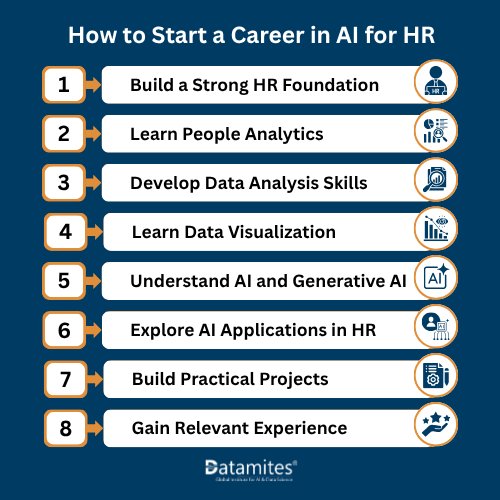
How to Start a Career in AI for HR
If you are wondering how to start a career in AI for HR, follow a gradual learning path that combines HR knowledge, data skills, and AI understanding. These steps can help HR professionals and beginners build practical skills and prepare for roles in People Analytics, HR Analytics, and HR Technology.
Build a Strong HR Foundation
Learn core HR functions such as recruitment, onboarding, performance management, employee engagement, learning and development, and workforce planning.
Learn People Analytics
Understand HR metrics such as employee turnover, absenteeism, retention, time-to-hire, cost-per-hire, and workforce composition.
Develop Data Analysis Skills
Start with Excel or Google Sheets, then progress to basic SQL and statistics. Focus on understanding what the data means and how it can support HR decisions.
Learn Data Visualization
Build HR dashboards using tools such as Power BI or Tableau. A useful beginner project could analyse headcount, turnover, recruitment performance, or employee engagement.
Understand AI and Generative AI
Learn the fundamentals of AI, machine learning, Generative AI, prompt engineering, and the limitations of AI-generated results.
Explore AI Applications in HR
Learn how AI can support recruitment, employee engagement, skills analysis, workforce planning, HR automation, and employee support.
Build Practical Projects
Create projects such as an employee turnover analysis, recruitment analytics dashboard, workforce planning report, or AI-assisted HR workflow. Document the problem, data, approach, findings, and limitations.
Gain Relevant Experience
Look for opportunities to work with HR data, reporting, dashboards, HR technology, or AI-enabled workflows in your current role. This practical experience can strengthen your profile when applying for people analytics, HR analytics, or HR technology roles.
Building a career in AI for HR requires a mix of HR knowledge, data skills, and practical AI experience. Start with People Analytics, data analysis, visualization, and Generative AI, then apply your skills through practical projects. This foundation can help you explore opportunities in People Analytics, HR Analytics, and HR Technology.
Implementing AI in HR Analytics
Implementing AI in HR Analytics requires more than selecting an AI tool. Organisations need a clear business problem, reliable data, appropriate technology, and responsible governance.
A practical implementation process can include:
- Define the HR problem.
- Identify the relevant workforce data.
- Check data quality and privacy requirements.
- Select an appropriate analytical or AI solution.
- Test the results with HR professionals.
- Monitor accuracy, bias, and business impact.
- Keep human review in important employee-related decisions.
The National Institute of Standards and Technology's AI Risk Management Framework recommends considering trustworthy AI characteristics such as validity and reliability, accountability and transparency, explainability, privacy, security, and fairness, with harmful bias managed. Its framework uses four core functions: Govern, Map, Measure, and Manage.
For HR, this is particularly important because workforce data can be sensitive. For example, AI may identify patterns associated with employee turnover, but HR teams should investigate the context before taking action. Correlation does not automatically mean that one factor causes another.
Career Opportunities in AI for HR and People Analytics
A people analytics career can lead to several roles depending on your interests and technical skills:
- People Analytics Specialist: Analyses workforce data and identifies trends.
- HR Analytics Specialist: Works with HR metrics, reporting, and dashboards.
- HR Data Analyst: Focuses more deeply on datasets, SQL, and analytical reporting.
- Workforce Analytics Specialist: Supports workforce planning and capacity analysis.
- People Analytics Consultant: Helps organisations solve workforce-related business problems.
- HR Technology Specialist: Works with HR systems, technology implementation, and automation.
- AI-enabled HR Specialist: Applies AI tools and workflows to selected HR processes.
These roles have different responsibilities and technical requirements, so candidates should build skills according to their desired career path.
Refer to these articles:
- Top AI Trends That Will Shape 2026
- PyTorch vs TensorFlow: Which is Better?
- What Are Graph Neural Networks?
Future of AI in HR
The future of AI in HR is likely to involve greater use of AI-assisted analytics, automation, skills intelligence, workforce planning, and Generative AI.
However, technology alone will not determine the future of AI in HR. Professionals will still need communication, critical thinking, business understanding, ethical judgement, and knowledge of people and organisational behaviour.
The World Economic Forum's research supports this broader view: alongside rapidly growing technological skills such as AI and big data, employers continue to place importance on analytical thinking, creative thinking, resilience, flexibility, agility, and talent management.
AI can process information quickly, but HR professionals remain responsible for understanding context and making appropriate decisions.
Starting a career in AI for HR is about combining three areas: HR knowledge, analytical ability, and practical AI skills.
You do not need to learn every AI technology at once. Start with HR fundamentals and people analytics, build data skills through Excel, SQL, and visualization tools, and then learn how AI can solve specific HR problems.
For students, career switchers, and experienced HR professionals, practical projects can be one of the best ways to demonstrate these skills. The goal is not simply to know how AI works but to understand when, where, and how it should be used in HR.
DataMites offers an AI for HR course designed to help HR professionals build practical skills in artificial intelligence, people analytics, and data-driven workforce management. The course covers areas such as talent acquisition, employee engagement, workforce planning, and performance management, helping learners understand how AI can be applied to various HR functions.
The Datamites program is available through online and classroom learning, with hands-on projects and internship opportunities to support practical experience. Learners can also earn globally recognized certifications, including IABAC accreditation and the Certified AI Professional in People Analytics credential. With training centres across cities including Bangalore, Hyderabad, Chennai, Pune, Mumbai, Ahmedabad, Coimbatore, and Delhi, DataMites provides flexible learning options for HR professionals looking to build AI skills and advance their careers