Data Analyst vs Data Scientist in Malaysia: Which Career Is Right for You?
Compare data analyst and data scientist careers in Malaysia, including 2026 salaries, job roles, skills, qualifications and career opportunities.
 Swagatam Sinha
Businesses in Malaysia are collecting more information from customers, transactions, supply chains and digital services. Banks use transaction data to monitor unusual activity, retailers study buying patterns, and manufacturers examine production performance. As companies make greater use of this information, professionals who can analyze data and build predictive solutions are becoming important to business operations.
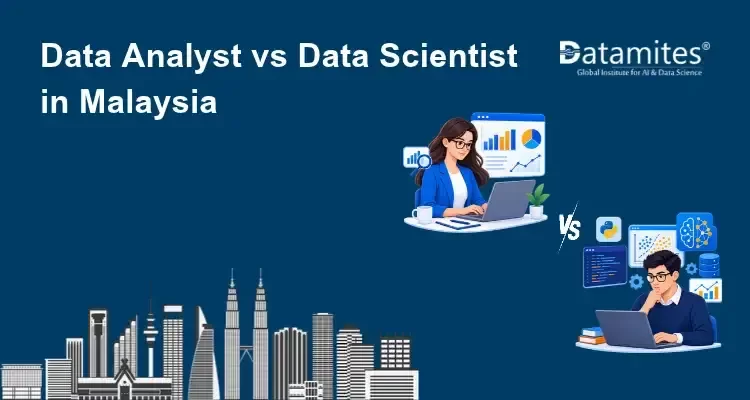
Data Analyst and Data Scientist are two career paths that often attract students, graduates and working professionals. Both involve working with data, but the responsibilities, technical skills and learning requirements are different.
Understanding these differences can help you decide which career is a better match for your interests and qualifications.
Data Analyst vs Data Scientist: Roles and Key Differences
A data analyst examines existing information to help a business understand its performance. A data scientist works with statistics, programming and machine learning to investigate complex problems and predict possible outcomes.
What Does a Data Analyst Do?
A data analyst collects, cleans and examines data to identify patterns that support business decisions. Much of the work involves preparing reports, creating dashboards and explaining findings to different teams.
For example, a retailer with outlets in Kuala Lumpur, Penang and Johor Bahru may want to understand why sales differ between locations. A data analyst can examine sales records, product performance and customer activity to identify the reasons behind those differences.
Common responsibilities include:
- Collecting and organizing information from different sources.
- Using SQL and spreadsheets to examine business data.
- Creating reports and interactive dashboards using Power BI or Tableau.
- Identifying trends and tracking business performance.
- Presenting findings to managers and other teams.
What Does a Data Scientist Do?
A data scientist uses statistical methods and programming to solve problems that may require more advanced analysis. The role often involves developing predictive models and testing how well they perform.
For example, a financial institution may want to identify transactions that could indicate fraudulent activity. A data scientist can use historical transaction data and machine learning techniques to develop a model that identifies unusual patterns.
Typical responsibilities include:
- Preparing datasets for statistical analysis.
- Developing predictive and machine learning models.
- Testing and improving model performance.
- Using Python or R for advanced analysis.
- Explaining model results to technical and business teams.
| Area | Data Analyst | Data Scientist |
| Main focus | Business reporting and insights | Prediction and advanced analysis |
| Common tools | Excel, SQL, Power BI, Tableau | Python, SQL, R, machine learning libraries |
| Technical requirements | Data cleaning, reporting and visualization | Programming, statistics and machine learning |
| Typical output | Reports and dashboards | Predictive models and analytical solutions |
A real example of data science in Malaysia can be seen at Tenaga Nasional Berhad (TNB). The company developed a machine-learning model to predict failures in 11kV underground electricity cables. It uses historical maintenance records, previous breakdown data, cable age and length, inspection results and location information to estimate the risk of cable failures. TNB reports that its pilot in Kuala Lumpur and Selangor achieved more than 90% prediction accuracy, with a phased nationwide rollout planned.
This project also helps explain the difference between the two careers. A data analyst could examine maintenance and breakdown records, identify recurring failure patterns, and prepare dashboards to help operations teams monitor cable performance. A data scientist could use the prepared data to develop and evaluate machine-learning models that predict failure risks and help prioritize maintenance work. The analyst focuses on understanding and communicating patterns, while the data scientist develops predictive solutions to address the problem.
Refer to these articles:
- AI Agents for Data Analysis: Tools and Use Cases
- How Looker, Tableau, and Power BI Are Revolutionizing Data Analytics
- Augmented Analytics Explained: How AI is Reshaping the Data Analyst Role
Data Analyst and Data Scientist Salary in Malaysia (2026)
Salary is an important consideration when comparing these careers. Earnings in Malaysia vary according to experience, technical skills, employer, industry and location.
According to Indeed's November 2026 salary data, the average salaries of data analysts and data scientists in Malaysia provide a useful basis for comparing the two career paths.
| Job role | Average annual salary | Estimated monthly equivalent |
| Data Analyst | RM48,248 | RM4,021 |
| Data Scientist | RM94,639 | RM7,887 |
Indeed's Data Analyst average is based on 271 reported salaries and was updated on 2 November 2026. The data scientist average is based on 87 reported salaries and was updated on 1 November 2026.
The monthly figures in the table are calculated by dividing the reported annual averages by 12. They are estimates rather than separately reported monthly salary figures.
The reported average salary for data scientists is higher in this salary snapshot. However, the difference should be considered alongside experience, employer, industry and the number of salaries reported for each role. Data scientists often work with statistical modelling, machine learning and predictive analysis, while data analysts generally focus on interpreting data, preparing reports and building dashboards.
These figures are useful benchmarks rather than guaranteed offers. The reported averages include different experience levels, so fresh graduates should not assume they represent entry-level pay.
Malaysia's Data and AI Job Market
Malaysia's digital development plans and investment activity provide useful context for people considering data-related careers.
In June 2026, the Ministry of Digital launched the Malaysia Digital Action Plan 2030. The plan supports the country's AI Nation 2030 ambition and targets a digital economy contribution of 30% to national GDP. It also identifies data as an important national asset.
Investment activity is another indicator. At its September 2026 MDX Forum, the Malaysia Digital Economy Corporation (MDEC) reported that 119 companies approved in Q2 2026 were projected to contribute RM133.6 billion in investments and 4,922 jobs over their first five years. Of those companies, 44 were primarily involved in AI. AI, data centers and cloud, and global business services together accounted for nearly 70% of new approvals.
These projected jobs cover all the approved companies, not only data analyst or data scientist positions. These figures highlight the growing investment in Malaysia's digital economy.
The Department of Statistics Malaysia (DOSM), in its Job Market Insights for Q2 2026, recorded 555,509 online job offerings. Professional occupations accounted for 51.5% of these listings, or 285,907 offerings. Professional, Scientific and Technical Activities recorded 32,127 offerings, while Financial and Insurance/Takaful Activities recorded 20,593.
These figures cover many occupations, not just data-related jobs. They help show the wider employment activity in sectors where data analysis and predictive modeling are used.
Employer feedback provides another perspective. PIKOM's TalentGAP survey gathered responses from 58 senior decision-makers across Malaysia's digital ecosystem. It identified demand for skills in AI, cloud and data analytics, along with a gap between certified graduates and candidates who have practical, job-ready experience. The survey respondents were concentrated in Kuala Lumpur and Selangor, so its findings should be read as employer feedback from those main digital hubs rather than a complete picture of every Malaysian region.
There is also a global connection. PwC's 2026 Global AI Jobs Barometer found that skills required in the most AI-exposed jobs are changing twice as fast as those in less exposed roles. Its Malaysia highlights reported a 7.4% rise in job postings requiring AI-related skills. This does not mean data scientist vacancies increased by 7.4%, but it does show why professionals need to keep updating their technical knowledge.
For a longer-term view, PwC's Global Data Centre Outlook 2026–2050 projects around US$287 billion in cumulative data centre investment in Malaysia under its central scenario. This is an infrastructure investment projection, not a direct estimate of new data jobs. It nevertheless provides context for the expanding digital infrastructure that supports cloud services, AI workloads and data-intensive business operations.
Refer to these articles:
- How to Prepare for Data Science Job Interviews
- Data Science Project Lifecycle: From Data Collection to Deployment
- Data Science and Automation: Will AI Replace Data Scientists?
Skills Malaysian Employers Look for in Data Analysts and Data Scientists
Both careers require analytical thinking and the ability to work with data. The difference lies in how deeply each role uses programming, statistics and modelling.
| Skill area | Data Analyst | Data Scientist |
| Programming | Basic to intermediate Python or R | Strong Python or R |
| Database | SQL and data extraction | SQL and large datasets |
| Visualization | Excel, Power BI, Tableau | Visualization for exploring and presenting results |
| Statistics | Descriptive statistics and trend analysis | Probability, statistical modelling and hypothesis testing |
| Machine learning | Basic understanding is useful | Important for many roles |
| Communication | Explaining reports and business findings | Presenting model results and technical findings |
For data analyst roles, start with Excel, SQL and a visualization tool such as Power BI. Python can help with data cleaning and repetitive tasks.
Data Scientist positions usually require stronger programming and mathematical foundations. Knowledge of libraries such as pandas, scikit-learn, and TensorFlow can be useful, depending on the role.
Global research also supports the importance of combining technical and analytical skills. The World Economic Forum's Future of Jobs Report identifies AI and big data among the fastest-growing skills through 2030. PwC's 2026 research also highlights the growing importance of human judgment, communication and problem-solving as AI changes job responsibilities.
Learners comparing an online data analyst course in Malaysia should look for practical coverage of SQL, data visualization, spreadsheet analysis and business reporting, rather than choosing a program based only on the number of tools it lists.
Qualifications Needed for Data Analyst and Data Scientist Jobs in Malaysia
Many employers prefer a bachelor's degree in a relevant subject, although the requirements depend on the position.
For data analyst jobs, degrees in business analytics, computer science, information technology, economics, finance, mathematics and statistics can provide a useful foundation. Graduates from other disciplines may also qualify if they can demonstrate skills in SQL, spreadsheets, reporting and data visualization.
Data scientist positions often require a stronger background in mathematics, statistics and programming. Relevant degrees include data science, computer science, statistics, mathematics and engineering. Some specialized roles may also prefer postgraduate qualifications or previous machine learning experience.
A degree is only one part of the application. Employers may also look for practical projects, internships and the ability to explain how you approached an analytical problem.
For working learners or graduates in the capital, an online data analyst course in Kuala Lumpur can be one option to compare when looking for structured learning. Check whether the syllabus matches the technical requirements of the roles you plan to apply for.
Refer to these articles:
- Data Science Job Roles, Salary Structure and Course Fees in Malaysia
- How to Become a Data Scientist in Malaysia?
- How to Become a Data Analyst in Malaysia?
How to Start a Career in Data Analytics or Data Science in Malaysia
Your learning plan should reflect the role you want to pursue. Trying to learn every data tool at once can make the process harder to manage.
- Choose your direction: Decide whether you prefer business reporting and analysis or programming, statistics and predictive modeling.
- Learn the relevant tools: Begin with Excel, SQL, and statistics. Add Python and machine learning if you are preparing for data scientist roles.
- Work on practical projects: Use public datasets or sample business information to analyze Malaysian retail sales, customer activity, financial trends or operational performance.
- Build a portfolio: Explain the problem, the data you used, your analysis and the findings. Include dashboards or model results where relevant.
- Prepare for applications: Look for suitable openings such as Junior Data Analyst, Reporting Analyst, Business Intelligence Analyst or entry-level Data Scientist.
An online data science course may be worth considering if you want structured learning in programming, statistics and machine learning. Before enrolling, review the course syllabus and check whether it includes practical projects that reflect the work expected in data scientist roles.
People moving from non-IT backgrounds can begin with data analysis while gradually building their technical knowledge. Those interested in data scientist roles can develop greater skills in statistics, Python and machine learning.
Data Analyst vs Data Scientist: Which Career Should You Choose?
Your choice should depend on the kind of problems you enjoy solving and the technical skills you want to develop.
A data analyst path may suit you if you like working with business information, finding trends and explaining results to teams. It can be a suitable option for graduates and professionals with backgrounds in finance, marketing, operations or business.
A data scientist path may be a better match if you enjoy coding, mathematics, experimentation and developing predictive models. It generally involves a deeper commitment to programming, statistics and machine learning.
Salary can be one factor in your decision, but it should not be the only one. Consider your qualifications, current skills and preferred working style before choosing a direction.
Data Analyst and Data Scientist careers both have a place in Malaysia's growing digital economy. Data Analysts help businesses understand performance through reports and insights, while Data Scientists use programming and statistical methods to develop predictive solutions.
Start by building a strong foundation in data handling, SQL and statistics. Then choose the technical skills and practical projects that match the role you want to pursue.
DataMites Institute is a professional training institute with more than 12 years of experience in the training industry and over 200,000 learners globally. It offers programs in data science, artificial intelligence and other technology-related fields.
Learners in Kuala Lumpur who are considering an online data science course in Kuala Lumpur can compare course content, learning format and practical project components before deciding whether a program matches their career objectives.
Those interested in the program can review the data science course in Malaysia to explore its curriculum and learning options.