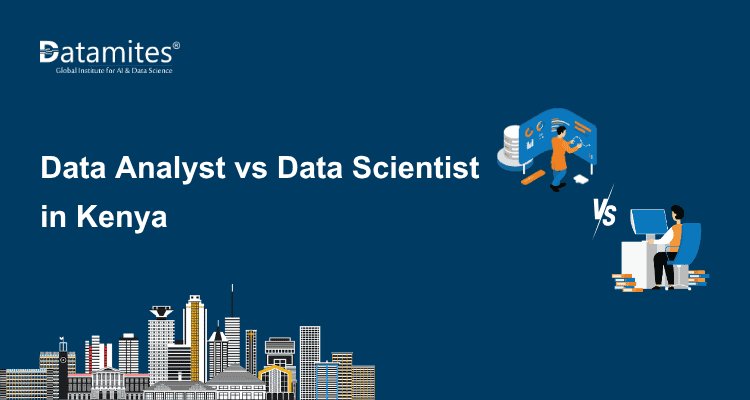
Data Analyst vs Data Scientist in Kenya
Compare data analyst vs. data scientist careers in Kenya, including 2026 salary estimates, essential skills, job opportunities and career paths.
 Swagatam Sinha
A dataset can help a bank understand why customers miss loan repayments. The same information can also help predict which customers may struggle to repay their loans in the future. Although these questions sound similar, they may require two different professionals: a data analyst and a data scientist.
Across Kenya, banks, fintech companies, retailers and other organizations use data to understand business performance and make decisions. Data analysts help explain what has happened, while data scientists use statistical methods and machine learning to investigate patterns and predict possible outcomes.
For graduates, freshers and working professionals, choosing between these careers requires more than comparing job titles. Understanding the salary expectations, technical skills and employment opportunities can help identify which path matches your interests and long-term goals.
What Is the Difference Between a Data Analyst and a Data Scientist?
The main difference lies in the type of questions each professional handles. Data analysis generally focuses on understanding existing information, whereas data science also involves developing models to estimate future outcomes.
What Does a Data Analyst Do?
A data analyst makes business information easier to understand. They collect data from different sources, check its accuracy, identify trends and prepare reports that help management teams make informed decisions.
Consider a supermarket operating across several Kenyan counties. Its management may want to compare monthly sales, monitor stock levels and understand customer purchasing patterns. A data analyst can use SQL, Excel and Power BI to organize the information and present findings through dashboards.
Other responsibilities include:
- Cleaning and validating business datasets.
- Preparing reports and performance dashboards.
- Writing SQL queries to retrieve information.
- Identifying changes in sales, costs and customer activity.
- Presenting findings to business teams.
Those interested in becoming data analysts can explore a data analyst course in Kenya to understand key areas such as SQL, Excel, data visualization and business reporting. These skills provide a foundation for interpreting business information and supporting data-driven decisions.
What Does a Data Scientist Do?
Some business questions require more than reporting. A financial institution, for example, may want to estimate the likelihood of a borrower missing a repayment. A data scientist can examine historical information, identify relevant variables and develop a machine learning model to support that assessment.
Python or R, statistical modelling, machine learning and model evaluation are important parts of this work. Depending on the employer, the role may also involve deploying models, monitoring their performance and working with data engineers.
Refer to these articles:
- How to Become a Data Scientist?
- Does Data Science Require Coding?
- How LLMs Are Transforming Data Science Careers
Data Analyst vs Data Scientist Salary in Kenya (2026)
Compensation depends on experience, employer, industry, technical ability and job responsibilities. Glassdoor provides salary estimates for both professions, although these figures should not be treated as official national pay scales.
| Salary information | Data Analyst | Data Scientist |
| Median monthly total pay | KSh 86,000 | KSh 103,000 |
| Monthly base pay range | KSh 50,000–100,000 | KSh 60,000–200,000 |
These figures represent estimated total compensation and base pay, not guaranteed monthly earnings. The difference between the two roles can change considerably depending on the company and level of responsibility. Candidates should compare salary, benefits and technical expectations in individual job advertisements.
Skills Required for Data Analysts and Data Scientists in Kenya
Excel, SQL and analytical thinking are useful starting points for either profession. However, the technical requirements become different as the work becomes more specialized.
| Skill or tool | Data Analyst | Data Scientist |
| Excel | Regular reporting and analysis | Initial data inspection |
| SQL | Database queries and reporting | Data extraction and preparation |
| Power BI / Tableau | Dashboards and business reporting | Visualizing analytical results |
| Python / R | Automation and advanced analysis | Statistical analysis and modelling |
| Statistics | Descriptive analysis and trends | Probability, inference and model evaluation |
| Machine learning | Useful in specialized positions | Important for predictive modeling |
Communication is another important requirement. Employers need professionals who can explain what the numbers mean, identify limitations and connect findings to business decisions.
Kenya's Digital Economy and Growing Use of Data Skills
Kenya's financial services and technology sectors are creating more opportunities to apply data analysis, business intelligence and predictive modeling. According to the Kenya National Bureau of Statistics (KNBS) Quarterly GDP Report for Q2 2026, the country's economy grew by 5.1% compared with the same quarter in 2025. Information and communication recorded growth of 7.2%, while financial and insurance activities expanded by 6.1%.
These figures highlight the continued contribution of technology and financial services to Kenya's economy. Both sectors depend on accurate information to monitor performance, understand customer behaviour and make business decisions. Data analysts can help organizations interpret this information through reports and dashboards, while data scientists can use statistical techniques and machine learning to examine more complex patterns.
Mobile financial services offer another example of the growing use of digital information. The Central Bank of Kenya's August 2026 statistics recorded 95.31 million registered mobile money accounts. During the same month, agent cash-in and cash-out activity reached 227.41 million transactions, valued at KSh 761.13 billion.
Banks and fintech companies handle large volumes of transaction information, which can be used for customer analysis, fraud monitoring, credit-risk assessment and financial reporting. These activities require professionals who can organize data, identify unusual patterns and communicate findings to business teams. However, transaction volumes and economic growth should not be confused with the actual number of vacancies available for data professionals.
Kenya's data analytics industry is also projected to expand over the coming years. According to 6Wresearch's Kenya Advanced Analytics Market report, updated in July 2026, the market was valued at an estimated US$184 million in 2025 and is expected to reach US$260 million by 2032, growing at a compound annual growth rate of 5.9% between 2026 and 2032. The report covers areas such as big data analytics, risk analytics and business intelligence applications. This expansion reflects increasing investment in tools and services that help organizations manage information, assess risks and make data-driven decisions. Data analysts and data scientists contribute to these activities through data preparation, reporting, statistical analysis and predictive modeling.
For learners interested in analyzing financial data and identifying business trends, a data analyst course in Nairobi can help develop practical skills in SQL, Excel, Power BI and data visualization.
Refer to these articles:
- How to Become a Data Analyst With No Experience
- Is AI Changing the Role of Data Analysts?
- Top 10 Data Analyst Projects for Beginners
Data Analyst and Data Scientist Job Opportunities in Kenya in 2026
Recent recruitment advertisements provide a practical view of the skills Kenyan employers are seeking. November 2026 listings include opportunities in financial services, fintech and international development organizations.
Some examples are:
- Data Analysis Assistant - UN-Habitat: The organization advertised a Nairobi-based position in November 2026. The work involves compiling and analyzing urban data, calculating indicators, validating information from different sources and supporting research activities.
- Junior Data Scientist - Pezesha: Posted on 6 November 2026, this Nairobi-based role involves analyzing customer behavior, lending performance and transaction data. Responsibilities include writing SQL queries, preparing reports, checking data quality and supporting credit-risk analytics. The position also offers exposure to machine learning and credit-scoring projects.
- Assistant Manager, Data Scientist - I&M Bank: Advertised in November 2026, this Nairobi-based position focuses on developing machine learning models and predictive analytics solutions. The listed responsibilities include data preparation, feature engineering, model development and performance monitoring. The technical requirements include Python, R, SQL and statistical modelling.
These examples show that data-related responsibilities vary across industries. Development organizations may need professionals to validate information and prepare research indicators, while banks and fintech companies look for people who can work with financial datasets, predictive models and customer analytics.
Data and Analytics Job Titles to Explore in Kenya
Candidates should also search for related job titles because employers do not always use the exact terms Data Analyst or Data Scientist when advertising vacancies.
Data analysis and business intelligence roles:
- Business Intelligence Analyst
- Reporting Analyst
- Credit Risk Analyst
- Monitoring and Evaluation Analyst
- Research Analyst
- Data Quality Analyst
- Data Analysis Assistant
Data science and machine learning roles:
- Junior Data Scientist
- Data Scientist
- Machine Learning Specialist
- Applied Scientist
- Predictive Analytics Specialist
- AI and Data Scientist
Some positions combine responsibilities from both fields. For example, a financial services company may expect an analyst to prepare dashboards and examine credit-risk patterns. A data scientist may have additional responsibilities involving model development, testing and deployment.
Candidates can explore advertised vacancies through the Kenya Labour Market Information System (KLMIS), which provides vacancy information by occupation, county, sector and skills. Comparing several job descriptions can help identify the tools, qualifications and experience employers are requesting.
Refer to these articles:
- How to Become an AI Engineer in Kenya?
- AI Engineer vs Data Scientist in Kenya
- How to Start a Data Science Career in Kenya
How to Prepare for a Data Analyst or Data Scientist Career in Kenya
A practical learning route starts with the fundamentals and gradually moves towards the requirements of the chosen profession.
Building a data science career in Kenya requires a combination of programming knowledge, statistical understanding and practical experience with real-world datasets.
Build a foundation first: Learn Excel, SQL and basic statistics. Practise organizing information, checking data quality and answering business questions using small datasets.
For someone considering an online data science course in Kenya, it is worth checking whether the syllabus covers SQL, Python, statistics, data visualization, and practical projects. These subjects provide a foundation for handling real datasets and understanding how organizations use analytical findings.
Choose a technical direction: For analytics, develop Power BI or Tableau skills and learn how to create reports that explain business performance. For data science, add Python, statistical modelling and machine learning to your knowledge.
Learners comparing an online data science course in Nairobi can also review the practical project work, learning format and course duration. Projects involving business, financial or public datasets can help demonstrate how well a learner applies technical concepts.
Work with Kenyan datasets: Public information can help make portfolio projects more relevant to local employers. The Kenya National Bureau of Statistics publishes economic, employment, agricultural and demographic data. You can use these resources to create projects examining county-level economic activity, agricultural production or employment trends.
Document your work: A portfolio should explain the question you investigated, the data you used, the tools involved and the conclusions you reached. For machine learning projects, include model evaluation and limitations rather than presenting predictions as certain outcomes.
Data Analyst vs Data Scientist: Which Career Should You Choose?
Your interests and existing skills should guide the decision.
Data analysis is a suitable direction if you enjoy working with business information, preparing dashboards and explaining trends. It can also provide a foundation for moving into more advanced analytical work.
Data science is worth considering if you are interested in programming, mathematics, experimentation and developing predictive models. The preparation can be more demanding, particularly for positions involving machine learning deployment.
Before enrolling in a course or applying for jobs, compare several Kenyan vacancies and identify the qualifications and tools employers repeatedly request. This can help you choose a learning path based on actual role requirements rather than job-title popularity.
Data analysts and data scientists both contribute to business decisions, but they approach problems differently. Analysts focus on interpreting existing information and communicating findings, while data scientists work with advanced statistics and machine learning to develop predictive solutions. Comparing the responsibilities, salary estimates and skills required can help you decide which career is a better match for your goals in Kenya.
At DataMites Institute, we understand that starting a career in data can involve learning new tools, building technical knowledge, and gaining practical experience. As a globally renowned training institute with over 12 years of experience and more than 200,000 learners globally, we offer courses in data science, data analytics, data engineering, Python development, and machine learning. Our programs cover relevant technical concepts and practical project work to help learners develop skills they can apply to real-world data problems.
Whether you are beginning your career or looking to expand your existing technical skills, we encourage you to explore the course syllabus, learning format, duration, and project components before choosing a program. A clear understanding of your goals and the skills required for your preferred role can help you take a more informed next step towards a career in data analytics or data science.